Introduction
Even a perfectly new tire can cause steering wheel vibration and premature wear if the wheel assembly isn't properly balanced. Wheel balancing isn't an upsell—it's a non-optional maintenance task that directly affects your vehicle's safety, comfort, and operating costs.
Skipping wheel balancing triggers a cascade of problems:
- Accelerates tire wear, shortening tread life by up to 20%
- Degrades handling and compromises safety
- Adds stress to suspension and steering components
- Reduces fuel efficiency
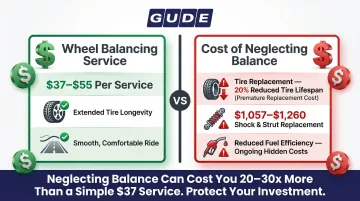
Commercial fleet studies show that unbalanced wheels can cut tire lifespan by a fifth—turning a $55 balancing service into a $1,200 suspension repair.
This guide covers what wheel balancing is, the types involved (static, dynamic, and road force), warning signs to watch for, how wheel weights make it all work, and a practical maintenance schedule to avoid the repair costs that come with neglecting it.
TL;DR
- Wheel balancing corrects uneven weight distribution to eliminate vibration and prevent premature wear
- Dynamic balancing is the current industry standard, correcting both vertical and lateral imbalances
- Key warning signs: steering wheel vibration at 50–70 mph, cupped tread wear, rough ride
- Wheel weights are small counterweights clipped or adhered to the rim; lead-free steel is now the industry standard material
- Balance wheels every 5,000–6,000 miles, at tire installation, or after hitting potholes
Why Wheel Balancing Is Important for Your Vehicle
When a tire-and-wheel assembly rotates at speed, any uneven mass distribution creates centrifugal force variations. These translate into vibrations that travel through the suspension, steering column, and cabin. The frequency and intensity of these vibrations increase with vehicle speed, which is why imbalance symptoms typically appear between 50 and 70 mph.
The compounding costs of neglecting balance:
- Unbalanced wheels cause tires to bounce rather than maintain constant road contact, creating "cupping" or "scalloping" wear patterns that cut tire lifespan by up to 20%
- Continuous vibration accelerates wear on wheel bearings, tie rods, shock absorbers, and suspension bushings—turning a $37–$55 balancing service into a $1,057–$1,260 shock or strut replacement
- Reduced road contact during cornering or emergency braking creates unpredictable handling, raising the stakes of an otherwise preventable issue
Wheel balancing also affects fuel efficiency. Unbalanced tires increase rolling resistance, forcing the engine to work harder. While a 10% reduction in rolling resistance yields 1–2% fuel economy improvement, the direct MPG loss from passenger vehicle imbalance remains difficult to isolate. Commercial fleet operators using consistent balancing protocols have documented 2.2% fuel economy gains in independently run tests.
Those gains depend on more than technique — they depend on the quality of the balancing weights used. Factors like weight material, coating durability, and dimensional accuracy all affect how precisely a correction holds over time. GUDE Corp, which manufactures lead-free steel clip-on and adhesive weights for OEM and aftermarket applications, produces its weights across ISO9001-certified facilities to meet the tolerance requirements both segments demand.
Types of Wheel Balancing: Static, Dynamic, and On-Vehicle
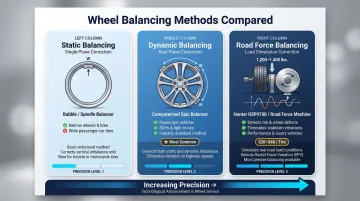
Three distinct balancing methods are used in tire service today — static, dynamic, and road force — and choosing the right one depends on the type of imbalance present and the vehicle involved.
Static Balancing
Static balancing corrects a single-plane imbalance—where the wheel's center of mass is not on the axis of rotation. A bubble balancer or non-rotating spindle machine identifies the heavy spot, and a single weight is placed opposite that location on the rim's centerline.
Limitations:
- Only addresses up-or-down vibration (hop), not side-to-side wobble (shimmy)
- Cannot correct couple imbalances caused by uneven lateral weight distribution
- Best suited for narrow wheels or as a first-pass factory check
- Modern tire shops have largely moved on to dynamic balancing for passenger vehicles
Because static balancing only addresses one plane of imbalance, it falls short on wider, modern tires. Dynamic balancing was developed to close that gap.
Dynamic Balancing
Dynamic balancing corrects both static and couple imbalances simultaneously. The wheel is spun at speed on a computerized spin-balancer, and sensors measure force variations in multiple planes. Correction weights are then placed on both the inner and outer flanges of the rim.
It's now the default for passenger vehicles because it:
- Addresses the full range of real-world imbalances a tire experiences under vehicle load
- Measurably more accurate than static methods across both planes
- Corrects vertical bounce and lateral wobble in a single pass
- Meets the requirements of modern passenger and light-truck applications
On-Vehicle (Road Force) Balancing
Road force balancing is a more advanced variation. A roller applies 1,200 to 1,400 lbs of pressure to simulate road surface contact while spinning the tire, detecting imbalances that occur only under load—particularly radial force variation (RFV) and stiff spots in the tire construction.
When to use road force balancing:
- Persistent vibration issues that standard dynamic balancing fails to resolve
- Low-profile tires or custom wheels
- Diagnosing hidden radial force variation or lateral runout
- Costs $20–$40 per tire vs. $10–$25 for standard dynamic balancing
Warning Signs Your Wheels Need Balancing
Wheel imbalance tends to start subtle and worsen over time. Catching it early prevents damage to tires, suspension components, and wheel bearings.
Vibration in the Steering Wheel or Seat
Steering wheel vibration typically points to front-wheel imbalance, while vibration felt through the seat or floorboard indicates rear-wheel imbalance. Vibration often peaks between 55–70 mph and may ease at higher speeds — a characteristic pattern of rotational imbalance.
Uneven or Cupped Tire Wear
"Cupping" or "scalloping" wear patterns—where the tread develops high and low spots in a repetitive pattern around the circumference—are direct physical signs of wheel imbalance. The tire bounces on the road rather than maintaining constant contact, creating worn patches every three to four inches around the tire.
How to distinguish from alignment issues:
- Imbalance = cupping or scalloping (circular pattern)
- Misalignment = edge wear (one side of the tread wears faster)
Increased Fuel Consumption Without a Clear Cause
Unbalanced wheels create irregular road contact and increased rolling resistance, raising the engine's fuel load. Properly inflated tires alone can save consumers as much as 11 cents per gallon — balanced wheels compound those efficiency gains further.
Recurring Issues After Hitting Road Hazards
Potholes, curbs, and road debris are common triggers for sudden imbalance. A wheel weight can be knocked off, or the tire can shift slightly on the rim. Any significant impact event should prompt a balancing check, even if no immediate symptoms are noticed.
How Wheel Weights Make Balancing Work
Once a spin-balancer identifies the location and magnitude of imbalance, small counterweights are attached to the rim at calculated positions to bring the assembly into balance. The accuracy of this correction depends directly on the precision, consistency, and material quality of the weights used.
Two primary application types:
- Clip-on weights: Attached to the rim flange, common on steel wheels
- Adhesive/stick-on weights: Applied to the inner barrel, used on alloy wheels where aesthetics matter
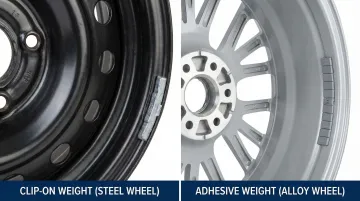
Weight selection must match the wheel type and OEM specifications. For example, GUDE Corp manufactures multiple clip-on series (MC, P, T, AW, IAW, FN) and adhesive formats (rolls and boxes) to serve diverse automotive applications, from passenger vehicles to OEM supply. That product range reflects a broader shift in what "quality" means for wheel weights today—starting with what they're made of.
The Environmental and Quality Dimension
Traditional lead weights have been a significant environmental concern. Europe banned lead weights in 2005, and various U.S. states have followed. Modern lead-free alternatives—including zinc, steel, and composite materials—meet or exceed the performance of lead while eliminating toxicity risk.
GUDE Corp, a pioneer in lead-free wheel weight production, operates three ISO9001-certified manufacturing plants and partners with TOHO Group (the #1 wheel weight manufacturer in Japan and #3 globally). All GUDE products use coated steel construction, offering strong durability and corrosion resistance without environmental compromise.
What makes a quality wheel weight:
- Holds consistent density so mass correction stays accurate
- Resists corrosion to maintain adhesion and weight over time
- Carries material certification confirming lead-free compliance
A weight that corrodes, shifts, or falls off re-creates the exact imbalance it was installed to correct. Weight quality is a maintenance variable, not a secondary consideration.
Wheel Balancing Maintenance Schedule
Balancing frequency depends on driving conditions, vehicle type, and usage intensity—but clear baseline guidelines apply to most passenger vehicles and commercial applications.
| Maintenance Trigger | Recommended Interval | Notes |
|---|---|---|
| Every tire installation or rotation | 5,000–6,000 miles | Standard balancing check at each rotation interval |
| After any significant road impact | Immediately | Pothole, curb strike—inspect and rebalance as needed regardless of mileage |
| When persistent vibration appears | As soon as symptoms occur | Diagnostic rebalance to rule out weight loss or tire shift |
| Annual check for high-mileage or highway-heavy drivers | Once per year | Proactive inspection even without symptoms |
Two additional factors can shift these intervals for specific fleets or vehicles:
- Highway-heavy vehicles experience greater centrifugal stress on wheels and typically need more frequent checks
- Vehicles stored for extended periods can develop flat spots that resolve with driving but warrant a check if symptoms persist
Frequently Asked Questions
What does wheel balancing do to your car?
Wheel balancing corrects uneven weight distribution in the tire-and-wheel assembly, eliminating vibration, reducing uneven tire wear, and protecting suspension and steering components over time.
How do you tell if your wheels need balancing?
Watch for steering wheel or seat vibration (especially at highway speeds), cupped or uneven tread wear, and the vehicle drifting or pulling. Vibrations between 50–70 mph are the most common indicator.
When should you do wheel balancing?
Balance wheels every 5,000–6,000 miles or at each tire rotation. Also rebalance after new tire installation, hitting a pothole, or when vibration symptoms appear.
How much does wheel balancing usually cost?
Standard dynamic balancing runs $10–$25 per tire ($37–$55 total on average). Road force balancing adds $10–$35 per tire and is often bundled with a tire rotation.
How do weights balance tires?
A spin-balancer identifies the location and size of imbalance, and small counterweights are clamped or adhered to the rim at precise positions to equalize mass distribution across the rotating assembly.
Do balance beads in tires really work?
Balance beads are a self-adjusting alternative used primarily in commercial and fleet applications. They can work on larger tires, but precision wheel weights are more accurate and reliable for passenger vehicles.