
Introduction
Fleet tire maintenance consistently ranks as one of the highest operational costs in commercial trucking—trailing only fuel. Yet most fleet managers focus on tire replacement while overlooking a more affordable lever: regular wheel balancing.
Many fleet managers treat balancing as optional—or defer it entirely—under pressure to keep vehicles on the road. That decision compounds costs fast. Unbalanced tires:
- Wear unevenly, shortening replacement cycles
- Increase fuel consumption through rolling resistance
- Accelerate suspension and bearing wear
- Cause unplanned downtime that disrupts delivery schedules
What follows breaks down exactly where those costs show up on the balance sheet—and how consistent balancing practice closes the gap.
TL;DR
- Commercial wheel balancing distributes rotating weight evenly across tire-wheel assemblies to eliminate vibration and uneven wear
- Balanced tires extend tire life by up to 30%, cutting replacement frequency significantly
- Proper balancing delivers a 2.2% fuel economy gain for 18-wheel tractor-trailers
- Skipping balancing accelerates suspension wear, raises maintenance costs, and increases CSA violation risk
- Consistent balancing at 20,000-mile intervals outperforms reactive balancing triggered only by driver complaints
What Is Commercial Wheel Balancing?
Commercial wheel balancing equalizes the weight distribution of a tire-and-wheel assembly so it rotates without causing vibration or uneven road contact. This applies to steer, drive, and trailer axle positions on heavy-duty trucks.
How It Differs from Passenger Car Balancing
Commercial balancing operates at a different scale. Trucks travel far more miles annually, carry heavier loads, and run at highway speeds where even minor imbalance amplifies across the entire drivetrain. A 0.5-ounce imbalance that goes unnoticed in a passenger car becomes a serious problem when multiplied across 18 wheels traveling 80,000+ miles per year.
Balancing as an Operational Input
That scale of exposure is exactly why balancing belongs in a fleet's maintenance plan, not just its service checklist. It's a routine input with measurable outputs:
- Reduced tire wear across all axle positions
- Smoother operation at highway speeds
- Fewer unplanned breakdowns and roadside service calls
For fleet operators, a consistent balancing program trades a known, manageable cost for protection against tire failures, drivetrain damage, and unscheduled downtime — expenses that are far harder to predict or budget around.
Key Advantages of Commercial Wheel Balancing
The three advantages below map directly to cost, reliability, and risk metrics that fleet managers track — each backed by real operating data, not general claims.
Extended Tire Life and Lower Replacement Costs
Unbalanced tires create uneven load distribution across the tread, causing the tire to wear faster and in irregular patterns. This condition often appears as "cupping," where waves or scallops form across the tread surface.
Consistent balancing eliminates these force variations, allowing the tire to wear evenly across its full surface area. The result is more usable miles per tire before replacement or retreading becomes necessary.
Here's what that means in dollar terms:
Research from commercial tire service providers shows that unbalanced tires can decrease tire life by approximately 30%. To put that in perspective:
- A commercial tire costs $400–$600+ on average
- A 30% reduction in lifespan raises your effective cost per tire by roughly $120–$180
- For an 18-tire tractor-trailer at $500 per tire ($9,000 total), a 30% extension in usable tread life yields $2,700 in equivalent value per lifecycle
KPIs impacted:
- Cost per tire and cost per mile
- Retread frequency
- Tire replacement cycle length
When this matters most:
High-mileage long-haul fleets where tires are one of the largest line items, and fleets that retread rather than replace, where maximizing casing life is critical.
Improved Fuel Efficiency Across the Fleet
Unbalanced wheels create rolling resistance. Instead of the tire rotating smoothly and evenly, weight imbalance causes micro-bouncing or lateral force variation at speed, which the engine must work against—consuming more fuel per mile.
Balancing reduces this resistance by allowing tires to maintain consistent, even road contact, lowering the energy required to maintain highway speed across all axle positions.
The fuel savings are measurable:
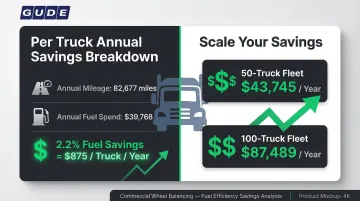
SAE J1321/TMC RP 1102 Type II fuel economy testing documented a 2.2% fuel economy improvement for tractor-trailers with 18 wheels when all tire positions were properly balanced. Translated into annual savings:
- Average 2024 fuel cost: $0.481 per mile
- Average annual truck mileage: 82,677 miles
- Annual fuel spend per truck: $39,768
- 2.2% fuel savings = $875 per truck, per year
Fleet-scale savings:
- 50-truck fleet: $43,745 annually
- 100-truck fleet: $87,489 annually
KPIs impacted:
- Fuel cost per mile
- Fuel spend per vehicle per year
- Fleet-wide fuel budget
When this matters most:
Long-haul fleets with high annual mileage per truck where fuel is the single largest operating cost, and fleets operating under tight margin pressure.
Reduced Component Wear and Lower Unplanned Downtime
Vibration caused by imbalanced tires doesn't stay isolated in the tire—it travels through the axle and drivetrain, accelerating wear on bearings, u-joints, tie rods, brakes, and suspension components. These parts fail expensively and unpredictably when vibration stress accumulates over time.
A balanced tire generates far less vibration at speed, reducing the load on these secondary components, extending their service intervals, and creating conditions where scheduled inspections trigger replacements instead of roadside failures.
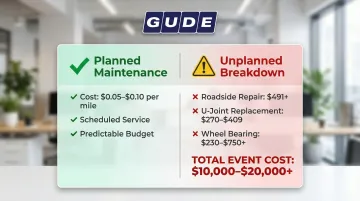
The cost gap between planned and unplanned maintenance is stark:
Unplanned breakdowns are disproportionately costly compared to scheduled maintenance:
- U-joint replacement: $270–$409
- Wheel bearing replacement: $230–$750+
- Average roadside repair: $491+ (not including towing or lost delivery revenue)
- Planned preventive maintenance: $0.05–$0.10 per mile
- Unplanned breakdown: $10,000–$20,000+ per event in total losses
Vibration reduction also affects driver performance. Research shows that whole-body vibration (WBV) in the 1–20 Hz frequency range reduces alertness and induces drowsiness.
Smoother-running vehicles keep drivers alert and on schedule — lowering incident rates and improving retention, a profitability factor most fleets underestimate.
KPIs impacted:
- Unplanned downtime hours
- Maintenance cost per mile
- Component replacement frequency
- Driver retention rate
When this matters most:
Fleets running older equipment where component margins are tighter, and operations with long routes where a mid-route breakdown is especially disruptive and costly.
What Happens When Commercial Wheel Balancing Is Skipped
When balancing is deferred or ignored, compounding consequences appear:
- Premature tire wear requiring early replacement
- Rising fuel costs from increased rolling resistance
- Accelerated suspension and drivetrain component failure
- Increased driver fatigue and associated safety risk
- Potential CSA violations that affect a fleet's safety rating and insurance costs
These costs don't appear all at once—they accumulate gradually, making it easy for fleet managers to miss the connection between skipped balancing and rising overall operating expenses until the damage is already significant.
Reactive maintenance consistently costs more than preventive maintenance. Industry data shows that planned maintenance costs $0.05–$0.10 per mile, while an unplanned breakdown results in $10,000–$20,000+ in total losses per event. A tire replacement, a failed u-joint, or a roadside breakdown will always exceed the cost of a scheduled balancing service.
Tire defects also carry severe FMCSA CSA penalty weights—a severity weight of 8 out of 10—which can negatively impact a fleet's safety rating and insurance costs.
How to Get the Most Value from Commercial Wheel Balancing
Balancing delivers the most consistent financial benefit when it's done on a fixed mileage schedule—industry recommendations typically suggest every 20,000 miles—not only when a driver reports vibration. Imbalance can be significant at non-steer positions where drivers feel it less acutely.
Use Quality Materials
A consistent schedule only delivers results if the materials hold up. Corrosion or weight detachment mid-interval effectively resets the balance, wasting the labor and service cost.
GUDE Corp manufactures lead-free steel wheel weights to ISO9001 standards, built for durability under commercial load and environmental stress. Key specs for their clip-on series include:
- Weight range: 0.25 oz to 3.00 oz in precise increments
- Material: Lead-free steel with corrosion-resistant finish
- Certification: ISO9001-certified manufacturing
- Application: Designed for demanding commercial axle positions
Integrate with a Comprehensive Tire Maintenance Program
Balancing works best as part of an integrated tire maintenance program—paired with:
- Proper inflation monitoring
- Rotation schedules
- Alignment checks
Each element reinforces the others: proper inflation slows uneven wear, rotation redistributes load, and alignment keeps the balance accurate between service intervals.
Conclusion
Commercial wheel balancing directly reduces the three largest variable cost categories in fleet operation: tire spend, fuel consumption, and unplanned maintenance. Treat it as a routine line item, and it consistently pays for itself.
Its financial advantages compound over time when applied consistently. A fleet that balances every 20,000 miles and uses properly rated weights will see lower cost per mile across tires, fuel, and repairs — gains that accumulate with every service interval.
Deferring balancing doesn't eliminate the cost — it shifts it into tire replacements, fuel overages, and roadside failures that cost far more than the service interval you skipped.
Frequently Asked Questions
What is the best way to balance truck tires?
Commercial truck tires should be balanced on a heavy-duty balancer capable of handling large assemblies, with weights placed precisely as indicated by the machine. Cover steer tires at a minimum and drive tires for full benefit, at regular 20,000-mile intervals.
What are the two types of wheel balancers?
Static balancers correct up-and-down bounce from a single heavy spot; dynamic balancers correct side-to-side wobble from uneven weight distribution across the tire's width. Dynamic balancing is the standard for commercial applications.
How often should commercial truck tires be balanced?
The standard recommendation is every 20,000 miles, or any time a driver reports vibration, after a tire is replaced, or during routine preventive maintenance inspections.
What are the signs that commercial tires are out of balance?
Key indicators include steering wheel or cab vibration at highway speed, uneven or "cupped" tread wear, and increased fuel consumption. On drive and trailer positions, imbalance often goes unfelt but continues causing wear and damage.
Can tire balancing reduce fuel costs for a commercial fleet?
Yes—SAE J1321/TMC RP 1102 Type II testing documented a 2.2% fuel economy improvement for properly balanced tractor-trailers. For a high-mileage fleet, these savings multiply significantly across multiple vehicles and annual miles.
What type of wheel weights work best for commercial vehicles?
Steel or zinc clip-on weights in 0.50 oz increments work best for most commercial applications, with adhesive weights used on alloy wheels. Lead-free, corrosion-resistant options are preferred for durability in harsh conditions and are required in many jurisdictions under environmental regulations.