
Introduction
A single missing balance weight can turn a smooth highway ride into a steering wheel shudder—and most drivers never see it coming. These small steel pieces attached to your wheel rim offset uneven weight distribution in the tire-wheel assembly, and when they're gone, the whole system is off.
Loss is more common than most shops account for. Weights come off due to installation errors, road impacts, rim contamination, and substandard materials — each leaving vehicles vulnerable to:
- Accelerated tread wear from sustained imbalance
- Steering vibration that worsens at highway speeds
- Suspension stress and premature component wear
- Reduced fuel economy from rolling resistance
This article breaks down the most common causes and what can be done to prevent them.
TLDR
- Weights fall off primarily due to improper installation, physical road impacts, corrosion, and low-quality materials
- Clip-on weights loosen from road shock and galvanic corrosion; adhesive weights fail without proper surface prep
- Missing weights cause steering vibration (especially 50–70 mph), uneven tire wear, and safety risks
- Prevention starts with clean surface prep, the right weight series for the rim type, and corrosion-resistant materials
- Rebalance after every road impact and at every tire rotation — typically every 5,000–7,500 miles
Common Causes of Tire Balance Weights Falling Off
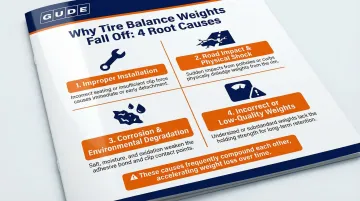
Weight loss typically traces back to one or more of four root causes: installation error, physical impact, environmental degradation, or incorrect weight selection. Multiple causes often compound each other—a marginally installed weight becomes vulnerable to even minor road impacts.
Improper Installation and Poor Surface Preparation
Adhesive weights require a clean, grease-free, dry wheel surface to bond properly. Any brake dust, oil residue, or moisture left behind weakens adhesion from the start. According to 3M technical guidelines, both the wheel surface and adhesive material must be between 60–110°F during application, and the tape must achieve 85% "wet-out" (full contact with the surface) to meet GM Standard GMW15851.
For clip-on weights, improper seating on the rim flange causes immediate or gradual loosening. Common shop scenarios include:
- Rushed installations without solvent cleaning
- Skipping the degreasing step entirely
- Applying weights to wet or cold wheels
- Using the wrong balancer collet fit, leading to inaccurate placement
Road Impacts and Physical Shock
Hitting a pothole, curb, or speed bump generates sudden, sharp force that can snap a clip-on weight off the rim flange or shear the adhesive bond of a stick-on weight. Finite element analysis shows that when a tire drops into a pothole at 40 km/h, vertical accelerations exceed 100g—more than enough to dislodge a marginally attached weight.
High-speed highway driving adds cumulative stress. Two conditions accelerate weight loss over time:
- Centrifugal force: Continuous stress on the attachment point at highway speeds fatigues both clips and adhesive bonds
- Repeated minor impacts: Each small hit degrades retention incrementally until eventual loss becomes inevitable
Corrosion and Environmental Degradation
Clip-on weights made from low-quality or uncoated materials are susceptible to rust and galvanic corrosion on alloy wheels, where dissimilar metals create an electrochemical reaction. Corrosion weakens the clip's grip on the rim flange and can cause the rim itself to deteriorate at the contact point. Alcoa explicitly warns that clip-on weights may "fly off" their Dura-Flange wheels and strictly recommends adhesive weights instead.
Adhesive weight backing degrades from multiple environmental stressors:
- Road salt and moisture: Penetrates the adhesive interface and breaks down the bond
- UV exposure: Dries out and cracks the tape backing over time
- Temperature cycling: Repeated expansion and contraction between summer heat and winter freezing causes peeling
3M VHB tapes pass 480-hour salt spray tests and maintain load-bearing capacity at 200°F. Lower-grade adhesives fail well short of those benchmarks.
Using Incorrect or Low-Quality Wheel Weights
Using the wrong weight profile for a given rim type leads to poor fitment and premature loss. According to industry application guides, rim flanges less than 3/16 inch deep should use adhesive weights only—clip-ons simply won't seat properly.
Low-quality weights—particularly older lead weights or substandard clip-ons—are more prone to deformation, corrosion, and adhesive failure. Higher-quality, lead-free steel or zinc weights manufactured to tight tolerances offer more reliable long-term retention. GUDE Corp's lead-free steel weights are produced in ISO 9001-certified facilities by Toho Kogyo, the #1 wheel weight manufacturer in Japan, and are built to the same specifications supplied to OEM automakers including Toyota. Nine U.S. states have banned lead wheel weights containing more than 0.1% lead by weight, making lead-free alternatives a compliance requirement in an increasing share of the market.
What Happens When Tire Balance Weights Fall Off
The immediate mechanical consequence: the wheel-tire assembly loses its counterbalance, causing it to spin unevenly. This generates vibration that travels through the steering wheel (front axle) or floorboard (rear axle) and worsens progressively as speed increases.
The longer-term costs add up fast. Sustained imbalance can reduce commercial tire life by up to 20% through irregular wear patterns like flat spotting and scalloping. SAE J1321 fuel consumption tests also found a 2.2% fuel economy improvement when wheel assemblies were properly balanced — meaning imbalance directly adds to fuel costs at scale.
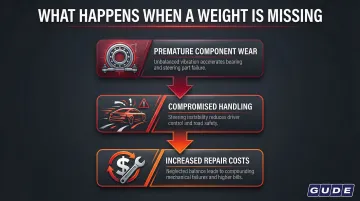
Beyond tires and fuel, the downstream effects include:
- Premature component wear — excess stress on wheel bearings, tie rods, and shock absorbers accelerates failure
- Compromised handling — at highway speeds, inconsistent tire contact with the road degrades braking response
- Increased repair costs — cascading component damage means imbalance rarely stays an isolated problem
Warning Signs That a Tire Balance Weight Has Fallen Off
Steering Wheel Vibration or Shimmy
Vibration felt through the steering wheel, especially one that intensifies between 50–70 mph before smoothing out at higher speeds, is a classic early indicator of front wheel imbalance. This speed range corresponds to the wheel hop frequency where vehicle suspensions typically resonate. If the vibration is speed-dependent rather than constant, the wheel assembly — not the road surface — is the likely source.
Unusual Tire Wear Patterns
Cupping, scalloping, or patchy wear on the tire tread—where some sections wear faster than others in a repeating pattern—points to a wheel bouncing rhythmically due to imbalance rather than rolling smoothly. While cupping is often blamed on worn shocks, out-of-balance tires are an equally common cause.
Pulling or Handling Changes After a Road Impact
If the vehicle begins pulling slightly to one side, feels less stable in corners, or the ride suddenly becomes rougher immediately after hitting a pothole or curb, a displaced or lost balance weight is a likely cause. Rebalancing the affected axle — starting with the wheel closest to the impact — will confirm whether a weight was dislodged.
How to Prevent Tire Balance Weights From Falling Off
Prevention comes down to three things: correct installation, smart material choices, and routine maintenance. Each of the four steps below addresses a distinct failure point.
Thorough Wheel Surface Preparation Before Installation
Always clean the wheel mounting area with an appropriate solvent or prep solution — such as 3M Wheel Weight Surface Prep 2000 — to remove brake dust, grease, road grime, and moisture before applying adhesive weights. For clip-on weights, inspect the rim flange depth and profile before selecting the weight style.
A contaminant-free surface maximizes adhesive contact area so the weight bonds fully from the start. Proper flange profiling ensures the clip seats securely and doesn't rock or shift under load.
Selecting the Right Weight Type for the Wheel
Matching the weight type to the wheel starts before installation:
- Use a rim profile gauge to match clip-on weight style to the exact rim flange
- Choose adhesive weights for alloy or decorative wheels where clip-on application risks coating damage or poor seating
- Verify that the balancer and weights are calibrated to the same unit system (ounces vs. grams)
Correct weight-to-rim fitment eliminates the mechanical looseness that leads to gradual migration and ejection. Proper unit matching prevents under- or over-weighting, which can push technicians to stack weights inappropriately.
Choosing High-Quality, Corrosion-Resistant Wheel Weights
Specify wheel weights manufactured to tight dimensional tolerances and built to resist corrosion — coated weights for alloy wheels, and lead-free coated steel weights as the baseline for all applications. Don't reuse old weights or substitute off-spec alternatives.
Weights produced in ISO 9001-certified facilities offer stronger clip retention, more consistent adhesive bonding, and greater resistance to the corrosion and temperature cycling that degrade lower-grade products over time.
Regular Rebalancing After Road Impacts and Tire Rotations
Schedule a rebalance check after any significant road impact — pothole, curb strike — and as part of every tire rotation service. The U.S. Tire Manufacturers Association recommends rotating tires every 5,000–8,000 miles, with most manufacturers specifying 5,000–7,500 miles.
Catching minor imbalances early prevents vibration from worsening and causing secondary damage. Pairing rebalancing with rotation ensures all four corners are inspected regularly, not just the front wheels where vibration is most noticeable.
Tips for Long-Term Wheel Weight Retention
Routine Visual Inspection
Check wheel weights when tires are off the vehicle during rotation or seasonal changeovers. Look for:
- Missing weights
- Loose clips
- Peeling adhesive backing
- Visible corrosion at the clip contact point
Document weight placement and quantities per wheel during each service visit so the next technician can immediately identify if a weight is missing compared to the previous service record.
Technician Training and Best Practices
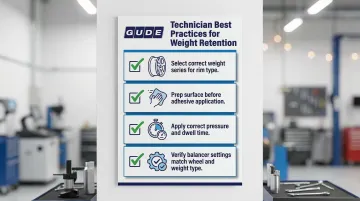
Consistent retention starts with trained technicians. Shops that follow standardized procedures see fewer comebacks and fewer rebalancing visits. Key practices include:
- Selecting the correct weight series for the specific rim type (steel, alloy, OEM-profile)
- Prepping the surface before applying adhesive weights — clean, dry, and free of wax or brake dust
- Applying correct pressure and dwell time per adhesive manufacturer specs
- Verifying balancer settings match the wheel and weight type before finalizing placement
Environmental and Regulatory Factors
Several U.S. states have banned or restricted lead wheel weights, including California, Illinois, Maine, Maryland, Minnesota, New Jersey, New York, Vermont, and Washington. Shops operating across state lines benefit from standardizing on lead-free weights now rather than managing a mixed inventory.
Choosing lead-free alternatives ensures compliance, reduces environmental liability, and typically improves corrosion resistance — extending weight service life.
Frequently Asked Questions
Why do tire balance weights fall off?
Weights fall off due to a combination of poor installation (skipped surface prep, wrong temperature), physical road impacts that exceed retention strength, corrosion of the weight or adhesive, and incorrect weight selection for the wheel type. Most cases are preventable with proper technique and quality materials.
What happens if tire balance weights fall off?
A missing weight causes immediate vibration in the steering wheel or cabin, accelerated tire wear, and added stress on suspension components. At highway speeds, handling and braking are also affected — a direct safety concern.
How can I prevent tire balance weights from falling off?
Four practices prevent most failures:
- Clean and dry the wheel surface with solvent before applying adhesive weights
- Match the weight type and profile to the specific rim
- Use corrosion-resistant weights from quality manufacturers
- Rebalance after every tire rotation or significant road impact
How long can I drive with an unbalanced tire?
While a vehicle can technically be driven short distances, prolonged driving on an unbalanced tire causes accelerating damage to tires, wheel bearings, and suspension components. It's best to have it rebalanced as soon as symptoms appear to avoid compounding repair costs.
How much does it cost to fix unbalanced tires?
Tire balancing typically costs between $37 and $55 for a standalone service, or $108 to $159 for rotation and balancing combined. Many shops include rebalancing as part of a tire rotation package, and retailers like Costco and Discount Tire offer lifetime balancing with tire purchases.
Do stick-on tire balance weights work and how are they installed?
Adhesive weights work well when installed correctly. Clean and dry the wheel surface with solvent, press the weight firmly at the balancer-indicated location, and verify at least 1/8-inch brake caliper clearance. Surface prep is the single most critical factor for long-term retention.