Introduction
When a light truck tire needs more than the expected amount of correction weight, that's a warning signal — not a cue to add more weight. Maximum wheel balance weight is a defined engineering limit that governs whether a tire assembly can be corrected through standard balancing procedures.
These limits exist because balance weight is designed to correct for minor manufacturing variations. It cannot — and should not — substitute for proper diagnosis when something more serious is wrong.
Exceeding those thresholds points to deeper problems: rim distortion from curb strikes, improper tire mounting, or significant uniformity defects. For fleet managers and tire technicians, these limits function as diagnostic triggers. Knowing when a tire assembly has crossed the threshold — and why — is what separates a corrective repair from a recurring problem.
TL;DR
- Maximum balance weight limits vary by axle position and service duty—steer tires carry stricter limits than drive or trailer positions
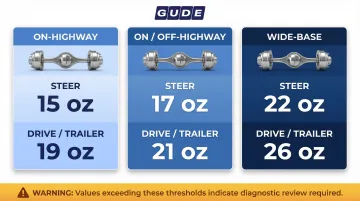
- On-highway service allows 15 oz for steer tires and 19 oz for drive/trailer; wide-base tires permit up to 26 oz
- Exceeding the maximum signals rim problems, mounting errors, or tire defects that require investigation
- Use ATA TMC RP 214 as your reference standard—it defines accepted thresholds for both commercial and light truck balancing
- Lead-free steel weights meet the same precision requirements as traditional weights when sourced from ISO 9001-certified manufacturers
What Maximum Wheel Balance Weight Means for Light Truck Tires
Maximum wheel balance weight defines the upper correction limit: the highest total mass that can be added to a wheel assembly during balancing while still indicating a correctable, normally functioning tire-and-rim system. This threshold exists because balance weight compensates for inherent mass asymmetries in the tire and rim; its magnitude directly reflects the combined uniformity of both components.
Light truck (LT-metric) tires differ fundamentally from passenger vehicle tires in size, load range, and structural mass. Larger contact patches and higher load ratings create greater rotational inertia, making these assemblies more sensitive to uncorrected imbalance at highway speeds.
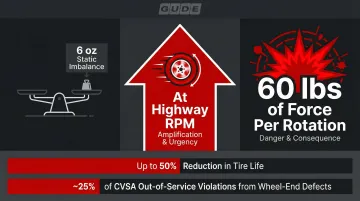
The same 6-ounce imbalance that causes mild vibration in a passenger car can generate several times the centrifugal force on a commercial vehicle wheel spinning at highway RPM — enough to accelerate bearing wear and fatigue suspension components well ahead of their design life.
The maximum balance weight limit functions as a design constraint, not an operating target. A properly specified and mounted tire-wheel assembly should require well below the maximum to achieve acceptable balance. When correction requirements approach or exceed published limits, the assembly has moved outside normal operating parameters.
Factors That Influence Balance Weight Requirements in Practice
Manufacturing tolerances in both tire and rim introduce baseline imbalance. Uniformity variation from the factory accounts for a portion of the balance correction needed at installation, but this should represent a small fraction of the allowable maximum.
Field conditions frequently increase balance weight demand beyond factory baselines:
- Rim damage from curb strikes or pothole impacts introduces geometric irregularities
- Tire mounting errors prevent concentric bead seating (the tire sitting evenly on the rim), one of the most common causes of high balance requirements in shop settings
- Uneven tread wear from alignment issues or insufficient rotation intervals
- Foreign material such as mud, ice, or road tar lodged in tread grooves or on rim surfaces
Beyond these field conditions, service duty classification shapes how quickly balance requirements grow over a tire's life. Mixed-service tires in construction, logging, or utility applications accumulate asymmetric wear patterns faster than highway-only tires — requiring wider correction envelopes without triggering diagnostic concern.
Balance Weight Limits by Service Type and Axle Position
Maximum balance weight limits for light truck and commercial tires are differentiated by tire position on the vehicle and service duty classification. The Technology & Maintenance Council (TMC) Recommended Practice 214 establishes these thresholds as industry standard.
On-Highway Service (20-Inch and Larger Tires)
For standard on-highway service, TMC RP 214 specifies:
- Steer tires: 15 oz maximum
- Drive and trailer tires: 19 oz maximum
Steer tires carry a lower maximum because steer axle imbalance transmits directly through the steering column as vibration to the driver. This makes precision more critical at the steer position than at drive or trailer positions.
The lower limit enforces tighter tolerance on steer tire uniformity. Radial or lateral runout exceeding 0.060 inches will cause detectable vibration in steer assemblies regardless of how well the tire is balanced.
On/Off-Highway Service
For tires operating in mixed on/off-highway duty—construction, logging, utility fleets—TMC RP 214 allows higher limits:
- Steer tires: 17 oz maximum
- Drive and trailer tires: 21 oz maximum
Tires in this category accumulate surface-level mass asymmetries faster from debris and rough terrain, so a wider correction envelope is needed without triggering diagnostic concern. The additional 2 oz allowance accounts for conditions where perfect uniformity simply cannot be maintained.
Wide-Base Tire Configurations
Wide-base single tires such as the 445/50R22.5 carry significantly higher maximum limits:
- Steer position: 22 oz maximum
- Drive and trailer positions: 26 oz maximum
Wide-base tires permit higher correction weights because their larger cross-section and greater mass naturally produce more imbalance at standard manufacturing tolerances. That said, consistently approaching these limits during service is a diagnostic signal — inspect for a mounting error or tire quality issue rather than adding more weight to compensate.
What Drives High Balance Weight Requirements in the Field
Consistently high balance weights on new tires at first mount often indicate a rim uniformity issue. An out-of-round or off-center rim introduces an imbalance baseline that compounds the tire's own manufacturing variation. Tubeless steel disc wheels are allowed maximum runout of 0.070 inches, while tubeless aluminum disc wheels are restricted to 0.030 inches.
The two most common root causes of excessive correction weight are:
- Improper mounting: Incorrect bead seating or off-center placement relative to the valve stem mark drives up correction weight. Re-mounting with the tire's high point matched to the rim's low point often reduces required weight dramatically.
- Rim runout or damage: An out-of-spec rim flange introduces a fixed imbalance that no amount of weight placement can fully correct.
When the same wheel position consistently demands high corrections across multiple tire change cycles, mounting error is unlikely — that pattern points to the rim itself. The rim should be pulled from service and inspected for runout or physical damage.
How Maximum Balance Weight Is Specified, Applied, and Verified
Balance weight limits are documented in industry standards—primarily ATA TMC RP 214—and tire manufacturer service guidelines. These specifications should be referenced at the point of service, not treated as general shop knowledge passed informally.
Measurement and Verification Process
A calibrated spin balancer measures imbalance magnitude and angular position in both inner and outer planes. The machine output is compared against the maximum weight limit before any weights are placed. If the indicated correction exceeds the threshold, the technician should dismount and inspect the assembly rather than overweight it.
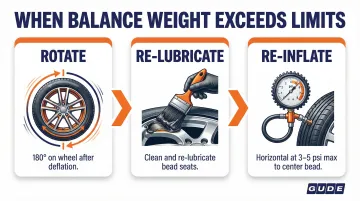
When runout exceeds 0.060 inches or required weight exceeds RP 214 limits, manufacturers recommend the "3 R's":
- Rotate the tire 180 degrees on the wheel after deflation
- Re-lubricate the bead seats after ensuring the wheel is clean
- Re-inflate horizontally at 3-5 psi maximum to allow gravity to center the wheel
Weight Type and Material Compliance
Weight type and material affect compliance with balance limits. Clip-on and adhesive weights must be correctly rated for the wheel flange type—steel versus alloy. Lead-free alternatives such as GUDE's ISO 9001-certified coated steel weights must match the same dimensional and mass-per-increment precision as the weights used during balancer calibration to ensure accuracy.
Selecting the right series for the application is part of maintaining that precision. GUDE's clip-on weights cover six series across common rim types:
- MC Series — standard steel rim flanges
- AW Series — alloy wheels, low-profile clip
- IAW Series — inner alloy wheel, hidden placement
- P Series — passenger vehicle steel wheels
- T Series — Toyota/Lexus OEM rim flange specification
- FN Series — OEM-specific rim profiles
All products are manufactured by Toho Kogyo across three ISO 9001-certified facilities in Japan and Vietnam, in standardized increments from 0.25 oz to 3.00 oz.
Consequences of Exceeding Maximum Balance Weight Limits
Adding weight beyond the published maximum does not fix imbalance — it masks it. When residual vibration persists after maximum weight is applied, the root cause is typically a shape irregularity (radial or lateral run-out) rather than a simple mass asymmetry, and no amount of additional weight will correct that.
Accelerated Component Wear
Persistent imbalance creates accelerated component wear through increased cyclic loading on wheel-end bearings, accelerated and irregular tread wear, and elevated stress on suspension linkage components. At highway speeds, 6 ounces of imbalance amplifies to 60 pounds of force, effectively hitting the tire with a sledgehammer on every rotation. This prevents the tire from achieving a consistent footprint and can reduce tire life by up to 50%.
Safety and Compliance Risks
Operating outside published balance weight limits creates compliance exposure on multiple fronts:
- Violates manufacturer service recommendations and fleet maintenance standards
- Creates warranty and liability risk if overweight correction is documented on a failed component
- Wheel-end defects account for approximately 25% of out-of-service violations during CVSA inspection blitzes
- Under North American Standard Out-of-Service Criteria, smoking wheel hubs from bearing failure are grounds for immediate removal from service
Misinterpretation of Maximum Limits
Technicians who approach maximum-weight assemblies as "normal" and do not investigate the root cause introduce ongoing operational risk. The maximum is a diagnostic threshold, not an acceptable endpoint for routine balancing work. When a maximum-weight situation appears, the correct next step is a run-out inspection — not more weight.
Frequently Asked Questions
What is the maximum wheel balance weight?
Maximum balance weight limits vary by service type and axle position per ATA TMC RP 214. On-highway service allows 15 oz for steer and 19 oz for drive/trailer; on/off-highway service permits 17 oz steer and 21 oz drive/trailer; wide-base tires allow up to 22 oz steer and 26 oz drive/trailer.
Why does my wheel need so many balance weights?
A high balance weight requirement usually signals a rim uniformity problem, improper tire mounting, or significant tire wear asymmetry. The most common cause is mismounting that prevents proper bead seating—creating an out-of-round assembly that additional weight alone cannot correct.
What happens if the required balance weight exceeds the maximum limit?
Exceeding the limit is a diagnostic trigger: the assembly should be dismounted, the rim inspected for run-out or damage, and the tire re-mounted or replaced rather than overloaded with correction weight. Adding more weight will not resolve the underlying geometric problem.
Is there a difference in balance weight limits between steer and drive/trailer tires?
Steer tires carry lower maximum limits than drive and trailer tires because steer axle imbalance is more directly felt by the driver and affects steering precision. Steer positions require tighter correction thresholds—typically 2-4 oz lower than drive/trailer positions in the same service category.
Can lead-free wheel weights be used on light truck tires?
Lead-free weights are approved—and in many jurisdictions mandated—provided they match the same mass-per-increment precision and are correctly rated for the wheel flange type. GUDE's coated steel weights meet ISO 9001 standards and are available in series-specific designs for both steel (MC, P) and alloy (AW, IAW) flanges.