
Introduction
35-inch tires are among the most popular upgrades for off-road trucks and SUVs, delivering the ground clearance and increased approach angle that off-road builds demand. Their larger mass and aggressive, non-uniform tread patterns make proper wheel balancing far more complex than standard passenger tire work.
Most balancing guides focus on passenger car tires, which leaves technicians working on 35-inch setups without reliable weight references. Too little weight leads to persistent vibration and premature tire wear. Too much creates new imbalances or damages the wheel finish.
Getting that balance right starts with understanding the actual numbers. This guide covers typical weight ranges for 35-inch tires, the factors that shift those numbers, which weight types work best for heavy off-road setups, and how to achieve a balance that holds up under demanding conditions.
TLDR
- Most 35-inch tires need 4–8 oz of balance weight per wheel — more for mud-terrain builds than all-terrain
- Wider mud-terrain variants (35x14.50 or 35x16) often need 8–10 oz or more
- Road force balancing delivers superior accuracy for large off-road tires compared to standard spin balancing
- Wheel runout and tire condition affect final weight requirements—weights can't fix structural problems
- Follow-up rebalancing at 500 miles, combined with clean surface prep, keeps the balance holding long-term
How Much Weight Does a 35-Inch Tire Need to Balance?
There's no universal answer—the weight required depends on your specific tire and wheel combination. However, industry benchmarks provide reliable starting ranges that help technicians and DIYers set proper expectations.
35-inch tires require more balance weight than standard passenger tires due to their increased mass and rotational diameter. A typical passenger car tire needs 1–3 oz per wheel, while 35-inch off-road tires commonly require 4–8 oz or more.
The larger the tire, the greater the effect of even small imbalances. This is why precision matters far more on oversized off-road setups than on a standard commuter vehicle.
Use the table below as a quick reference before diving into the details for each configuration.
| Tire Size | Typical Weight Range | Notes |
|---|---|---|
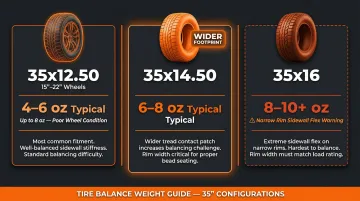
| 35x12.50 (15"–22" wheels) | 4–6 oz per wheel | Up to 8 oz with poor wheel condition |
| 35x14.50 | 6–8 oz per wheel | Wider footprint shifts range upward |
| 35x16 | 8–10+ oz per wheel | More on narrow rims due to sidewall flex |
Standard 35x12.50 on 15"–22" Wheels
The 35x12.50 is the most common 35-inch tire size, and its balance weight requirements are well-documented across the industry. For this configuration, expect a starting weight range of 4–6 oz per wheel, with some assemblies requiring up to 8 oz depending on tire construction and wheel condition.
Wheel diameter (from 15" to 22") has relatively minimal impact on balance weight for this width. Whether you're running a 35x12.50 on a 15" steel rim or a 20" alloy wheel, the weight range stays consistent because the tire's mass distribution—not the wheel diameter—is the primary driver of imbalance.
Wider 35-Inch Variants (35x14.50 and 35x16)
Wider tires carry more mass distributed across a larger footprint, which typically shifts the balance weight range upward. For 35x14.50 configurations, expect 6–8 oz per wheel as a starting point, while 35x16 setups often require 8–10 oz or more.
A wider tire on a smaller wheel (such as a 35x16 on a 15" rim) may require even more weight due to increased sidewall flex and irregular load distribution during rotation. The combination of a wide tire and narrow wheel creates a "ballooning" effect that can introduce additional imbalance.
Important context: These weight ranges assume properly mounted tires with no runout, no excessive tire lube pooled inside the tire cavity, and a clean wheel surface free of old weight residue. If any of these conditions aren't met, the actual weight required can increase significantly—or balancing may prove impossible until you correct the underlying issue.
Key Factors That Affect How Much Balancing Weight You Need
The same 35-inch tire size can require vastly different amounts of weight depending on construction, mounting conditions, and balancing method. Understanding these variables prevents under- or over-weighting and helps diagnose persistent vibration issues.
Tire Construction and Tread Pattern
Mud-terrain tires—with their aggressive, asymmetric tread blocks—are inherently harder to balance than all-terrain or highway-terrain 35-inch tires. The deep, widely spaced lugs create uneven mass distribution around the tire's circumference, often pushing weight requirements to the high end of the range or beyond.
New mud-terrain tires may shift slightly during the first few hundred miles as the tread compounds settle and the tire fully seats on the rim. This break-in period can alter the balance, which is why rebalancing after 500–1,000 miles is common practice for heavy off-road tires.
Wheel Size, Offset, and Condition
A wheel with significant positive or negative offset changes the lever arm of imbalance. Greater offset moves the tire's mass farther from the hub centerline, amplifying the rotational forces that cause vibration. This can affect both the amount and placement of balance weight required.
Runout is a separate but related factor. Radial runout (up-and-down wobble) and lateral runout (side-to-side wobble) create vibration that no amount of balance weight can fix. If runout is excessive, the wheel must be straightened, replaced, or match-mounted to the tire's low spot before balancing will be effective.
Balancing Method Used
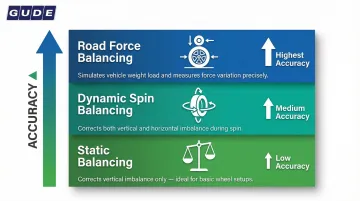
Three main methods exist for balancing 35-inch tires:
- Static balancing — addresses vertical imbalance only; rarely sufficient for large off-road tires
- Dynamic (spin) balancing — accounts for both vertical and horizontal imbalance; the minimum acceptable standard
- Road force balancing — simulates vehicle weight on the tire and measures force variation in the casing; the most accurate option for heavy off-road applications
Road force balancing is the most accurate method for large, heavy off-road tires. It simulates the weight of the vehicle pressing down on the tire and measures force variation—stiffness inconsistencies in the tire casing that standard spin balancing can't detect. For thick-sidewall off-road tires, force variation is more common and more severe, making road force balancing the preferred choice over standard spin methods.
Types of Wheel Weights for 35-Inch Tires
Choosing the right type of wheel weight for your specific wheel finish and application is just as important as getting the right amount. The wrong type can damage alloy wheels, fail at high speeds, or come loose under off-road stress.
Clip-On vs. Adhesive Wheel Weights
Clip-on weights are preferred for steel wheels and wheels with a clear lip or flange where the clip can securely grip. They're fast to install, easy to remove, and hold up well under extreme conditions.
Adhesive (stick-on) weights are better suited for alloy wheels, custom wheels, or show wheels where clip-on weights would mar the finish or where there's no suitable flange for a clip. Many aftermarket wheels common on lifted 35-inch tire setups are alloy and require adhesive weights to preserve aesthetics and prevent damage.
Critical installation rule: Never stack multiple adhesive weights or combine smaller clip-ons to hit a target weight. Always use a single, correctly-sized weight for each location. Inferior adhesives can fail under the high heat and stress of off-road use, especially when multiple weights are stacked.
For shops and fleet operations balancing high volumes of 35-inch tires, GUDE Corp offers adhesive weights in both roll format (720 pieces per roll) and box format (144 pieces with 24 pre-cut strips), with weight increments from 0.25oz to 1.00oz.
For clip-on applications on aftermarket alloy wheels, the AW Clip-On Series features a low-profile clip design engineered specifically for alloy wheel rim flange geometry — minimizing visibility on custom wheels while providing secure retention.
Material: Lead-Free Options
Lead wheel weights have been phased out in many states and countries due to environmental regulations. Zinc and steel are now the standard alternatives, with zinc being the OEM-preferred material for clip-on weights due to its superior corrosion resistance and durability.
GUDE Corp's lead-free wheel weights (coated steel) are built to ISO9001 standards for both OEM and aftermarket applications. Key compliance and quality credentials include:
- Lead-free coated steel — meets state and federal environmental regulations across the US
- ISO9001 certified — consistent production quality across every batch
- Manufactured by Toho Kogyo — the #1 wheel weight manufacturer in Japan and #3 globally
- Three certified plants in Japan and Vietnam, purpose-built for high-volume, heavy-duty applications
That manufacturing pedigree matters for 35-inch tire setups, where balancing weights face more stress than typical passenger vehicle applications.
How to Get the Best Balance on Your 35-Inch Tires
Proper preparation before and during balancing has as much impact on the final result as the weight amount itself. For large, heavy off-road tires, small errors compound quickly.
Pre-Balancing Checks
Before mounting the tire on the balancer, inspect for visible runout by spinning the assembly by hand and watching for wobble. Check that no tire lube or sealant has pooled inside the tire—pooled mounting lubricants make dynamic and road-force balancing mathematically impossible because the liquid acts as a moving counterweight.
Also verify the wheel is clean and free of old weight residue. Hunter Engineering's official guidance mandates removing all previous weights, rocks, and debris from the tire tread, and cleaning the center hole of the wheel before mounting the assembly on the balancer spindle. Removing old balance weights before rebalancing is essential — adding new weights on top of old ones will throw off every reading.
Clean the balancer's spindle shaft and the wheel's hub-mating surface. Dirt or rust on these surfaces prevents flush mounting, leading to false runout readings and inaccurate weight placement.
During and After Balancing
For adhesive weight application, the mounting surface must be clean and dry before you start. Follow these steps to avoid the most common failure points:
- Remove all grease, brake dust, and moisture — these are the leading causes of adhesive weight failure under off-road heat and flex
- Press each weight firmly into place rather than just setting it down
- Follow the balancing machine's indicated position precisely, not approximated
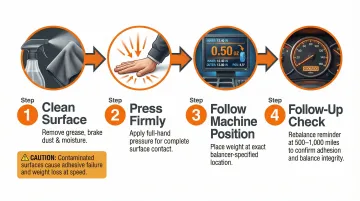
New off-road tires, particularly mud terrains, often benefit from a follow-up balance check after 500–1,000 miles of use as the tire seats and tread compounds settle. Because it takes time for mounting lubricants to dry, aggressive driving immediately after installation can cause the tire to slip on the rim, ruining a perfect balance job. Avoid hard acceleration or braking for the first 500 miles or 24 hours, whichever comes first.
Common Balancing Mistakes with 35-Inch Tires
Avoid these errors to ensure a smooth, lasting balance:
- Underestimate how much weight a 35-inch tire needs — these tires almost always require more than a comparable smaller setup, making underweighting the most common error
- Use balance weights to mask vibrations from wheel runout, bent wheels, or improper mounting — weights can't fix mechanical problems; diagnose the root cause first
- Skip surface prep before applying adhesive weights to alloy wheels — grease, brake dust, or moisture is the leading cause of adhesive failure under off-road conditions
- Stack multiple small weights instead of using one correctly-sized weight — this increases detachment risk and creates uneven weight distribution
Getting the weight amount right matters, but so does surface prep, weight type, and ruling out mechanical issues before you start. Miss any one of those steps and the balance won't hold — regardless of how accurate the machine reading was.
Frequently Asked Questions
How much weight is needed to balance a tire?
Balance weight requirements vary by tire size and construction. Standard passenger tires typically require 1–3 oz per wheel, while large off-road tires like 35-inch setups commonly need 4–8 oz or more per wheel depending on width and tread pattern.
How much does the average 35-inch tire weigh?
35-inch tires typically weigh between 50–70 lbs depending on construction. Mud-terrain tires are at the heavier end while all-terrain and highway variants are lighter. This physical weight directly influences how much balance weight is needed.
What is the 3% tire rule?
The 3% rule states that a tire's overall diameter should not exceed 3% more than the OEM spec. Going beyond that threshold requires vehicle adjustments — gear ratio changes, speedometer calibration, or a lift kit. 35-inch tires frequently exceed this limit on stock setups.
What's better, 33s or 35s?
35-inch tires offer more ground clearance and off-road capability, but they're heavier, harder to balance, and require more vehicle modifications than 33s. The right choice depends on your intended use and how your vehicle is set up.
Why do 35-inch tires need more balance weight than standard tires?
35-inch tires have far greater mass, a larger rotational diameter, and often more irregular tread patterns than passenger tires. All of these factors amplify the effect of even small imbalances and require proportionally more corrective weight.
Can a 35-inch tire ever be impossible to balance with weights alone?
Yes—if a tire or wheel has excessive runout, a flat spot, or internal structural damage, balance weights cannot correct the problem. In those cases the tire or wheel must be repaired, repositioned, or replaced before balancing will be effective.