
Introduction
Are the lead wheel weights on your shop floor about to be regulated out of existence? For tire shops and automotive professionals across the United States, this question became more urgent in December 2024 when the EPA issued a major decision on lead wheel weights — a decision that surprised many industry observers expecting a federal ban.
Since 2009, the EPA has faced mounting pressure from environmental and health advocacy groups to prohibit lead wheel weights under the Toxic Substances Control Act, citing risks of lead exposure to children and contamination of roadside soil.
The health stakes are real. Lead exposure causes neurological damage and cognitive impairment, particularly in children. Nine states have already banned lead wheel weights, and Canada followed suit in 2024.
Meanwhile, virtually all major automakers have switched to lead-free alternatives on new vehicles — accelerating an industry-wide transition regardless of what federal regulators decide. Understanding what changed, and what didn't, in the EPA's December 2024 decision is now critical for businesses navigating compliance, inventory planning, and the industry's broader shift to lead-free alternatives.
TLDR: Key Takeaways
- The EPA decided in December 2024 not to pursue a federal ban on lead wheel weights under TSCA
- Nine U.S. states already ban the sale, distribution, and use of lead wheel weights; Canada prohibited them in 2024
- Virtually all major OEMs eliminated lead wheel weights on new vehicles years ago
- The industry standard is now lead-free steel, zinc, or tungsten weights
- Shops still using lead weights need a transition plan: state bans remain in force, and federal action is still on the table
What Is the EPA Lead-Free Wheel Weight Initiative?
The Role of Lead in Wheel Balancing
Wheel weights are small metal components attached to vehicle wheels to correct imbalances and ensure smooth rotation at highway speeds. Since the 1930s, lead dominated this application because of its high density, workability, and low cost — properties that let technicians shape it by hand while small amounts delivered enough mass to counterbalance tire and wheel imperfections.
The National Lead-Free Wheel Weight Initiative (NLFWWI)
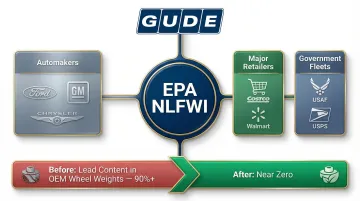
Recognizing the environmental and health risks of lead, the EPA launched the National Lead-Free Wheel Weight Initiative as a voluntary partnership program. Charter members included major automakers (Ford, General Motors, Chrysler), large retailers (Costco, Walmart Tire and Lube Express), and government fleet operators (U.S. Air Force, U.S. Postal Service). The program worked. By the time the EPA issued its 2024 decision, lead content in new vehicle wheel weights had dropped from over 90% to near-trace amounts.
Why Lead Wheel Weights Are a Concern
The contamination pathway is straightforward. Approximately 1.6 million pounds of lead are lost annually in the United States when wheel weights fall off vehicles — dislodged by potholes, curbs, or vibration. Traffic then grinds detached weights into fine dust that settles into roadside soil and indoor dust near high-traffic areas.
Children face the greatest risk. The CDC confirms there is no safe blood lead level in children, and normal hand-to-mouth behavior means contaminated soil and dust translate directly into exposure. Even low-level exposure is linked to:
- Neurological damage and developmental delays
- Decreased IQ scores
- Attention-related behavioral problems
These effects are irreversible, which is why roadside lead contamination remains a persistent pediatric health concern.
The 2009 Citizen Petition
On May 29, 2009, environmental and health advocacy groups — including the Ecology Center and Sierra Club — petitioned the EPA under Section 21 of the Toxic Substances Control Act to formally ban lead wheel weights. The EPA granted the petition on August 26, 2009, committing to commence rulemaking. That rulemaking process took 15 years to resolve. The December 2024 decision ultimately declined to issue a mandatory federal ban, leaving enforcement to state-level regulations and existing voluntary industry commitments.
EPA's December 2024 Decision: What It Means for the Industry
What the EPA Actually Decided
After publishing an Advance Notice of Proposed Rulemaking (ANPRM) in April 2024 and receiving over 21,000 public comments, the EPA officially decided on December 23, 2024 not to proceed with a federal rule banning or restricting lead wheel weights under TSCA Section 6(a).
The EPA's Reasoning: Low Estimated Risk
The agency's technical analysis found that lead wheel weights contribute an "extremely small fraction" to residential soil and dust lead concentrations relative to other background sources. According to the EPA's published assessment, the estimated IQ impact on children from wheel weight exposure specifically was very small compared to baseline lead exposure from legacy sources like old paint, contaminated soil, and aging infrastructure. The EPA calculated that dust from lead wheel weights led to less than a 1% increase in blood lead levels for children in near-roadway scenarios.
This low-risk finding was reinforced by voluntary industry action. The Alliance for Automotive Innovation confirmed through a member survey that none of their OEMs use lead wheel weights on new vehicles manufactured or distributed to U.S. dealerships—meaning the primary source of new lead wheel weights had already been eliminated before any federal rule was needed.
What This Decision Does NOT Mean
The EPA's decision is not a green light for lead wheel weights. It simply means no new federal ban was added at this time. Critical realities remain:
- State bans remain fully in force across nine jurisdictions
- Automakers continue using lead-free weights, with OEM compliance requirements unchanged
- Lead and lead compounds remain on EPA's TSCA candidate chemicals list for future prioritization and a comprehensive risk evaluation
The EPA explicitly noted that a broader federal action on lead—covering wheel weights as part of a more comprehensive assessment—remains a future possibility.
Canada's 2024 Action
While the U.S. paused federal action, Canada moved forward. In February 2024, Canada issued the Prohibition of the Manufacture and Importation of Wheel Weights Containing Lead Regulations, banning wheel weights containing more than 0.1% lead by weight. This prohibition shows the global regulatory direction even as U.S. federal action stalled.
State-Level Lead Wheel Weight Bans: Where Things Stand
Current State Ban Landscape
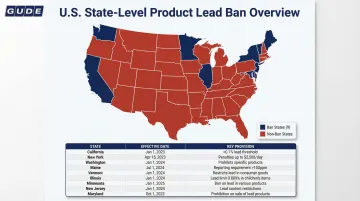
As of 2024, nine U.S. states have enacted bans on the sale, distribution, and/or use of lead wheel weights:
| State | Effective Date | Key Provisions |
|---|---|---|
| California | January 1, 2010 | Prohibits manufacture, sale, or installation of weights with >0.1% lead; penalties up to $2,500 per day per violation |
| Washington | January 1, 2011 | Requires replacement with environmentally preferred weights |
| Maine | January 1, 2011 | Bans use and sale of weights with intentionally added lead or mercury |
| New York | April 1, 2011 | Prohibits use and sale of weights containing >0.1% lead |
| Vermont | September 1, 2011 | Bans sale of new motor vehicles with lead wheel weights |
| Illinois | January 1, 2012 | Prohibits use and sale of weights with >0.1% lead |
| Minnesota | January 1, 2016 | Prohibits use and sale; explicitly requires recycling of removed lead weights |
| New Jersey | January 2018 | Prohibits installation and sale of weights with intentionally added lead |
| Maryland | January 1, 2020 | Prohibits use and sale of externally attached weights with >0.1% lead |
What the Bans Require
California's law (Health & Safety Code 25215.6) established the benchmark other states largely followed. It defines lead wheel weights as any weight containing more than 0.1% lead by weight and imposes penalties up to $2,500 per day, per violation.
The bans cover both new vehicle sales and wheel balancing on older vehicles. Shops in ban states cannot install lead weights during service, even on vehicles originally equipped with them.
The Practical Industry Response
Complying with nine different state laws — plus Canadian requirements — across an interstate supply chain is impractical to manage weight-by-weight. Most OEMs serving the U.S. market responded by switching entirely to lead-free weights across all production. That standardization has effectively made the OEM supply chain lead-free, regardless of federal inaction.
Lead-Free Wheel Weight Alternatives: What Are Your Options?
Overview of Lead-Free Materials
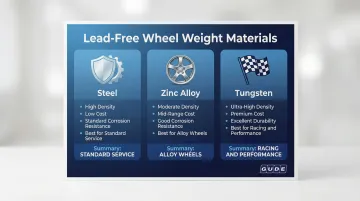
Three primary alternatives have replaced lead in wheel balancing applications:
Steel (Most Widely Adopted):
- High density among cost-effective alternatives
- Becoming the industry standard
- Preferred for low toxicity and reasonable manufacturing impacts
- Coated versions offer excellent corrosion resistance
Zinc Alloy:
- Less dense than lead or steel, resulting in larger physical sizes
- Used by OEMs for alloy wheels to provide a contoured appearance
- Good balance of performance and environmental compliance
Tungsten:
- Extreme density (16.85 to 18.85 g/cm³)
- Niche applications requiring maximum weight in minimal space
- Primarily used in racing and specialized high-performance applications
Performance Considerations for Shops
Adhesive/stick-on weights require thorough surface preparation before installation. Follow these steps to prevent detachment:
- Remove all grease, oil, dirt, and brake dust from the mounting surface
- Peel the protective liner immediately before placing the weight
- Avoid touching the adhesive surface—skin oils reduce adhesion performance
Coated steel weights often offer longer service life than traditional lead weights due to superior corrosion resistance. However, proper weight selection by wheel type (clip-on for flanged steel rims, adhesive for flangeless alloy wheels) remains critical for performance and safety.
Regulatory Compliance Advantage of Going Lead-Free Now
Shops that switch to lead-free alternatives now gain several concrete advantages:
- Avoid compliance risk in the nine ban states
- Prepare for any future expansion of state or federal rules
- Align with OEM standards and customer expectations
- Eliminate occupational exposure risks for technicians
Sourcing from a Reliable Supplier
Quality and consistency matter when sourcing lead-free wheel weights. GUDE Corp manufactures lead-free steel clip-on and adhesive weights across three ISO9001-certified facilities in Asia, with production capacity built to support both high-volume OEM programs and aftermarket distribution.
The company operates under the TOHO Group—the #1 wheel weight manufacturer in Japan and #3 worldwide—giving automotive businesses a supply chain partner with proven global manufacturing scale and regulatory compliance built in.
What Automotive Businesses Should Do Now
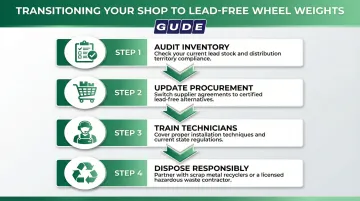
Audit Current Inventory and Practices
Shops and distributors should immediately:
- Review whether they currently stock or install lead wheel weights
- Identify specific vehicle types and applications involved
- Assess exposure to state-level regulatory risk based on operating locations and distribution territories
- Determine if any inventory crosses state lines into ban jurisdictions
Train Technicians and Update Procurement
Ensure shop staff understand:
- The regulatory landscape (state bans, EPA status, future risks)
- Proper installation techniques for lead-free weights, especially surface preparation for adhesive applications
- Weight selection by wheel type and vehicle application
Update supplier agreements to transition purchasing to compliant lead-free alternatives. Suppliers like GUDE Corp carry a full range of steel clip-on and adhesive weights across OEM and aftermarket applications—a practical starting point when transitioning away from lead inventory.
Handle Existing Lead Wheel Weight Stock Responsibly
Removed lead wheel weights must be treated as hazardous waste or recycled as scrap metal. Under RCRA (Resource Conservation and Recovery Act), discarded lead wheel weights exhibit the toxicity characteristic for lead (D008) if their extract contains lead at concentrations of 5.0 mg/L or greater.
That said, excluded scrap metal being recycled is exempt from hazardous waste regulation at the point of generation. Practical disposal options include:
- Using existing hazardous waste contractors (the same vendors handling used oil, antifreeze, and brake pads)
- Enrolling in manufacturer or distributor take-back programs, which maintain exempt status through verified recycling channels
- Confirming scrap metal recyclers accept lead wheel weights before drop-off
Frequently Asked Questions
Are lead weights illegal?
Lead wheel weights are not banned at the federal level in the U.S. as of the EPA's December 2024 decision. However, nine states have enacted their own bans, and Canada prohibited them in 2024, so legality depends entirely on where you operate or distribute products.
Why do some technicians say that lead wheel weights have been outlawed in some states?
States like California banned the sale, manufacture, and installation of lead wheel weights effective January 1, 2010—years before any federal action. Technicians in those states or who received training citing those state laws correctly understand that lead wheel weights are illegal in their jurisdictions.
Do they still use lead for wheel weights?
Virtually all major OEMs have eliminated lead wheel weights on new vehicles. However, lead wheel weights may still appear in the aftermarket—particularly imported products—and remain in use on older vehicles being serviced in states without bans.
How to dispose of lead wheel weights?
Removed lead wheel weights can be recycled as scrap metal—typically exempt from hazardous waste regulation—or handled as hazardous waste through a licensed contractor. Contact your waste hauler or check for manufacturer take-back programs in your area.
What are lead-free wheel weights made of?
Lead-free wheel weights are made from three main materials:
- Steel — most common and cost-effective for standard applications
- Zinc alloy — suited for contoured alloy wheel profiles
- Tungsten — used in high-performance and racing applications requiring extreme density
What are the three types of wheel weights?
The three types by attachment method are:
- Clip-on weights — attach to the wheel rim flange
- Adhesive/stick-on weights — applied to the inner barrel using a pressure-sensitive tape backing
- Tape weights — sold in rolls for custom-cut application on low-profile and alloy wheels