
Introduction
When your steering wheel vibrates or your tires show uneven wear, the diagnosis isn't always obvious. Many drivers face the same confusion: do I need wheel balancing, wheel alignment, or both? And if I fix one, will it solve the other?
Here's the short answer: wheel balancing does not directly affect tire alignment. These are two distinct services — one corrects weight distribution around your wheels, the other adjusts suspension angles. Overlapping symptoms — vibration, uneven tire wear — make them easy to mix up.
This guide breaks down exactly what each service does, how they interact, and how to tell which one your vehicle actually needs.
TLDR
- Wheel balancing corrects uneven weight distribution in the tire-wheel assembly; alignment adjusts the suspension angles that control how tires meet the road
- Balancing does not cause or fix misalignment—they're independent services for different systems
- Both produce similar symptoms (vibration, uneven wear), causing frequent misdiagnosis
- Long-term imbalance can stress suspension components, which may contribute to alignment drift over time
- Each service follows its own maintenance schedule—don't substitute one for the other
What Are Wheel Balancing and Wheel Alignment?
What Is Wheel Balancing?
Wheel balancing corrects uneven weight distribution around the wheel and tire assembly. Even a weight difference of just 14 grams creates approximately 7 kg of centrifugal force at highway speeds, causing noticeable vibration because your wheels spin hundreds of times per minute.
The balancing process works like this:
- A technician mounts the wheel-tire assembly on a calibrated balancing machine
- The machine spins the assembly and detects weight imbalances
- Small wheel weights are attached at precise rim locations to counteract heavy spots
Common causes of imbalance:
- Normal tread wear changing weight distribution
- Losing a wheel weight after hitting a curb or pothole
- Manufacturing imperfections in tire rubber
- Flat spots from extended parking periods
Balancing must be redone whenever tires are rotated, replaced, or after significant road impacts — it's a maintenance item, not a one-time fix.
What Is Wheel Alignment?
Wheel alignment adjusts your vehicle's suspension system—the components connecting wheels to the vehicle—not the tires or wheels themselves. Where balancing deals with weight distribution, alignment deals with geometric angles that determine how tires meet the road.
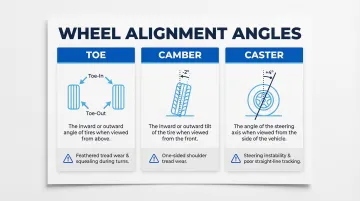
The three alignment angles technicians check and adjust:
| Angle | Definition | Impact When Incorrect |
|---|---|---|
| Toe | Angle of tires pointing inward or outward (viewed from above) | Feathered tire wear, squealing in turns |
| Camber | Tilt of tire inward or outward (viewed from front) | One-sided shoulder wear |
| Caster | Angle of steering axis (viewed from side) | Steering instability, poor self-centering |
Both services address different failure modes — but as the next section shows, neglecting either one produces symptoms that can look deceptively similar.
Does Wheel Balancing Affect Tire Alignment?
No—wheel balancing does not directly affect tire alignment. The two services address entirely separate vehicle systems. Balancing corrects weight distribution within the wheel assembly; alignment adjusts suspension geometry.
Why the Confusion Is So Common
Both conditions produce overlapping symptoms—vibrations, uneven tire wear, and handling issues—making self-diagnosis difficult. When you feel vibration or notice unusual wear, the root cause could be either problem, or both simultaneously.
The Indirect Connection
While balancing cannot cause misalignment, severely unbalanced tires left unaddressed create persistent vibration and abnormal forces on wheel bearings and suspension components. This chronic stress accelerates wear on alignment-critical components, eventually contributing to alignment drift over time:
- Tie rods — connect the steering rack to the wheel hub; wear causes looseness and pull
- Ball joints — allow suspension pivoting; degraded joints shift camber and caster angles
- Control arm bushings — absorb road shock; worn bushings let the suspension shift under load
- Wheel bearings — support wheel rotation; excessive vibration accelerates bearing fatigue
The Pothole Scenario
If a wheel weight falls off after hitting a pothole, it will cause imbalance (vibration) but won't directly shift suspension angles. However, hitting that same pothole hard enough can at the same time knock the suspension out of alignment. Both problems may appear together from a single road event—and in 2021, pothole damage cost U.S. drivers $26.5 billion—even though they remain independent issues.
Because symptoms overlap, when you notice vibration, pulling, or unusual tire wear, have a technician check both wheel balance and alignment before settling on one diagnosis.
Balancing vs. Alignment: How to Tell Which One Your Car Needs
Key Symptoms of Wheel Imbalance
Primary indicator: Noticeable vibration—especially in the steering wheel or seat—that appears or intensifies at certain speeds (typically above 40–50 mph).
Location clues:
- Steering wheel vibration → front tire imbalance
- Seat or floorboard vibration → rear tire imbalance
Additional symptoms:
- Rhythmic humming, growling, or thumping noise increasing with speed
- Cupped or scalloped tire wear—random scooped-out divots around the tread edge
Key Symptoms of Misalignment
Primary indicators:
- Car consistently pulls or drifts to one side without driver input
- Steering wheel sits off-center when driving straight
- Tires squeal during normal turns
Tire wear patterns:
- Feathered wear—tread blocks smooth on one side, sharp on the other (indicates incorrect toe)
- One-sided shoulder wear—excessive wear on inner or outer edge only (indicates incorrect camber)
The Shared Symptom That Complicates Diagnosis
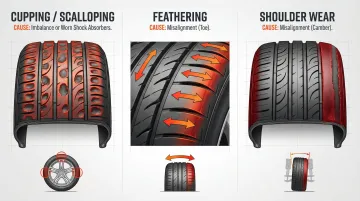
Uneven or accelerated tire wear can result from both imbalance and misalignment, but the patterns differ:
| Wear Type | Pattern | Primary Cause |
|---|---|---|
| Cupping/Scalloping | Random scooped divots (3-4 inches wide) | Imbalance or worn shocks |
| Feathering | Smooth one side, sharp the other | Misalignment (toe) |
| Shoulder wear | Inner or outer edge only | Misalignment (camber) |
Since symptoms overlap and both conditions can occur at the same time, a technician with balancing and alignment equipment can pinpoint the true cause—and fix both in a single visit rather than guessing which service to skip.
How Often Should You Get Each Service Done?
Wheel Balancing Frequency
Most shops recommend balancing every 3,000 to 6,000 miles — roughly in line with tire rotation intervals of 5,000 to 7,500 miles.
Beyond mileage, get balancing done immediately after:
- Installing new tires
- Repairing or patching a flat tire
- Hitting a significant pothole or curb
- Noticing vibration at highway speeds
Combining balancing with a scheduled tire rotation saves time — both services together typically take 15–45 minutes versus two separate visits.
Wheel Alignment Frequency
Alignment checks are generally recommended every 6,000 to 12,000 miles, or once to twice per year.
Schedule an immediate alignment check after:
- Pothole impact, curb strike, or minor collision
- Replacing any steering or suspension component
- Vehicle pulling to one side
- Off-center steering wheel
Manufacturer recommendations vary. Toyota advises alignment checks every 6,000 to 8,000 miles, while Chevrolet recommends four-wheel alignment every 7,500 miles — so check your owner's manual for model-specific guidance.
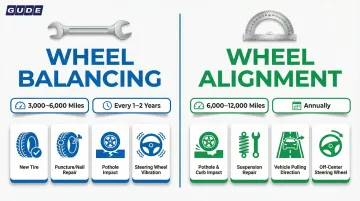
| Service | Mileage Interval | Time Interval | Trigger Events |
|---|---|---|---|
| Wheel Balancing | 3,000-6,000 miles | 1-2 years | New tires, puncture repair, pothole impact |
| Wheel Alignment | 6,000-12,000 miles | Annually | Pothole/curb impact, suspension repair, vehicle pull |
What Happens If You Ignore These Issues?
Consequences of Ignoring Wheel Imbalance
Neglecting unbalanced wheels leads to:
- Uneven tread wear that shortens tire lifespan
- Heat buildup from constant vibration that weakens tire structure
- Wheel bearing strain that leads to premature failure
- Suspension wear — shocks, struts, and control arm bushings all take a hit
All of these repairs cost far more than a simple $15–30 balancing service. Misalignment carries its own set of compounding costs.
Consequences of Ignoring Misalignment
Driving with misaligned wheels causes:
- Tire life cut by thousands of miles from uneven tread contact
- Higher fuel consumption from increased rolling resistance
- Handling and directional control issues that create real safety hazards
- Accelerated wear on steering and suspension components from abnormal load forces
Fix Both — Not Just One
Both issues are cheap to fix early but compound into costly repairs if neglected. Since they share symptoms, address both at the first sign of trouble.
Frequently Asked Questions
Does balancing tires mess up alignment?
No, balancing tires does not mess up alignment. The two are independent processes affecting different vehicle systems—balancing adjusts weight distribution around the wheel assembly, while alignment adjusts suspension geometry.
How many wheel balancing weights are too many?
There's no strict limit, but an unusually high number of weights (typically more than 3-4 ounces total per wheel) may indicate the tire or rim is damaged or severely worn. In such cases, the wheel assembly may need replacement rather than continued balancing attempts.
Can bad wheel alignment cause tires to become unbalanced?
Misalignment does not directly cause a tire to become unbalanced. However, misalignment causes uneven tread wear that over time changes weight distribution around the tire, which may eventually require rebalancing.
Can you drive with unbalanced tires?
While a vehicle can still move with unbalanced tires, doing so accelerates tire wear, strains wheel bearings and suspension components, and creates unsafe vibrations that affect handling. Get the wheels balanced promptly to avoid these compounding issues.
Should you get wheel balancing and alignment done at the same time?
Yes, combining both services during a tire rotation is efficient and recommended, especially when symptoms are ambiguous. Most shops complete both in 60-90 minutes total.