
Introduction
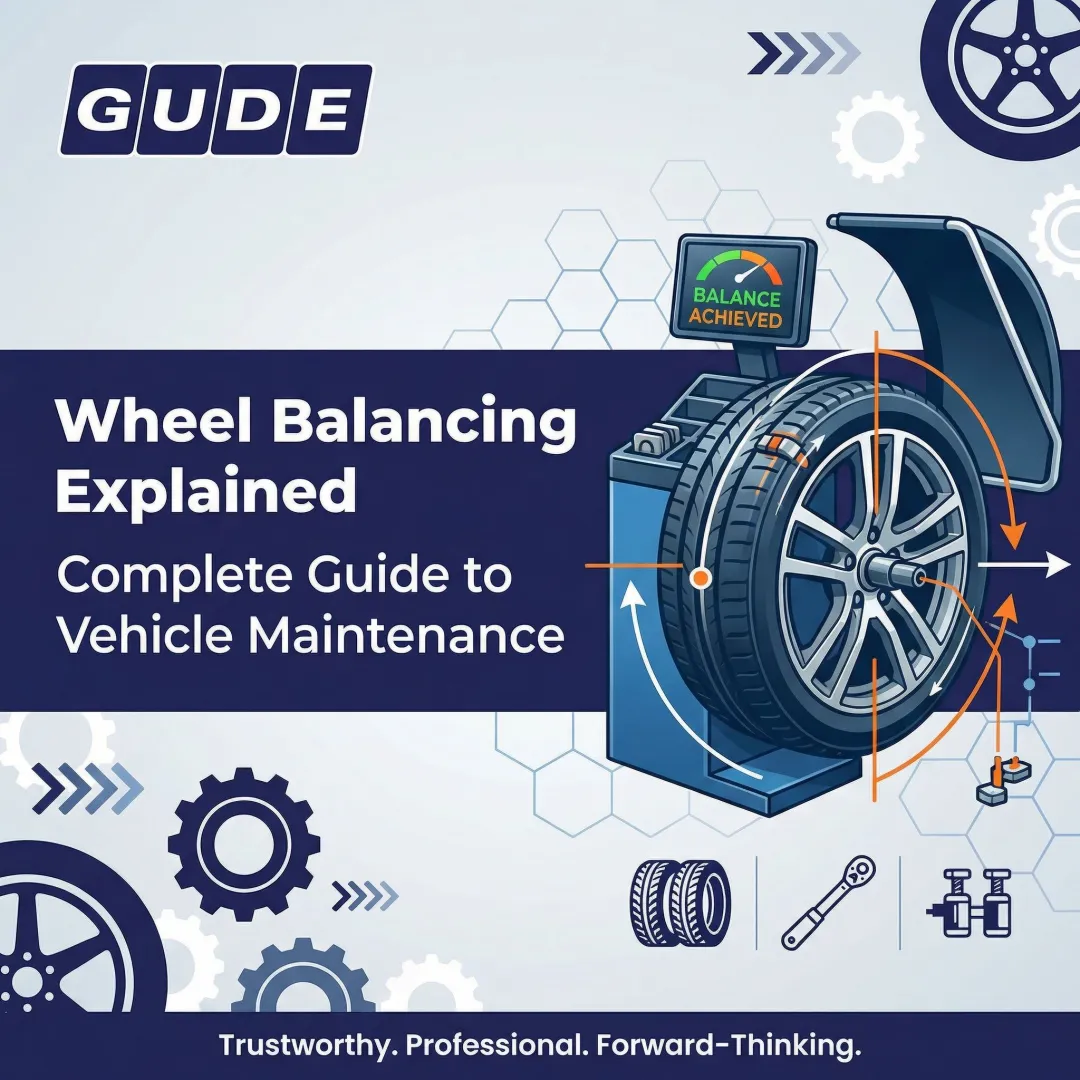
BMW vehicles are built to tight engineering tolerances, and wheel balance is part of that equation. Even a few grams of uneven weight across a wheel-tire assembly creates vibration, premature tire wear, and compromised handling.
Wheel balance weights are small counterweights attached to rims to correct these imperfections. This guide covers:
- Weight types suited to BMW applications
- Materials that meet current environmental regulations
- BMW-specific factors including TPMS integration and wheel styles
- Warning signs that rebalancing is overdue
TLDR
- Wheel balance weights correct uneven weight distribution in BMW wheel-tire assemblies, preventing vibration and premature tire wear
- Two styles dominate BMW applications: clip-on weights for steel and standard alloy rims, and stick-on weights that stay hidden on premium alloys
- BMW's integrated TPMS sensors add 24g to 45g near the valve stem, requiring extra corrective weight
- Lead-free materials (steel, zinc, coated alloys) have replaced lead due to environmental regulations and perform equivalently
- Schedule a rebalance after road impacts, when steering vibration appears at highway speeds, or when tire wear looks uneven
Why Wheel Balance Weights Matter for Your BMW
Even premium BMW wheels and tires have minor manufacturing imperfections that create uneven weight distribution. At speed, centrifugal force amplifies these small differences into noticeable oscillations — the heavy spot pulls the assembly off-axis with each revolution, causing the wheel to bounce at its own rotational frequency.
Performance consequences specific to BMW ownership include:
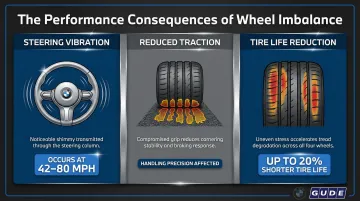
- Steering wheel vibration between 42–55 mph, per BMW Service Information Bulletin 36 01 13; F-chassis models can experience it across a broader 37–80 mph range
- Reduced traction from inconsistent road contact, undermining the precise handling BMW engineers designed for
- Up to 20% shorter tire life from accelerated wear caused by unbalanced rotation
These consequences can also appear on tires with no visible wear. Road impacts or improper installation can knock balance weights off at any point in a tire's life, creating sudden imbalance on an otherwise healthy tire. An estimated 1.6 million pounds of wheel weights fall off annually during normal driving conditions.
Rebalancing should happen beyond new tire installation. Normal tread wear shifts weight distribution over time, so BMW tires benefit from rebalancing checks every 6,000 miles or at each tire rotation.
Types of BMW Wheel Balance Weights
Clip-On (Clamp) Weights
Clip-on weights attach to the inner or outer edge of a steel or alloy wheel rim's flange. They're the traditional standard, typically used on steel wheels and older BMW alloy designs where the rim lip accommodates the clamp mechanism.
On BMW's stylized alloy wheels — especially M-series and newer designs with narrow flanges — clip-on weights on the outer edge may be cosmetically unacceptable or structurally incompatible. Technicians often place them on the inner rim flange only to preserve appearance.
Stick-On (Adhesive) Weights
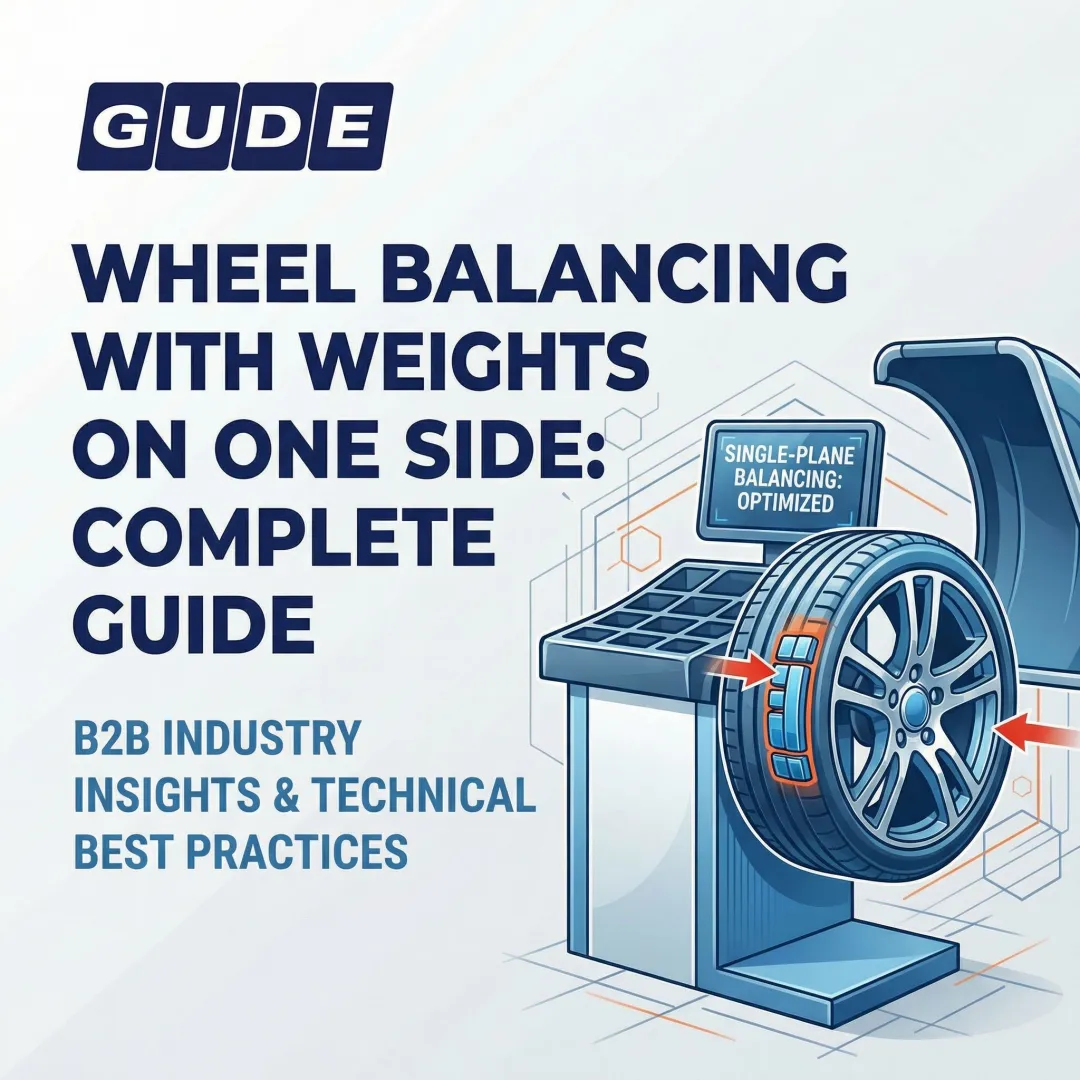
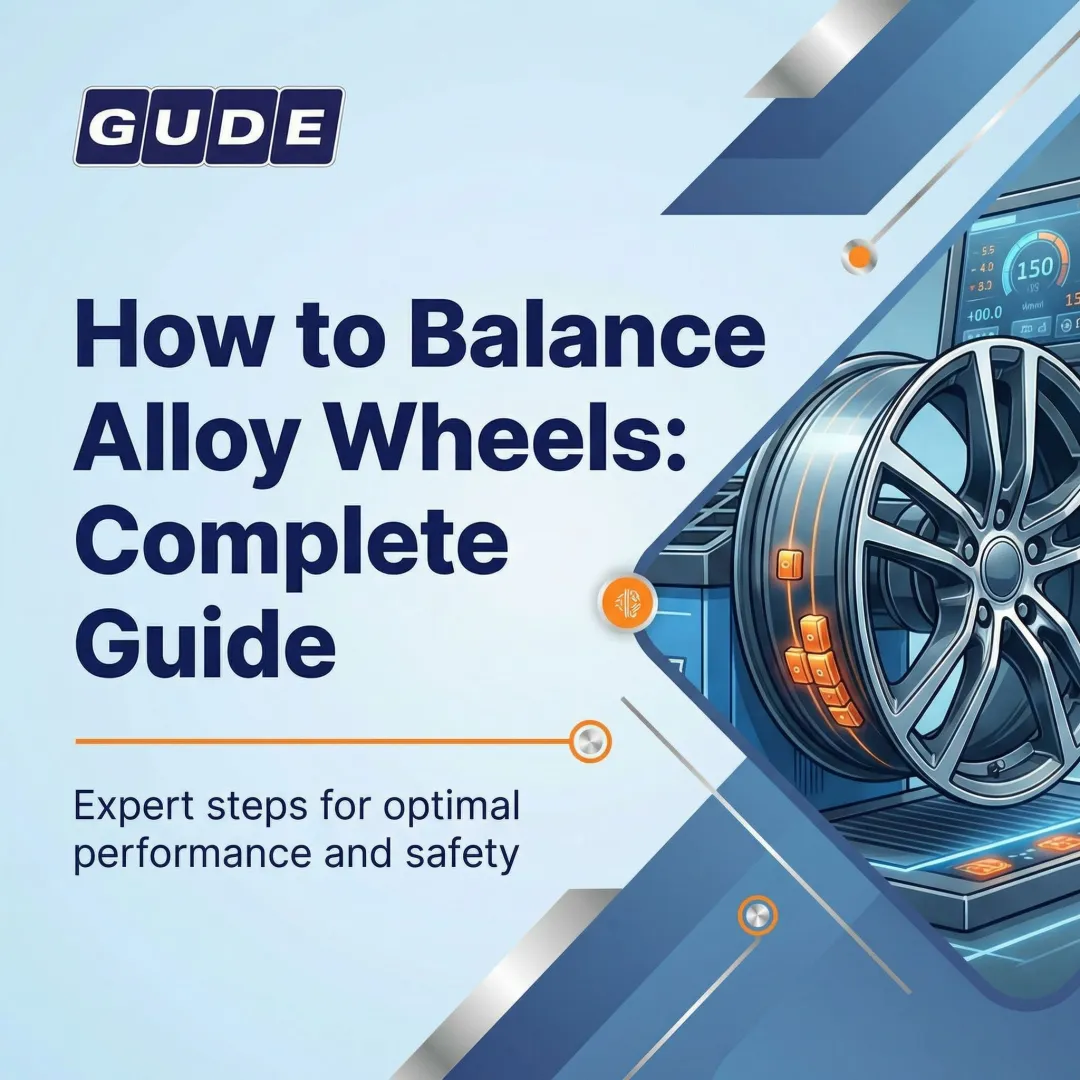
Adhesive-backed stick-on weights adhere to the inner flat surface of the rim barrel, making them invisible from outside. They're ideal for BMW's premium alloy and multi-spoke wheels where appearance matters.
Surface preparation is critical. Residue from old weights or road contamination will cause premature detachment. For alloy surfaces, use ISO 9001-certified lead-free weights — GUDE Corp's AW and IAW series are built specifically for alloy rim profiles, with corrosion-resistant coatings suited to BMW fitments.
Spoke Weights (for BMW Motorcycle / ADV / Dual-Sport)
For BMW motorcycles and ADV bikes with wire-spoked wheels (such as the R 1250 GS), rim flanges are too narrow for standard stick-on weights. Spoke-mounted weights that clamp onto individual spokes with M4 set screws torqued to 2 Nm are the correct solution.
These are more secure than simple crimp-on types, especially under off-road stress. BMW Motorrad Service Information SI 36 001 18 (2018) specifies maximum corrective weight of 80g per wheel.
BMW-Specific Wheel Balancing Considerations
TPMS and the Valve Stem Weight Challenge
Many BMW vehicles use an OEM TPMS unit integrated with the valve stem, adding substantial mass at that single point on the wheel. BMW TPMS sensors range from 24g to 45g depending on type — creating an intentional heavy spot that technicians must account for.
Aligning the tire's light spot (marked by the factory paint dot on the sidewall) with the valve/TPMS helps minimize total corrective weight needed. Bridgestone technical documentation confirms that best initial balance is obtained by matching the tire's yellow dot at the valve stem.
Despite this alignment strategy, BMW TPMS-equipped wheels typically require significantly more total balance weight than non-TPMS wheels — that's expected behavior, not a sign of a problem.
Wheel Construction: Cast, Forged, and Alloy
BMW uses several wheel constructions across its lineup, and each affects how and where balance weights should be applied:
- Standard cast alloy — most production models (95% of BMW Group's 10 million annual wheels)
- Forged alloy — M-series performance models (M3, M4 summer wheels)
- Wire-spoke — motorcycles and ADV models
Forged wheels are lighter and stiffer but still require balancing. Their tighter manufacturing tolerances typically mean less initial imbalance, though balancing is still required.
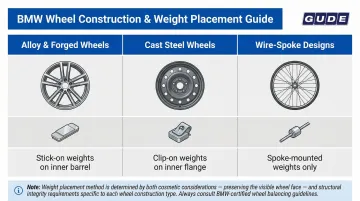
Weight placement follows the wheel type:
- Alloy and forged wheels take stick-on weights on the inner barrel — both for cosmetic reasons and to avoid stressing the flange
- Cast steel wheels can accept clip-on weights on the inner flange
- Wire-spoke designs require spoke-mounted weights specifically
Splitting Weights for Precision
When a correction calls for a single large weight, splitting it across two positions reduces stress on any one spot. For example:
- Single placement: 2 oz at 12 o'clock
- Split placement: 1 oz at 11 o'clock + 1 oz at 1 o'clock
This avoids creating secondary imbalance points and is especially important on BMW M-series wheels, where dynamic balance at high speeds is critical.
Lead-Free vs. Traditional Wheel Weight Materials
Lead was the historical standard for wheel weights due to its high density and easy trimming. Environmental regulations across North America and Europe have phased it out — the EU ELV Directive 2011/37/EU and multiple U.S. state laws (California, Washington, Maine, Vermont) strictly prohibit lead wheel weights.
Shops and manufacturers have transitioned to steel, zinc, and coated alloy alternatives.
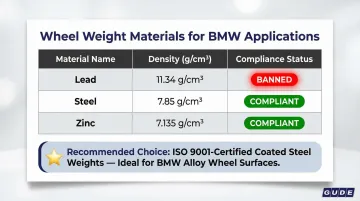
Material comparison:
| Material | Density (g/cm³) | Status |
|---|---|---|
| Lead (Pb) | 11.34 | Banned in EU and multiple US states |
| Steel (Fe) | 7.85 | Compliant alternative |
| Zinc (Zn) | 7.135 | Compliant alternative |
Steel and zinc weights require slightly more volume than lead to achieve the same mass, but modern manufacturing precision compensates for this. For shops supplying BMW service, sourcing from manufacturers with tight production tolerances matters. GUDE Corp's lead-free steel weights are produced in ISO 9001-certified facilities by Toho Kogyo — the #1 wheel weight manufacturer in Japan — and meet OEM-grade balancing performance while staying fully compliant.
For BMW alloy wheels specifically, coating selection is not optional. Uncoated steel weights corrode against premium alloy surfaces, leaving stains that are difficult to remove. Weights with zinc-plated or black-coated finishes are the correct choice for BMW applications.
Signs Your BMW Needs Wheel Weight Attention
The most common symptom is a rhythmic vibration felt through the steering wheel, floorboard, or seat that intensifies at specific speed ranges (typically highway speeds). This is the wheel's rotation frequency amplifying the heavy spot's effect. It may disappear at other speeds, which makes it easy to dismiss — but not safe to ignore.
Visible signs include:
- Uneven or cupped tire wear — scalloped tread edges indicate the tire is bouncing rather than rolling smoothly
- Missing wheel weight — adhesive residue or an empty clip groove on the rim signals rebalancing is needed, even before symptoms appear
When to proactively check balance:
- After any tire rotation or replacement
- Following a significant road impact (pothole, curb strike)
- At routine service intervals (every 6,000 miles/10,000 km)
Catching imbalance early — before vibration becomes noticeable — protects tire life and keeps BMW service callbacks to a minimum.
Frequently Asked Questions
Do you need wheel balancing weights?
Yes, virtually all wheel-tire assemblies require some corrective weight because manufacturing tolerances in both wheels and tires create unavoidable minor weight imbalances. The only exception is wheels specifically designed for off-road-only use at low speeds.
What happens if you don't balance your rims?
You'll experience steering vibration and ride discomfort first. Over time, expect accelerated and uneven tire wear, reduced traction, and increased stress on suspension components and wheel bearings.
What's better, balancing beads or weights?
Balancing beads — poured inside the tire and designed to continuously self-adjust — suit trucks, off-road, and some motorcycle applications. For passenger cars and BMW vehicles, traditional external weights are the industry standard because they allow precise, fixed correction as determined by a balancing machine.
How often should BMW wheel weights be checked or replaced?
Weights should be inspected at every tire rotation and replacement, after any significant road impact, and at least once annually. Any lost weight should be replaced promptly.
Are lead-free wheel weights as effective as lead weights for BMW vehicles?
Yes, modern lead-free weights (steel, coated alloys) perform equivalently to lead for balancing purposes. Weights from ISO 9001-certified facilities meet or exceed OEM specifications for BMW applications while complying with environmental regulations.
Can wheel weights fall off a BMW rim?
Yes. Adhesive weights can detach if surfaces are not properly cleaned before installation or if low-quality adhesive is used. Clip-on weights can be dislodged by road debris or improper installation. Both scenarios require immediate rebalancing to restore proper wheel balance and prevent tire damage.