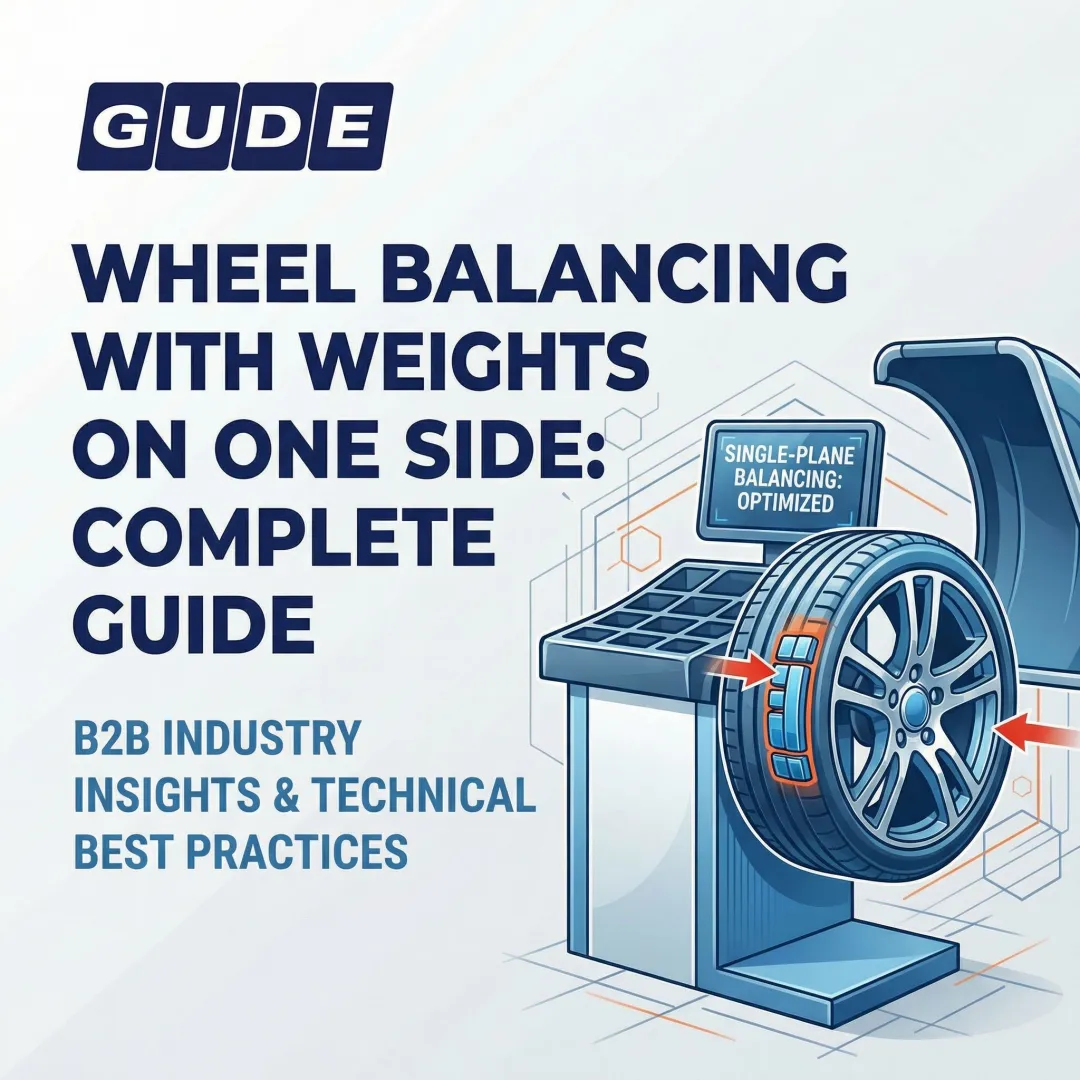

There are two main categories of wheel weights: clip-on (hammer-on) weights that grip the rim flange through spring tension, and adhesive (stick-on) weights that bond to the inner rim surface. Each type has a completely different failure mechanism when removed and reinstalled, making the reuse question far more nuanced than it appears at first glance.
This guide covers the technical reasons why reuse is discouraged by industry professionals, the specific risks when weights fail or come loose, what proper replacement practice looks like, and how to identify when weights must be replaced regardless of their appearance.
TLDR
- Clip-on weights lose clamping force permanently when removed — the metal clip deforms and cannot return to its original shape
- Once peeled off, adhesive weights lose their bonding integrity — reattaching without fresh adhesive is unreliable
- Failed weights cause steering vibration, uneven tire wear, and can detach at speed as road hazard projectiles
- Industry-standard recommendation: always install fresh weights matched to the wheel application
- New weight cost is negligible compared to rework labor, rim damage, or liability exposure
Why Clip-On Wheel Weights Should Never Be Reused
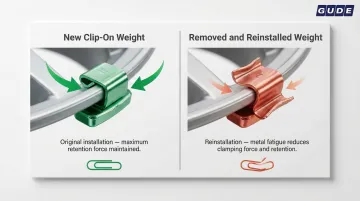
The core mechanical reason is straightforward: a clip-on weight stays on the rim flange through the spring tension of its metal clip. When you remove that weight, the clip is physically spread open. Like any spring stretched beyond its elastic limit, it cannot return to its original clamping shape. Think of it like a paperclip you've bent open. Even if you bend it back, it never quite grips the same way again.
Clip Retention Loss in Practice
"Clip retention loss" means the clip that once gripped the rim flange firmly now has reduced clamping force. The weight may appear to snap back on and look secure, but it's sitting more loosely than it was originally — even when no visible damage is present. Industry technicians explicitly state that reusing clip-on weights "should never be done due to clip retention loss" and warn that the weight "may fail during normal use, becoming a hazard to drivers behind you."
Why Crimping Doesn't Fix the Problem
Some technicians try to work around this by tightening or crimping the clip after reinstallation. This approach actually makes things worse: you're adding stress to already-fatigued metal and accelerating work-hardening. The clip can crack or snap off entirely under the cyclical stress of driving. The metal is already compromised; additional manipulation just hastens failure.
Some shops assume a different weight material sidesteps this issue. It doesn't.
Material Differences Don't Eliminate Risk
The degree of deformation varies slightly by weight material. Steel clips tend to retain marginally more shape than zinc or softer alloys, but no material is immune to retention force loss once opened. Weights manufactured to precise tolerances for OEM fitment — such as those built to Toyota or other manufacturer specifications — are especially unforgiving of reuse because they're engineered for exact fit on specific rim profiles.
Can Adhesive Wheel Weights Be Reused?
Adhesive weights bond to the clean, flat inner rim surface via a pressure-sensitive adhesive strip. That bond is engineered to withstand heat cycles, centrifugal force, and vibration, but only when applied correctly to a properly prepared surface the first time.
What Happens to the Adhesive Layer
When you remove a stick-on weight, the adhesive stretches, deforms, and loses significant tack. Residue is left on both the rim and the weight itself. Even if the weight body is undamaged, the adhesive is no longer factory-fresh and cannot be expected to hold the same way. Adhesive wheel weights are strictly single-use; once removed, the adhesive bond is destroyed and cannot be reapplied safely.
When Reuse Is Technically Possible (and Why It's Still Not Recommended)
Some sources suggest adhesive weights "can" be reused if they're undamaged, cleaned thoroughly, and re-adhered with fresh automotive-grade adhesive tape. While this is technically possible in emergency or low-stakes scenarios, professional wheel balancing services should always use new weights. The original adhesive integrity cannot be guaranteed, and a weight loss at highway speed can cause dangerous vibration or loss of vehicle control.
Why Surface Prep Makes Quick Reuse Impractical
Improper reinstallation — especially without fully cleaning old adhesive residue from the rim first — introduces microscopic gaps that allow moisture intrusion. This leads to corrosion on alloy wheels and eventual weight loss. The rim surface must be degreased and prepped before any adhesive weight application, making "quick" reuse counterproductive from both a time and reliability standpoint.
Proper adhesive application requires:
- Cleaning with isopropyl alcohol or specialized prep solution
- Complete removal of grease, dust, silicone, brake dust, and old residue
- Surface and weight temperatures between 15°C to 43°C (60°F to 110°F)
- Minimum application pressure of 100 kPa applied from center to outer ends
The Real Risks of Reusing Wheel Weights
The Domino Effect of Wheel Imbalance
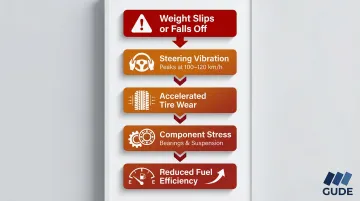
When a weight slips or falls off, the wheel assembly goes out of balance. The consequences cascade:
- Vibration: Vibration amplitude increases with speed, with the highest increase typically occurring on the steering wheel between 100-120 km/h (62-75 mph)
- Accelerated tire wear: Unbalanced assemblies cause abnormal and uneven tread wear due to continuous vibration and irregular road contact
- Component stress: Driving with unbalanced wheels directly accelerates wear on wheel bearings, steering mechanisms, drive components, and suspension systems
- Reduced fuel efficiency: Rolling resistance becomes uneven, increasing fuel consumption
The Road Safety Hazard
At highway speeds, a clip-on weight that comes loose becomes a projectile. A replacement clip-on costs under $1. A weight striking another vehicle's windshield or a cyclist is a genuine liability scenario — and one that connects directly to the business consequences shops face when a job goes wrong.
Business Consequences for Tire Shops
A customer who returns with vibration complaints after recent tire service, or who sustains rim damage from a loose weight, creates a costly comeback. Reusing weights to save pennies can result in:
- Hours of diagnostic and rework labor
- Damaged customer trust and negative reviews
- Potential warranty claims or liability exposure
- Lost repeat business
Signs Your Wheel Weights Need to Be Replaced
Visible Physical Indicators
Replace weights immediately if you observe any of the following:
- Flattening, spreading, or bending of the clip body
- Corrosion — rust on steel weights (especially in salt-belt environments) or white powdery aluminum oxide spreading from the weight body
- Visible cracks in the weight body or at the clip junction
- Adhesive peeling, crystallization, or contamination with brake dust and grime
- Bubbling paint near the rim lip from trapped moisture under the clip
Positional Signs of Failure
- A clip-on weight that has rotated around the rim flange from its original position has already partially failed
- A stick-on weight that has shifted or partially lifted at one edge — replace it, don't reposition it
- Any weight that slides, rocks, or pulls away under gentle hand pressure
Proactive Inspection Schedule
Don't wait for a customer to report vibration. Inspect weights at every tire rotation and balancing service — catching a compromised weight early prevents safety incidents and unnecessary comebacks.
Most manufacturers recommend inspection every 5,000–7,500 miles or whenever a tire is removed from the rim.
Best Practices When Installing New Wheel Weights
Pre-Installation Process
For clip-on weights:
- Confirm the correct clip profile for the rim flange
- Verify rim flange depth: flanges less than 3/16" deep require adhesive weights instead
- Inspect the rim flange for damage, corrosion, or irregularities
For adhesive weights:
- Clean the rim surface with isopropyl alcohol or specialized prep solution
- Remove all old adhesive residue, brake dust, oils, and contaminants
- Ensure both rim and weight are at room temperature (60°F-110°F)
- Apply firm, even pressure from center to edges after placement
Matching Weight Type and Material to Wheel
Choose the right weight for the application:
- Alloy and painted rims require coated weights to prevent galvanic corrosion between dissimilar metals
- Standard steel rims can use uncoated steel weights
- Weight sizing should match your balancer's output exactly — most machines specify in 0.25 oz increments, so stock weights in those same increments
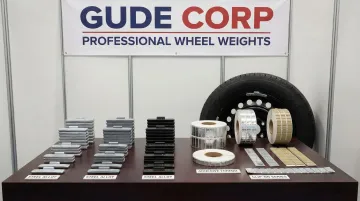
Dimensional consistency matters here. Weights from ISO 9001-certified manufacturers hold tighter tolerances on clip geometry and adhesive backing, which translates to fewer remounts and rebalances. GUDE Corp's lead-free weights — made by Toho Kogyo, the #1 wheel weight manufacturer in Japan — cover six clip-on series (MC, P, T, AW, IAW, FN) and two adhesive formats (rolls and pre-cut strips), giving shops a single-source option across rim types.
Post-Installation and Disposal
- Always verify balance on the machine after weight application
- Send old weights to a local scrap metal recycler
- Steel, zinc, and lead weights are all recyclable; follow local hazardous material guidelines for lead weights
Frequently Asked Questions
Can clip-on wheel weights be reused?
No. Clip-on weights should not be reused because removal permanently deforms the metal clip, reducing its clamping retention. The weight may appear to fit back on, but it is far more likely to slip around the rim flange or detach entirely during driving.
What happens if wheel weights fall off?
A missing wheel weight throws the wheel assembly out of balance, causing steering vibration, uneven tire wear, and increased stress on bearings and suspension components. At speed, the detached weight becomes a road projectile that can damage other vehicles or injure pedestrians and cyclists.
Are clip-on or stick-on wheel weights better?
The correct type depends on the wheel design. Clip-on weights suit steel and traditional alloy rims with adequate flange depth (minimum 3/16"), while adhesive weights are preferred for low-profile or decorative alloy wheels where clips could damage the finish or won't seat properly.
How do I know when wheel weights need to be replaced?
Replace weights whenever removed during tire service, or if you notice visible corrosion, deformation, cracking, a peeling adhesive bond, or a clip-on weight that has rotated from its original position. Inspect at every tire rotation — approximately every 5,000 miles.
Can old wheel weights be recycled?
Yes. Lead-free steel weights go through standard metal recycling streams, while shops handling older lead weights should follow local hazardous material disposal guidelines. Many manufacturers and specialized recyclers offer collection programs for both types.
How often should wheel balancing be done?
Most vehicle manufacturers recommend wheel balancing every 5,000-7,500 miles, at every tire rotation, whenever a vibration is noticed, or any time a tire is removed from the rim — such as after a tire change or flat repair. Regular balancing extends tire life and maintains ride quality.