Introduction
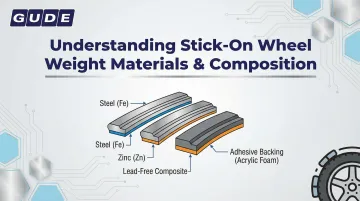
The metal alloy in a stick-on wheel weight—lead, zinc, or steel—directly determines its density, corrosion behavior, regulatory compliance, and how reliably it stays bonded to the rim under real-world conditions. These aren't interchangeable commodity parts. Each material produces different physical sizes for the same gram value, responds differently to environmental stress, and carries distinct legal implications depending on your geography.
This article breaks down each material option—its properties, sizing implications, and adhesive compatibility—so technicians and buyers can make the right selection for both OEM and aftermarket applications.
TL;DR
- Stick-on wheel weights use three metals: lead (highest density), steel (densest lead-free option), and zinc (lower density, larger footprint)
- Lead is banned in nine U.S. states due to environmental contamination and faces increasing international restrictions
- Steel delivers more precise balance accuracy among lead-free alternatives by avoiding oversized weights that shift center of gravity
- Retention depends on adhesive backing chemistry; without proper surface prep, even quality weights fail under heat, vibration, and moisture
- Material selection impacts regulatory compliance, balance precision, rim compatibility, and total service life
What Material Composition Means for Stick-On Wheel Weight Performance
Material composition refers to both the metal alloy of the weight body—lead, zinc alloy, or steel—and the adhesive system bonding it to the rim. These are engineered components, not commodity inputs. Each element plays a distinct role in performance.
How Density Controls Physical Size
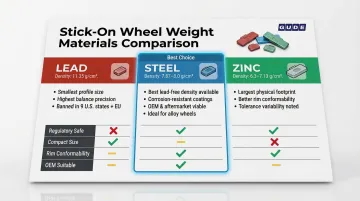
Material density directly controls physical weight dimensions. Higher-density materials (lead at 11.35 g/cm³, steel at ~7.9 g/cm³) produce shorter, narrower weights for a given gram value. Lower-density materials like zinc (~7.1 g/cm³) create longer weights to achieve the same mass.
This matters because oversized weights can place the center of gravity below the rim flange, causing balance accuracy issues and "weight chasing" scenarios where technicians struggle to achieve perfect dynamic balance.
Material as a Design Parameter
Material composition is an active design parameter. It determines:
- Ability to maintain consistent mass over time
- Resistance to corrosion-driven mass loss
- Capacity to hold adhesive bond through thermal cycling and road vibration
- Compatibility with different rim surface chemistries
Environmental interaction follows directly from material choice. Steel weights on bare alloy rims behave differently from zinc weights on painted rims in terms of galvanic corrosion risk. The adhesive backing must also be compatible with the rim surface chemistry—painted, anodized, bare aluminum, and coated steel all present different bonding challenges.
Regulatory and Compliance Dimensions
Material specification carries legal compliance weight, not just performance implications. Nine U.S. states have banned lead wheel weights: California, Illinois, Maine, Maryland, Minnesota, New Jersey, New York, Vermont, and Washington. International frameworks add further constraints:
- EU End-of-Life Vehicles Directive restricts lead in vehicle components
- REACH Annex XVII limits lead use across manufacturing applications
For procurement teams and service operations, material specification is a compliance decision as much as a performance one.
The Three Main Materials Used in Stick-On Wheel Weights
The three metals—lead, zinc, and steel—represent distinct trade-offs in density, environmental impact, manufacturing characteristics, and application fit. No single material is universally optimal.
Lead
Lead dominated wheel weight manufacturing for decades due to its high density (11.35 g/cm³) and malleability, which allowed small, contoured weights that conformed to rim profiles. It remains the densest option, meaning the smallest physical size for an equivalent gram value.
The U.S. Geological Survey estimated that 2,000 metric tons of lead from wheel weights were lost on U.S. roadways annually. When weights detach, passing traffic grinds them into fine particles that migrate to soils and waterways, posing serious health and environmental risks.
States with active lead wheel weight bans:
- California: Banned manufacture, sale, and installation (>0.1% lead) effective January 1, 2010; penalties up to $2,500 per day
- Illinois: Banned use, sale, and distribution effective January 1, 2012; civil penalty up to $50,000 plus $10,000/day
- New York: Banned use and sale effective April 1, 2011; civil penalty up to $2,500 per violation plus $500/day
- Washington: Mandates replacement with environmentally preferred alternatives effective January 1, 2011
- Minnesota: Banned use, sale, and distribution effective January 1, 2016; requires recycling of removed weights
- Maine, Maryland, New Jersey, Vermont: Active bans with varying enforcement provisions

The EU banned lead wheel weights under the End-of-Life Vehicles Directive, with the exemption expiring July 1, 2005.
Those bans pushed the industry toward two primary alternatives: zinc and steel.
Zinc
Zinc stick-on weights use zinc-based alloys, not pure zinc. Typical formulations include Zamak 3 (approximately 4% aluminum, trace magnesium) and ZA-8 (approximately 8% aluminum). Purity and alloy composition vary by manufacturer, affecting density and weight tolerance accuracy.
Zinc alloys have a density around 6.3–7.13 g/cm³, significantly lower than lead. That gap has real consequences in practice:
- Physically larger weights for the same gram value
- Harder to manufacture to tight tolerances
- Higher weight increments can cause center-of-gravity issues below the rim flange
- Currently under environmental review with no established recycling programs
Zinc offers malleability similar to lead, allowing some conformability to complex rim profiles, but the larger footprint limits placement options on modern wheels.
Steel
Steel has become the lead-free benchmark for density among compliant alternatives. With a density of approximately 7.87–8.0 g/cm³, steel provides higher density than zinc, so steel weights avoid the center-of-gravity-below-flange problem that affects zinc at higher weight increments.
Key advantages over zinc:
- Higher density means smaller footprint for equivalent gram values
- Now available in colored finishes—such as black for black-painted alloy wheels
- Coated construction delivers corrosion resistance across varied operating conditions
- Viable for both OEM and aftermarket applications
GUDE Corp manufactures ISO9001-certified steel and zinc stick-on weights designed to meet OEM and aftermarket specifications, produced across three world-class facilities in Asia.
The Role of Adhesive Backing Composition in Stick-On Wheel Weights
The adhesive backing is a distinct engineered material—typically a pressure-sensitive acrylic foam tape. Its specifications matter just as much as the metal body it holds in place.
Key Adhesive Performance Parameters
- Initial tack: How quickly the adhesive grips after application
- Long-term shear resistance: Resistance to weight sliding under centrifugal force at high RPM (tested per ASTM D3654)
- Peel strength: Resistance to lifting under thermal cycling (tested per ASTM D3330)
For example, Avery Dennison FT 2150 automotive acrylic tape exhibits 180° peel adhesion of 5.6 N/cm on stainless steel after 24-hour dwell, with static shear exceeding 10,000 minutes under 1,000g load.
Temperature Effects on Adhesive Bond
Automotive-grade pressure-sensitive adhesives have a defined working range: application temperatures between 15°C and 43°C (60°F–110°F), with operating tolerance from -40°C to over 140°C (-40°F to 175°F). Push outside those limits and bond performance degrades fast.
Temperature Challenges:
- High operating temperatures: Brake heat transfer through the rim and summer pavement radiation push adhesive toward upper limits
- Cold temperatures: Cause adhesive embrittlement and prevent proper wet-out during application
- Thermal cycling: Repeated expansion and contraction stress the bond interface
Applying weights below minimum temperature causes the adhesive to become too firm to wet-out properly, severely compromising initial bond strength.
Surface Preparation is Not Optional
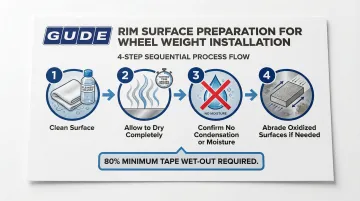
Surface contamination is the leading cause of adhesive weight detachment. Tire lubricants, skin oils, brake dust, and airborne dirt reduce adhesion performance. To achieve the required 80% minimum tape wet-out—the actual contact area between adhesive and rim—technicians must:
- Clean the landing surface with compatible solvent (isopropyl alcohol or proprietary prep wipes)
- Allow surface to dry completely
- Ensure no condensation is present (bringing cold wheels into warm shops causes moisture barriers)
- Consider light abrasion for heavily oxidized surfaces
Follow all four steps and the adhesive performs as engineered. Skip any one of them and you've introduced the most common failure point in the field.
How to Choose the Right Stick-On Wheel Weight Material for Your Application
Picking the wrong weight material costs you in rework, adhesion failures, and compliance risk. Work through these three decision points before specifying.
Decision Framework
Step 1: Check Regulatory Compliance
Verify lead ban status for your geography. If operating in California, Illinois, Maine, Maryland, Minnesota, New Jersey, New York, Vermont, Washington, or internationally in the EU, lead is not an option.
Step 2: Match Density to Rim Type
Assess available placement zone and rim configuration:
- Limited placement space: Steel provides smallest footprint among lead-free options
- Complex rim contours: Zinc offers slightly better conformability
- High weight corrections: Steel avoids center-of-gravity issues inherent to zinc's lower density
Step 3: Verify Adhesive Compatibility
Confirm adhesive backing matches rim surface material:
- Painted rims: Standard acrylic foam adhesives work well
- Anodized aluminum: May require specific adhesive formulations
- Bare alloy: Ensure coating on weight provides galvanic isolation
- Coated steel: Verify adhesive chemistry bonds to coating type
Primary Application Scenarios
- Modern alloy or custom wheels: Steel is the primary choice — black-coated steel matches black-painted wheels while delivering optimal density and corrosion resistance.
- Certification-specific requirements: Zinc is appropriate when particular alloy certifications are mandated or when slight rim-contour conformability provides a placement advantage.
- Legacy or transitional fleets: Where lead weights remain in service, replacing them with lead-free steel or zinc alternatives at the next service interval eliminates compliance exposure without sacrificing balance accuracy.
OEM and Fleet Procurement Considerations
OEM and fleet buyers have tighter requirements than the aftermarket. Two factors drive specification decisions at scale:
- Production tolerances: Weight increments held to ±1g or tighter directly affect balancing machine accuracy and final balance quality across high-volume runs.
- Certified traceability: ISO9001-certified sourcing ensures consistent specification compliance and provides the documentation trail that OEM audits require.
Common Misconceptions About Stick-On Wheel Weight Materials
"All Stick-On Weights Are Equivalent"
Treating zinc and steel weights as interchangeable ignores significant differences in density, physical size, and balance accuracy outcomes. At higher weight values, zinc's lower density produces weights with a center of gravity below the rim flange, reducing dynamic balance accuracy. Steel's higher density maintains proper weight geometry across the full range.
"Lead-Free Automatically Means Better"
"Lead-free" is not a universal upgrade. Zinc carries its own environmental review status and tolerance challenges, while steel may require different rim surface prep.
The right material depends on the specific application:
- Regulatory compliance requirements
- Rim type and surface characteristics
- Placement constraints
- Operating environmental conditions
Ignoring Adhesive Backing Specification
Material selection gets most of the attention, but adhesive backing specification is just as critical. Practitioners who skip verifying temperature ratings and surface compatibility often see weights that pass initial installation checks but fail in service — either from adhesive reaching thermal limits or losing bond on incompatible rim surfaces.
Frequently Asked Questions
What are stick-on wheel weights made of?
Stick-on wheel weights consist of a metal body—made from lead, zinc alloy, or steel—bonded to a pressure-sensitive adhesive backing tape. Material choice affects density (physical size for a given gram value), regulatory compliance (lead bans in nine U.S. states), and adhesive performance under heat and vibration.
Are stick-on wheel weights good?
Stick-on weights are the right choice for alloy, painted, or custom wheels where clip-on weights would damage the finish. Performance depends on correct material selection for the application and proper surface preparation—cleaning and degreasing—before installation.
Can stick-on wheel weights be reused?
Once removed, adhesive-backed weights cannot be reliably reused. The pressure-sensitive adhesive loses its tack and bonding capability after the first application. Always install new weights during rebalancing to ensure adequate bond strength.
What is the difference between lead, zinc, and steel stick-on wheel weights?
Lead has the highest density (11.35 g/cm³) but faces regulatory bans in nine U.S. states and the EU due to environmental contamination. Steel is the densest lead-free option (7.87–8.0 g/cm³) with no known health or environmental issues. Zinc is lower density (6.3–7.13 g/cm³), producing larger weights with more variable manufacturing tolerances.
Are lead wheel weights banned?
Lead wheel weights are currently banned in California, Illinois, Maine, Maryland, Minnesota, New Jersey, New York, Vermont, and Washington, with penalties ranging from $500/day to $50,000 plus daily fines. The EU banned them effective July 1, 2005. Additional states and countries are considering restrictions—verify local regulations before specifying lead weights.
How do you make sure stick-on wheel weights stay attached?
Two factors determine retention: choosing a weight rated for your temperature range (typically -40°C to 140°C operating; 15°C to 43°C application) and properly preparing the rim surface. Before installing:
- Clean with isopropyl alcohol or prep wipes
- Allow the surface to dry completely
- Confirm no oils, brake dust, or moisture remain on the bond area