
This article answers the core question every driver and technician should understand: what is the normal range of balancing weight for a tire, what threshold crosses into "too much," and what excessive weight actually signals about a tire or wheel assembly.
TL;DR
- Most passenger car wheels balance properly with 0.25–1.5 oz per plane (inner/outer), totaling 1–3 oz per wheel
- Consistently needing more than 3 oz total per wheel signals an underlying problem worth diagnosing
- Excess weight requirements usually point to an underlying issue: improper bead seating, significant runout, or a defective tire
- Adding more weight masks the problem — investigate and correct the root cause instead
How Much Balancing Weight Is Normal?
Wheel balancing weights are available in increments as small as 0.25 oz (approximately 7 grams), and the total amount needed per wheel varies based on vehicle type, tire size, and condition.
Typical Weight Ranges by Vehicle Type
Published industry benchmarks provide specific guidance on acceptable weight ranges:
| Vehicle / Wheel Type | Residual Static Imbalance Target | Maximum Total Weight |
|---|---|---|
| Passenger Car | < 0.30 oz (8.5 g) | 4 oz (aluminum wheels) |
| Light Duty Truck | < 0.60 oz (17 g) | 6 oz (steel wheels) |
Hunter Engineering targets residual static imbalance below 0.30 oz for passenger cars and 0.60 oz for light trucks. TMC RP 214D guidelines permit up to 4 oz for tubeless aluminum disc wheels and 6 oz for steel wheels.
These ranges represent weight added per balancing plane (inner and outer), so total weight per wheel is distributed across both the inner and outer planes.
Static vs. Dynamic Balancing and Weight Distribution
Two types of imbalance determine where weight gets placed:
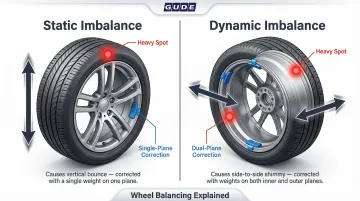
- Static imbalance occurs when a heavy spot sits at a single point on the tire/wheel circumference, causing an up-and-down bounce as the wheel rotates
- Dynamic imbalance involves heavy spots at offset locations, producing a side-to-side shimmy from lateral torque
Dynamic balancing splits correction weight across the inner and outer planes to address both simultaneously. Applying more than 20 grams (0.71 oz) of correction to a single plane can actually induce dynamic shimmy, which is why split placement is standard practice. When the balancer reads "zero" on both planes, the wheel is properly balanced — regardless of how much total weight that required.
The Role of Weight Precision and Material
Accurate balancing depends on weight consistency — using imprecise or non-standardized weights introduces error that produces persistent vibration even when the balancer shows a zero reading. The industry standard smallest increment is 0.25 oz (7 grams).
Material matters too. Lead-free coated steel weights maintain dimensional accuracy and resist corrosion over time, preventing the gradual balance drift that occurs when weights degrade. GUDE Corp produces lead-free coated steel wheel weights through ISO 9001-certified manufacturing, available in both adhesive stick-on and clip-on formats with the following specifications:
- 0.25 oz increments (smallest available) for precise correction
- Coated steel construction for corrosion resistance and dimensional stability
- Adhesive and clip-on formats covering passenger, truck, alloy, and OEM rim profiles
- Manufactured by Toho Kogyo across facilities in Japan and Vietnam
Factors That Determine How Much Weight a Tire Needs
Several physical, mechanical, and procedural variables drive how much balancing weight a wheel assembly actually needs.
Tire Size, Weight, and Tread Condition
Larger and heavier tires (such as SUV or truck tires) carry more mass, creating a greater potential for imbalance and requiring more corrective weight on average than compact car tires. Worn or unevenly worn tires compound this because material loss is not uniform across the tread surface, creating localized heavy spots that demand additional balancing weight.
Wheel Design and Material
Alloy and steel wheels differ in their balance characteristics. Spoke patterns, rim width, and material density can shift the center of mass of a wheel assembly, affecting how much weight is required and where it should be placed.
Because rim geometry varies so much between wheel types, clip-on weights must match the specific flange profile to seat correctly. GUDE Corp's clip-on series are each built for a distinct rim type:
- AW Series — alloy wheels; low-profile clip for the outer rim flange (visible placement)
- IAW Series — alloy wheels; mounts on the inner rim edge for hidden placement
- MC and P Series — steel wheels; spring steel clips sized for standard steel rim flanges
- T Series — built to Toyota/Lexus OEM rim flange specifications
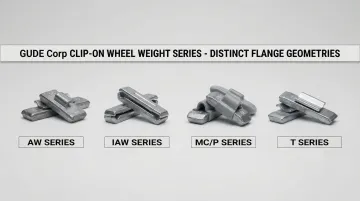
Each profile ensures proper retention and weight distribution for its intended geometry.
Manufacturing Tolerances of Tire and Rim
No tire or rim is manufactured to a perfect weight distribution. Minor factory-level imbalances are normal and correctable. SAE J332 describes the design requirements for equipment to evaluate nonuniformities in passenger car and light truck tires.
OEM specs illustrate the range of acceptable manufacturing variation:
- P-Metric passenger tires: General Motors specifies 18 lbs (8 kg) or less of radial force variation
- LT tires: GM tolerates up to 35 lbs (16 kg)
Tire Seating on the Rim
How well the tire bead is seated on the rim dramatically affects balance readings. A poorly seated tire will show a high weight requirement because the assembly is not centered—this is a mounting issue, not a tire defect. Re-mounting the tire and ensuring proper bead seating resolves the problem without adding excessive weight.
Balancer Mounting Accuracy
How the wheel mounts on the balancer directly determines whether the imbalance reading is real. Even a small centering error—wrong cone type, worn adapter—produces false readings that point to weight problems that don't actually exist.
Industry data shows that a 36-pound tire and wheel assembly that is off-center by only 0.006" will result in a 1/2 ounce imbalance error. To demonstrate this effect, technicians can balance a wheel, loosen the assembly, place a standard business card (approximately 0.013" thick) between the backing plate and the wheel, tighten, and respin—the card alone can shift the reading by a half ounce or more.
Hub-centric versus lug-centric mounting errors are among the most common sources of this kind of false reading.
When Is the Amount of Balancing Weight Too Much?
There is a practical threshold beyond which the amount of weight being used is no longer just a balancing solution—it is a diagnostic signal that something else is wrong.
The Industry Threshold for "Excessive" Weight
While thresholds vary by source, Coats wheel balancer manuals explicitly state that Match Balance (optimization) procedures should be initiated when the balancer calls for Total Static weights in excess of 3 ounces (85 grams) on passenger car tires. For light trucks and SUVs in dynamic mode, equipment manufacturers recommend optimization when weight exceeds 2 oz per plane.
The physics explain why this matters in practice: a 15-inch wheel with just 1 oz of static imbalance generates approximately 4.6 lbs of impact force at 60 mph. Excessive imbalance requires more weight and creates greater damaging forces at speed — a safety concern, not just a ride quality issue.
What Excessive Weight Typically Indicates
When a tire consistently requires unusually high weight, three root causes are most common:
- The tire is not properly seated on the rim bead — the assembly is not centered, causing false imbalance readings
- The tire or rim has significant runout — deformation or out-of-round conditions that cannot be corrected with weight alone
- The tire has a manufacturing defect — uneven material distribution or structural issues
Runout Thresholds
TMC RP 214D and Michelin guidelines establish strict runout limits:
| Component | Maximum Radial & Lateral Runout |
|---|---|
| Aluminum Wheels | < 0.030 inch |
| Steel Wheels | < 0.070 inch |
| Tire/Wheel Assembly | < 0.125 inch |
Runout under 0.030" typically does not cause noticeable vibration. Runout over 0.125" generally calls for tire or wheel replacement rather than additional weight.
Consequences of Over-Weighting Instead of Investigating
Adding weight to achieve a "zero" reading on a defective or improperly seated tire treats the symptom, not the cause. The structural problem remains — and the consequences compound:
- The underlying defect stays in place, so balance degrades again quickly
- Weight concentrated in one area creates new dynamic imbalance problems
- Force variation (caused by out-of-round tires or uneven sidewall stiffness) can still produce vibration even when the machine reads zero
- Continued operation accelerates wear on tires, steering, and suspension components
When to Re-Seat, Inspect, or Replace
Follow this practical decision framework when high weight is required:
- First: Remove all old weights and remount the tire
- If reading remains high: Re-seat the tire bead properly
- If still excessive: Check for rim damage or significant runout
- If runout exceeds safe thresholds: Replace the tire or rim rather than continuing to add weight
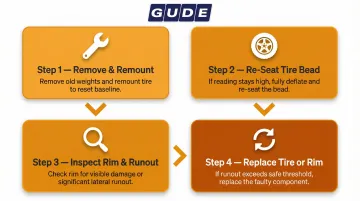
Normal Weight vs. Excessive Weight—What's the Difference?
Not all balanced wheels are equal. A wheel that reads "balanced" on the machine may still have a problem—and the difference between correct weighting and excessive weighting shows up in how the vehicle rides, how the tires wear, and how long the balance lasts.
Here's how the two scenarios compare:
- Ride quality: Properly weighted wheels eliminate vibration at all speeds. Over-weighted wheels may read balanced on the machine but still vibrate at highway speeds when runout or improper tire seating is the real cause.
- Tire wear: Correctly balanced tires wear evenly across the tread. When excessive weight compensates for a structural problem, uneven wear continues because the root cause was never fixed.
- Rebalancing frequency: Quality lead-free weights in appropriate amounts hold balance over the tire's life. Over-weighted assemblies require more frequent rebalancing as the underlying issue worsens.
- What the numbers tell you: Consistent weight needs above 2–3 oz on the same wheel position are a diagnostic flag, not a normal outcome.
What Most People Get Wrong About Wheel Balancing Weight
Many shops treat a high weight requirement as a normal result and simply add more weight. It's a symptom, not the solution. The root cause—a seating issue, rim damage, or tire defect—stays unresolved and keeps getting worse.
Two additional errors plague many balancing jobs:
- Skipping weight removal before rebalancing. Leftover weights skew new readings and produce seriously inaccurate corrections. Strip all existing weights before starting fresh.
- Using the wrong clip profile for the rim type. Mixing gram and ounce-rated weights, or fitting a clip designed for steel rims onto an alloy wheel, causes placement errors regardless of how good the tire is.
Profile compatibility matters here. GUDE Corp's clip-on weights come in series matched to specific rim flanges—T-profile for Toyota OEM specs, AW-profile for alloy wheels, MC-profile for standard steel rims—so the clip seats correctly and the reading is accurate from the start.
Frequently Asked Questions
How much weight is too much when balancing a tire?
Most industry guidelines suggest more than approximately 3 oz (85 grams) total per wheel on a standard passenger tire warrants investigation into the root cause—such as improper tire seating, runout, or a defective tire—rather than simply adding more weight.
Does 10 lbs per tire make a difference?
10 lbs of balancing weight per tire is far beyond any normal threshold for passenger vehicles. That amount indicates a severe underlying defect in the tire or rim — the assembly should be inspected and replaced, not balanced.
What happens if you use too much balancing beads?
Excessive balancing beads can over-correct imbalance, creating new vibration problems. Too many beads restrict free movement, forcing them into the wrong balance position and producing erratic vibrations — particularly at low speeds.
How bad is too bad wheel balancing?
Severe wheel imbalance causes steering vibration, accelerated and uneven tire wear, premature wear of suspension and bearing components, and reduced vehicle safety—particularly at highway speeds where even small imbalances generate significant impact forces.
Can too much wheel weight cause vibration?
Yes. Weight placed in the wrong location, or on a tire with runout or seating issues, can fail to eliminate vibration or create new imbalance. The balancer may read zero while the physical assembly still has structural problems that weight alone cannot fix.
What does it mean if a tire needs a lot of weight to balance?
A consistently high weight requirement usually signals that the tire is improperly seated on the rim, that the tire or rim has significant runout or damage, or that there is a manufacturing defect. A technician should re-seat and inspect the assembly before assuming more weight is the answer.