Introduction
Mini Cooper wheel weight is a performance-defining design parameter that directly influences steering response, braking efficiency, and that go-kart feel Mini owners expect. Because the Mini is a lightweight, agile vehicle, the ratio of unsprung to sprung mass is higher than in larger cars—making even small changes to wheel weight noticeably affect handling.
This guide covers the actual mass of Mini Cooper OEM wheels—not tire weight or total corner weight—broken down by generation, wheel size, and construction method.
Whether you're planning winter wheel swaps, aftermarket upgrades, or checking brake clearance requirements, knowing your specific wheel's weight helps you make decisions that keep the Mini's handling intact.
TL;DR
- Mini Cooper OEM wheels range from ~13–14 lbs (15" R-series alloys) to 22–25 lbs (17"–18" F-series and JCW cast alloys).
- Going from 15" to 17" adds several pounds per corner, directly affecting unsprung mass and handling response.
- Cast aluminum alloy dominates OEM construction; forged JCW wheels weigh noticeably less at the same diameter.
- As wheel mass and diameter increase, balancing weight placement becomes more precise and consequential.
Why Wheel Weight Matters for Mini Cooper Performance
Unsprung Mass and the Mini's Lightweight Advantage
Unsprung mass is all weight not carried by the suspension—wheels, tires, brakes, and portions of suspension linkages. In a lightweight car like the Mini Cooper, this ratio is highly sensitive. The first-generation R50 Cooper weighs just 2,315 lbs, and the R53 Cooper S weighs 2,678 lbs. The modern F56 Cooper S weighs 2,678 lbs as well.
Because the vehicle's total mass is relatively low, heavy wheels disproportionately degrade ride quality and handling. Engineering studies demonstrate that a 10% reduction in unsprung mass can contribute to a 6% reduction in sprung mass acceleration for the same level of wheel-hop, directly improving suspension response and road surface feedback.
Rotational Inertia and Throttle Response
Wheel weight is rotational mass, not just static load. During acceleration and braking, the powertrain and brakes must overcome both the vehicle's linear inertia and the rotational inertia of the driveline and wheels. Heavier OEM wheels increase rotational inertia, requiring more energy to accelerate and decelerate. The practical effects on a Mini Cooper include:
- Slower throttle response off the line
- Longer braking distances under hard stops
- Reduced agility and the "tossable" feel the platform is engineered to deliver
Reducing wheel weight lowers rotational inertia at each axle, which shortens braking distances and sharpens throttle response — two areas where the Mini's character is most noticeable.
Factors That Influence OEM Wheel Weight in the Mini Cooper Lineup
Diameter and Width: The Primary Sizing Factors
Wheel mass is directly tied to the barrel's diameter and width. Larger diameter increases the rim's circumference and material volume, while a wider rim adds mass to the barrel. The jump from 15" to 17" or 18" across Mini Cooper trim levels is a practical example—upsizing requires significantly more material just to form the hoop, before spokes are even added.
Construction Method: Cast vs. Forged vs. Flow-Formed
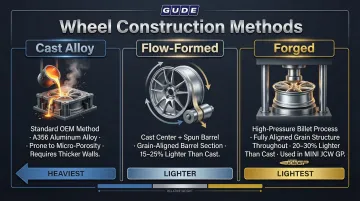
Cast aluminum alloy is the standard OEM construction method. Mini Cooper OEM cast wheels use A356 or A356-T6 aluminum alloys, with a density of approximately 2.67 to 2.68 g/cm³. The casting process can trap microscopic air bubbles (porosity) and create a brittle grain structure, requiring thicker, heavier spokes and barrels to meet load ratings.
Forged wheels achieve the same structural strength with less material. Forging applies high pressure to aluminum billet, aligning grain structure and increasing strength per unit weight. This allows material to be removed from spokes and barrel without sacrificing structural integrity, resulting in measurably lower weights at the same diameter. Forged wheels are typically 20% to 30% lighter than cast equivalents.
Flow-formed wheels split the difference between cast and forged. The center is cast, but the barrel is spun and stretched under heat, which aligns the grain structure in that section and reduces material needed to hit the same load rating. The result is typically 15% to 25% lighter than a comparable cast wheel.
Spoke Design and Geometry
Spoke design, spoke count, and spoke geometry contribute to weight variance between OEM wheel styles within the same generation. A 7-spoke design vs. a multi-spoke design in the same diameter can differ by 1–3 lbs. For example, at identical 15x5.5 ET45 dimensions, Mini OEM wheels vary by up to 3.7 lbs per wheel—the R81 7-hole (Imola) weighs just 12.0 lbs, while the R101 Rotator-spoke weighs 15.7 lbs.
Mini Cooper OEM Wheel Weight by Generation and Size
R-Series (R50/R52/R53): 15-Inch and 16-Inch Variances
The R-series spanned 2001–2006 and introduced OEM wheel sizes from 14" to 17". Even at the smallest OEM diameters, spoke design dictates massive weight variances.
15-Inch R-Series Wheels:
- R81 7-hole (Imola) 15x5.5 ET45: 12.0 lbs (5.45 kg)
- R96 Delta-spoke 15x5.5 ET45: 13.8 lbs (6.2 kg)
- R12 Steel Wheel 15x5.5 ET45: 14.8 lbs (6.7 kg)
- R86 Star-spoke 15x5.5 ET45: 15.0 lbs (6.8 kg)
- R101 Rotator-spoke 15x5.5 ET45: 15.7 lbs (7.1 kg)
16-Inch R-Series Wheels:
- R84 X-lite (V-spoke) 16x6.5 ET48: 17.6 lbs (8.0 kg)
- R115 Rib-spoke 16x6.5 ET48: 18.0 lbs (8.2 kg)
- R83 5-star (Daytona) 16x6.5 ET48: 20.1 lbs (9.1 kg)
- R94 Bridge-spoke 16x6.5 ET48: 20.9 lbs (9.5 kg)
The R84 X-lite uses thin, optimized spokes to trim rotational mass — 3.3 lbs less than the thick-spoked R94 Bridge-spoke.
R56 Generation (2006–2013): The 17-Inch Penalty
Upgrading to 17x7 wheels exposes buyers to severe weight penalties if dense spoke designs are chosen.
17-Inch R56 Wheels:
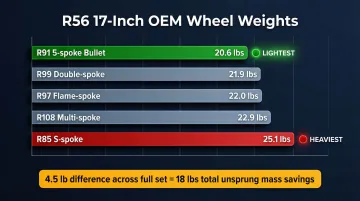
- R91 5-spoke Bullet 17x7 ET48: 20.6 lbs (9.4 kg)
- R99 Double-spoke 17x7 ET48: 21.9 lbs (9.95 kg)
- R97 Flame-spoke 17x7 ET48: 22.0 lbs (10.0 kg)
- R108 Multi-spoke 17x7 ET48: 22.9 lbs (10.4 kg)
- R85 S-spoke (S-lite) 17x7 ET48: 25.1 lbs (11.4 kg)
The iconic R85 S-spoke is notoriously heavy due to its thick spokes and heavy barrel transition. Enthusiasts can shed 18 lbs of total unsprung rotational mass across a full set of four wheels simply by swapping from the R85 S-spoke to the R91 Bullet.
F-Series (F55/F56/F57/F54/F60): Modern Topology Optimization
Modern CAD and topology optimization have narrowed the weight variance in the F56 generation to just 2.2 lbs across 17-inch styles. At this point, choosing a larger diameter matters more for weight than choosing between spoke designs.
17-Inch F-Series Wheels:
- Tentacle Spoke 500 17x7 ET54: 21.15 lbs (9.6 kg)
- Track Spoke 501 17x7 ET54: 21.59 lbs (9.8 kg)
- Cosmos Spoke 499 17x7 ET54: 22.20 lbs (10.08 kg)
- Roulette Spoke 502 17x7 ET54: 23.35 lbs (10.60 kg)
JCW Forged Wheels:
- JCW GP Forged 18x8.0: < 19.8 lbs (< 9.0 kg)
According to the BMW Group's official JCW GP press release, the F56 JCW GP's forged 18-inch wheels weigh under 9 kg — lighter than most cast 17-inch options in the same lineup. When Mini targets outright performance, forging replaces casting entirely.
Summary Reference Table
The table below consolidates per-wheel weights across all three generations for quick comparison.
| Generation | Wheel Code & Name | Size & Offset | Weight (lbs / kg) | Construction |
|---|---|---|---|---|
| R-Series | R81 7-hole (Imola) | 15x5.5 ET45 | 12.0 lbs (5.45 kg) | Cast Alloy |
| R-Series | R96 Delta-spoke | 15x5.5 ET45 | 13.8 lbs (6.2 kg) | Cast Alloy |
| R-Series | R12 Steel Wheel | 15x5.5 ET45 | 14.8 lbs (6.7 kg) | Steel |
| R-Series | R84 X-lite (V-spoke) | 16x6.5 ET48 | 17.6 lbs (8.0 kg) | Cast Alloy |
| R-Series | R94 Bridge-spoke | 16x6.5 ET48 | 20.9 lbs (9.5 kg) | Cast Alloy |
| R56 | R91 5-spoke Bullet | 17x7 ET48 | 20.6 lbs (9.4 kg) | Cast Alloy |
| R56 | R97 Flame-spoke | 17x7 ET48 | 22.0 lbs (10.0 kg) | Cast Alloy |
| R56 | R85 S-spoke (S-lite) | 17x7 ET48 | 25.1 lbs (11.4 kg) | Cast Alloy |
| F-Series | Tentacle Spoke 500 | 17x7 ET54 | 21.15 lbs (9.6 kg) | Cast Alloy |
| F-Series | JCW GP Forged | 18x8.0 | < 19.8 lbs (< 9.0 kg) | Forged |
How Wheel Weight Affects Balancing Requirements
As wheel mass increases, the sensitivity to small imbalances also increases. A heavier wheel spinning at highway speed generates greater centrifugal force from even minor mass asymmetry, making precise balancing more critical. This is particularly relevant when moving to larger OEM wheels or replacing a wheel after damage.
The amount and distribution of wheel balancing weights (clip-on or adhesive) must be calibrated to the specific wheel's mass and diameter. A 22 lb 17" JCW wheel will require a different balancing weight profile than a 14 lb 15" base Cooper wheel. Using undersized or imprecise balancing weights leads to persistent vibration.
Choosing the right weight type for the specific rim profile solves that problem. GUDE Corp's lead-free clip-on series addresses the rim flange geometry differences between steel and alloy wheels directly:
- AW Clip-On Series — low-profile clip designed for alloy wheel rim flanges, minimizing visibility on premium wheels
- IAW Clip-On Series — inner-edge placement for hidden positioning on alloy wheels, preserving aesthetics on JCW models
Both series are available in 0.25oz to 3.00oz increments and are manufactured by Toho Kogyo under ISO 9001 certification.
OEM vs. Aftermarket: Weight Trade-offs to Consider
Aftermarket Wheels Are Not Always Lighter
Aftermarket wheels marketed as "lightweight" are not always lighter than Mini Cooper OEM equivalents. Some styled aftermarket cast wheels in larger diameters exceed OEM weight, while quality forged aftermarket options can be significantly lighter.
For example, a standard Mini Cooper OEM 17-inch cast wheel, such as the R85 S-spoke, weighs 25.1 lbs. In contrast, the OZ Racing Alleggerita HLT (a flow-formed 17-inch wheel) weighs just 14.0 lbs. Swapping from the heaviest OEM 17-inch cast wheel to a lightweight aftermarket alternative can reduce unsprung mass by over 11 lbs per corner.
Going Heavier vs. Going Lighter
That weight difference cuts both ways depending on which direction you go:
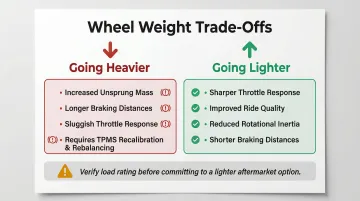
- Going heavier (for example, upsizing to a larger aftermarket wheel) adds unsprung mass penalties and typically requires TPMS sensor recalibration and a fresh balancing procedure
- Going lighter can improve throttle response and ride quality, but verify the wheel carries an appropriate load rating before committing
Dedicated Winter Wheel Sets
For owners considering dedicated winter wheel sets, OEM steel or entry-level alloy wheels in smaller diameters (15"–16") are often chosen for their lighter weight versus the larger performance wheels. Dropping one or two inches in diameter on a winter set can shave several pounds per corner — a meaningful reduction when road feel and fuel efficiency matter most in cold-weather driving.
Common Misconceptions About Mini Cooper Wheel Weight
OEM Wheel Weight Trade-Offs
A common misconception is that factory wheels are engineered to be as light as possible. In reality, OEM wheels are optimized for a balance of competing priorities:
- Cost — cast alloy is cheaper to produce at volume than forged
- Aesthetics — spoke geometry and finish choices influence shape and thickness
- Durability — extra material helps wheels survive pothole impacts over a 100,000-mile lifespan
- NVH — added mass dampens road noise, vibration, and harshness
The JCW forged wheel is the exception, demonstrating what Mini's OEM engineering looks like when weight reduction takes priority.
Wheel Weight vs. Tire Weight
It's easy to conflate wheel weight and tire weight when discussing "corner weight." For unsprung mass calculations, what matters is the complete wheel and tire assembly — and in some configurations, tire weight equals or exceeds wheel weight.
Manufacturing Tolerance Variance
The same wheel model number can produce slightly different measured weights due to manufacturing tolerances, finish coatings (painted vs. machined), and valve hardware. Published OEM specifications represent nominal weight — real-world measurements may vary by up to 5–10% from listed values.
Frequently Asked Questions
How much do Mini Cooper wheels weigh?
Mini Cooper OEM wheels typically range from 13–14 lbs (15" base alloy on R-series) up to 21–25 lbs (17"–18" cast alloy and JCW wheels on F-series). Exact weight depends on the wheel code, diameter, and construction method.
Do larger Mini Cooper OEM wheels always weigh more than smaller ones?
As a general rule, larger diameter and wider OEM wheels weigh more due to greater material volume. Construction method also plays a role. A well-engineered forged 17" wheel can weigh less than a cast 16" wheel, so diameter is not the only factor.
What is the difference in weight between a Mini Cooper base wheel and a JCW wheel?
JCW OEM wheels use forged aluminum construction versus cast aluminum for base/mid trims, which typically results in a weight reduction of several pounds per wheel at comparable diameters. For example, the F56 JCW GP forged 18" wheel weighs less than 19.8 lbs, while many 17" cast wheels weigh 22–25 lbs.
How does Mini Cooper wheel weight affect handling?
Heavier wheels increase unsprung mass, slowing suspension response, adding steering effort, and dulling the go-kart handling Mini Cooper is known for. Lighter wheels sharpen agility and can shorten braking distances by reducing rotational inertia.
Do I need to re-balance my Mini Cooper wheels after switching to a different OEM wheel?
Yes, any wheel change—even between OEM wheels of the same generation—requires a fresh dynamic balance procedure, as each individual wheel has its own mass distribution. Using properly calibrated wheel balancing weights ensures the new setup runs vibration-free.
Are Mini Cooper steel wheels heavier than alloy OEM wheels?
OEM steel wheels are consistently heavier than alloy equivalents at the same diameter due to steel's higher density. Many owners choose smaller-diameter alloy winter wheels over steel specifically to keep the weight penalty of a seasonal swap in check.