Introduction
The GR86, 86, and FR-S represent Toyota's commitment to lightweight sports car philosophy, where every rotating pound directly affects the driving experience. Yet wheel weight remains one of the most consequential and frequently misread specifications on this platform.
The core challenge: owners researching wheel upgrades encounter conflicting numbers across forums and spec sheets. Is that "27 lbs" figure wheel-only or wheel-plus-tire? Does it apply to gen 1 FR-S wheels or gen 2 GR86 wheels? Without context, these numbers become meaningless when evaluating aftermarket options.
What follows covers verified OEM wheel specifications across all three generations and trim levels, what unsprung and rotational mass actually mean at the wheel, and how to read aftermarket weight comparisons without getting misled by incomplete data.
TL;DR
- First-gen 86/FR-S use 17x7 alloy wheels (+48mm offset, 5x100 bolt pattern); GR86 base uses 17x7.5 wheels, premium trim uses 18x7.5 wheels
- Stock first-gen FR-S wheel weighs approximately 20 lbs bare; GR86 base corner weight (wheel + tire) is 43.2 lbs
- Aftermarket wheels cut unsprung mass, but heavier tire choices often cancel out those gains
- Correct balancing weight selection prevents vibration, uneven wear, and premature suspension wear
- T Series clip-on weights are built to Toyota OEM rim flange specs — a direct fit for GR86 and 86 alloy wheels
What Stock Wheel Weight Means for the GR86, 86, and FR-S
Stock wheel weight refers to two distinct measurements that enthusiast forums often conflate: the bare wheel (rim only) weight and the corner weight (wheel + tire + valve stem + balancing weights). Both figures appear in online discussions—often interchangeably, and incorrectly.
Wheel weight falls into two performance-critical categories:
- Unsprung mass: weight not supported by the suspension spring, which the suspension must accelerate and decelerate to keep the tire in contact with the road
- Rotational mass: weight that must be spun up during acceleration and spun down during braking, creating resistance to changes in wheel speed
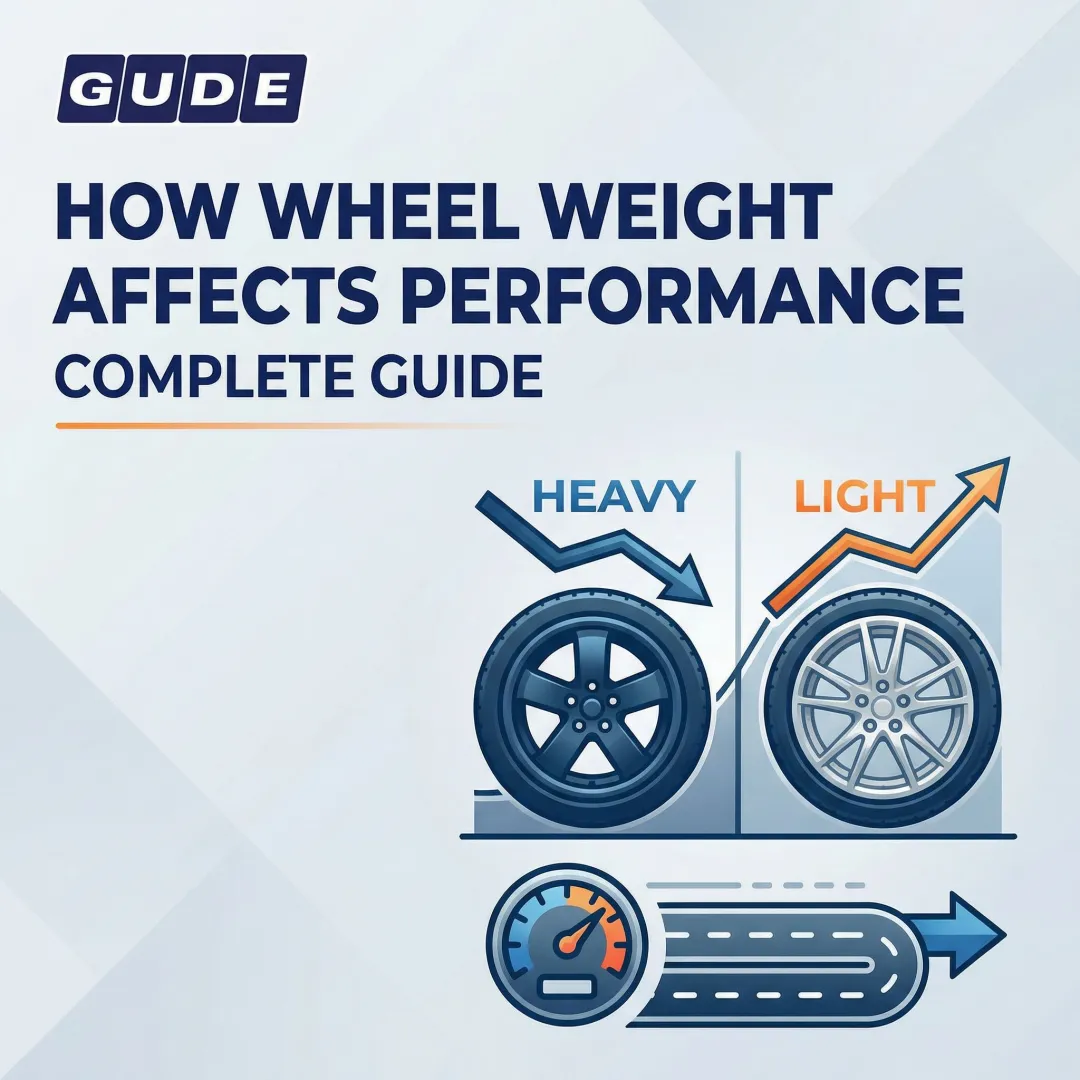
Both have multiplied effects on handling dynamics compared to equivalent static weight reductions elsewhere on the car. Reducing wheel weight delivers more performance gain per pound than cutting weight from the chassis or interior.
Toyota engineered the GR86/86/FR-S platform to a sub-2,900 lb curb weight target, meaning each component's mass was a deliberate design decision. Stock wheels balance cost, durability, and weight within that envelope.
That design intent extends to how the OEM wheel manages balance. The stock wheel controls two weight-relevant variables: its own mass and the balancing weight required at installation. A heavier or less precisely manufactured wheel needs more balancing weight at each corner, compounding the rotational mass penalty.
Trim level and model year matter. Key differences include:
- GR86 premium trim 18" wheels are heavier than the base 17" wheels
- Gen 1 FR-S/86 wheels differ from gen 2 GR86 wheels in both size and construction
OEM Wheel Specifications: Weight, Size, and Fitment by Generation
Gen 1 (2012–2021 Toyota 86 / Scion FR-S / Subaru BRZ)
Wheel specifications:
- Size: 17x7
- Offset: +48mm
- Bolt pattern: 5x100
- Center bore: 56.1mm
- Material: Cast aluminum alloy
- OEM tire: 215/45R17 Michelin Primacy HP
Verified weights:
- Bare wheel: approximately 20.1 lbs
- OEM tire: approximately 20.4 lbs
- Total corner weight: approximately 40–41 lbs (wheel + tire + valve stem + balancing weights)
Gen 2 (2022+ Toyota GR86)
Base trim specifications:
- Size: 17x7.5
- Offset: +48mm
- Bolt pattern: 5x100
- Center bore: 56.1mm
- Material: Cast aluminum alloy
- OEM tire: 215/45R17 Michelin Primacy HP
- Verified corner weight: 43.2 lbs per corner (wheel + tire assembly)
Premium trim specifications:
- Size: 18x7.5
- Offset: +48mm
- Bolt pattern: 5x100
- Center bore: 56.1mm
- Material: Cast aluminum alloy
- OEM tire: 215/40R18 Michelin Pilot Sport 4
- Verified corner weight: approximately 42–43.1 lbs per corner
These specs have a direct impact on balancing. OEM cast alloy construction adds more weight than forged alternatives, so corner weights run higher — and balancing requirements follow. Tire weight alone accounts for roughly 20 lbs per corner, meaning tire choice affects total unsprung mass as much as wheel choice does. Both inner and outer flanges on these alloy rims accept standard clip-on balancing weights, with Toyota-specific rim flange geometry requiring weights built to those OEM tolerances for a secure fit.
How Unsprung Mass and Rotational Weight Affect Real-World GR86 Performance
Unsprung Mass and Suspension Response
The suspension system must accelerate and decelerate all unsprung mass independently. Heavier wheels increase the force required to keep the tire in contact with the road over bumps and mid-corner undulations — a dynamic amplified on the GR86's short-travel, sport-tuned suspension.
Research using a 2-DOF quarter-car model demonstrated that every 10% reduction in unsprung mass contributes to approximately 6% reduction in sprung mass acceleration for the same level of wheel-hop. This translates to better tire contact patch consistency and improved ride quality.
How Rotational Inertia Affects Acceleration and Handling
Wheel weight located at the rim's outer diameter (the heaviest part of a cast wheel) has an outsized effect on rotational inertia compared to equivalent weight at the hub. This affects acceleration response, braking bite, and the effort required to change wheel direction in transitions.
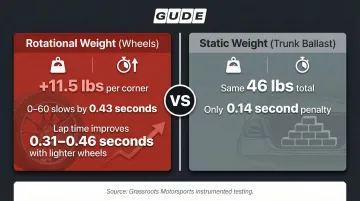
Grassroots Motorsports instrumented testing on a lightweight sports car (Miata) quantified this effect:
- Adding 11.5 lbs per corner slowed 0-60 mph times by 0.43 seconds (8.61s to 9.04s)
- Adding the same 46 lbs as static trunk ballast only slowed it by 0.14 seconds
- Lap times on a handling-focused track improved by 0.31 seconds average and 0.46 seconds best lap with lighter wheels
The Tire Weight Paradox
Those rotational inertia gains can disappear quickly when tire selection enters the equation. Switching to a lighter forged wheel but fitting a heavier high-performance tire can result in net higher per-corner weight than OEM.
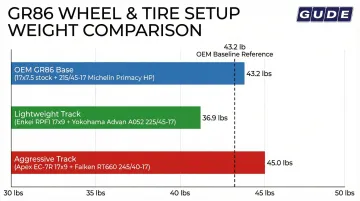
Real-world data makes this concrete: an Apex EC-7R forged wheel (17.3 lbs) paired with a 245/40-17 Falken RT660 tire (27 lbs) reaches approximately 45 lbs per corner — heavier than the OEM 43.2 lb baseline.
For daily-driven GR86s, the difference in unsprung mass between OEM and quality cast aftermarket wheels is perceptible but not transformative. The benefit becomes more pronounced at track speeds, autocross events, or on roads with significant surface variation.
Stock vs. Aftermarket: Making Sense of the Weight Numbers
The Most Common Misinterpretation
Comparing bare wheel weights between OEM and aftermarket without accounting for tire weight, balancing weight, and hardware creates misleading conclusions. A "17 lb forged wheel" is not a 3-lb-per-corner saving over a "20 lb OEM wheel" once tires are fitted. The meaningful comparison is always corner weight (wheel + tire + balance weights).
Practical Benchmark for the GR86/FR-S Platform
A lightweight 17x9 aftermarket wheel fitted with a 225/45-17 performance tire achieves approximately 36.9 lbs per corner—a reduction of roughly 6-7 lbs per corner from the OEM 43.2 lb baseline. For a street/track dual-purpose build, 6–7 lbs per corner is about the most you can expect to recover.
Real-world aftermarket assembly weights:
| Setup | Wheel | Tire | Corner Weight |
|---|---|---|---|
| OEM GR86 Base | 17x7.5 stock | 215/45-17 Michelin Primacy HP | 43.2 lbs |
| Lightweight Track | Enkei RPF1 17x9 | Yokohama Advan A052 225/45-17 | 36.9 lbs |
| Aggressive Track | Apex EC-7R 17x9 | Falken RT660 245/40-17 | 45.0 lbs |
Why Forged Wheels Need Fewer Balance Weights
Those corner weight numbers don't tell the whole story. Forged aluminum wheels are manufactured to tighter tolerances than cast equivalents, which means they arrive closer to true balance. In practice, a forged wheel often requires less corrective weight at the balancing machine — keeping total rotational mass lower than the bare wheel comparison suggests.
Getting the Balance Right: Why Wheel Weight Quality Matters
Proper wheel balancing is non-negotiable regardless of whether you retain stock wheels or upgrade to aftermarket. Imbalance at even modest highway speeds creates vibration that loads wheel bearings, degrades tire contact patch consistency, and causes uneven wear that undermines any performance gains from a lighter wheel.
The Role of Wheel Balancing Weights
Small masses adhered to or clipped onto the wheel flange correct residual imbalance left after tire mounting. The mass, placement accuracy, and durability of these weights directly affect balance quality. Low-quality weights that shift, corrode, or detach over time defeat the purpose of precision balancing.
SAE Technical Paper 2010-01-0245 notes that unbalanced tire/wheel assemblies cause vibrations that "may propagate to chassis components such as bearing and bushing. This in turn causes excessive wear that eventually leads to premature failure."
Specification for Performance Applications
For a performance-focused platform like the GR86, lead-free wheel weights manufactured to tight tolerances are the right call. Quality weights maintain adhesion through the thermal and mechanical cycling common in sport driving, resist corrosion against alloy wheel finishes, and meet current environmental standards.
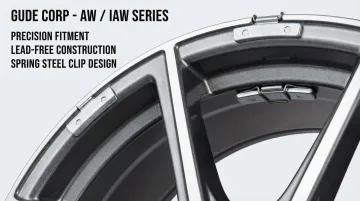
GUDE Corp manufactures ISO 9001-certified wheel weights designed for alloy wheel applications. Two series cover the GR86's typical fitment needs:
- AW Clip-On Series — low-profile clip engineered for alloy wheel rim flange geometry, minimizing visibility on custom and premium wheels
- IAW Clip-On Series — hidden placement on the inner edge of alloy wheel rims, for fitments where any visible outer-flange weight is unacceptable
Both series are manufactured by Toho Kogyo, the #1 wheel weight manufacturer in Japan and #3 globally, using lead-free coated steel construction with spring steel clips designed for precise fitment and long-term retention.
Frequently Asked Questions
What are the stock wheels on the GR86?
The GR86 base trim uses 17x7.5 cast alloy wheels, while the premium trim uses 18x7.5 cast alloy wheels. Both maintain the 5x100 bolt pattern with +48mm offset and 56.1mm center bore carried over from the gen 1 platform.
How much do FR-S OEM wheels weigh?
The bare FR-S OEM wheel weighs approximately 20.1 lbs. The combined wheel-and-tire corner weight on the GR86 base model is approximately 43.2 lbs. These figures are often confused because forum discussions don't always specify whether they're citing bare wheel or total assembly weight.
What size are the OEM FR-S wheels?
OEM FR-S wheels are 17x7 with a +48mm offset and 5x100 bolt pattern. The center bore is 56.1mm.
What is the factory offset of FR-S OEM wheels?
The factory offset is +48mm. This measurement affects tire clearance and suspension geometry, so matching it closely matters when selecting aftermarket wheels.
What size tires are on the OEM GR86?
The OEM tire size for the GR86 base is 215/45R17. The premium 18" fitment uses 215/40R18 Michelin Pilot Sport 4 tires. OEM tire weight adds approximately 20 lbs per corner to the total assembly.
Is 20 lbs light for FR-S OEM wheels?
20 lbs is typical for a cast OEM alloy in this class. Quality forged aftermarket wheels in the same 17" size can reach 15-17 lbs, delivering 3-5 lbs of savings per corner before tire selection.