Introduction: How Wheel Weight Affects Performance
Many drivers overlook wheel weight when upgrading their vehicles, yet it's one of the most impactful decisions you can make. Unlike static weight in the trunk or cabin, every pound of rotating wheel mass creates a disproportionate penalty. A spinning wheel must be accelerated, decelerated, and turned constantly, and the heavier it is, the more energy every one of those actions demands.
This guide breaks down rotating mass physics, real-world performance data, EV-specific considerations, and why proper wheel balancing locks in the gains lighter wheels deliver.
TLDR
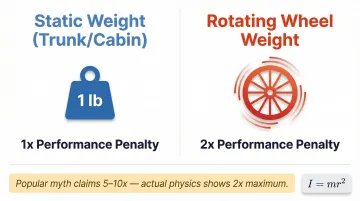
- Rotating weight carries roughly 2x the performance penalty of static weight — not the exaggerated 5–10x often cited
- Lighter wheels cut 0–60 times by 0.3 seconds and improve city fuel economy by up to 8% in real testing
- EVs are especially sensitive: a Tesla Model 3 loses 43 miles (12% range) switching from 18" to 20" wheels
- Material type drives weight: cast aluminum wheels weigh 20-27 lbs, flow-formed 16 lbs, forged as low as 10-15 lbs
- Proper wheel balancing with precision weights preserves handling and fuel economy benefits from lighter wheels
The Physics Behind Wheel Weight: Sprung Mass, Unsprung Mass, and Rotational Inertia
Understanding wheel weight starts with distinguishing between two types of vehicle mass. Sprung weight includes everything supported by the suspension—engine, chassis, body, passengers. Unsprung weight encompasses components that move directly with the road surface: wheels, tires, hubs, brakes, and suspension arms.
Reducing unsprung weight delivers outsized benefits because the suspension can respond faster to road irregularities. Engineering studies confirm that a 10% reduction in unsprung mass yields approximately 6% less sprung mass acceleration (body bounce), keeping tires in better contact with the pavement and improving both ride quality and handling precision.
Rotational inertia (also called moment of inertia) describes a spinning object's resistance to changes in rotational speed. A figure skater pulling their arms inward spins faster with less effort; extending them outward demands more energy to change speed. Wheels follow the same principle. A heavy outer rim requires far more energy to accelerate and decelerate than an identically heavy wheel with mass concentrated near the hub. Because rotational inertia scales with the square of the radius ($I = mr^2$), rim mass penalizes performance exponentially more than hub mass.
The Truth About the Rotational Weight Multiplier
The popular claim that "1 pound of rotating wheel weight equals 5–10 pounds of static weight" is mathematically false. According to Fundamentals of Vehicle Dynamics, the rotational inertia of a wheel converts to an equivalent mass of at most 2x the actual wheel weight for straight-line acceleration—and that's only if all mass is concentrated at the absolute outer radius.
The 2:1 ratio exists because the engine must simultaneously accelerate the vehicle forward (linear acceleration) and spin the wheels (rotational motion). These are two separate energy demands, but the multiplier effect is far smaller than the commonly cited figure implies—typically overstated by 3–5x.
Why Weight Distribution Within the Wheel Matters
Mass concentrated near the outer rim contributes far more to rotational inertia than mass near the hub. Spoke design and barrel construction therefore affect performance well beyond total weight alone.
Two 20-lb wheels can behave very differently:
- A wheel with thick spokes and a heavy rim lip accelerates more sluggishly despite the same total mass
- A wheel with thin spokes and a lightweight barrel delivers noticeably quicker response
When evaluating aftermarket wheels, total weight and mass distribution both matter.
Real-World Driving Scenarios
The rotational mass penalty is most pronounced in city stop-and-go driving, where wheels are constantly accelerated and decelerated. Highway cruising minimizes this effect because the wheels maintain relatively constant speed, with aerodynamic drag and rolling resistance dominating energy consumption instead.
How Wheel Weight Impacts Vehicle Performance
Acceleration and Braking
Grassroots Motorsports tested a 1992 Mazda Miata, swapping heavy 42.3-lb wheels for lightweight 30.9-lb Volk TE37s—a reduction of 11.4 lbs per corner. The result: 0-60 mph time improved by 0.29 seconds. To verify the rotational weight multiplier, they added the saved wheel weight back into the trunk as static ballast. The 0-60 time slowed by only 0.14 seconds, proving that rotating mass penalizes acceleration roughly twice as much as static mass.
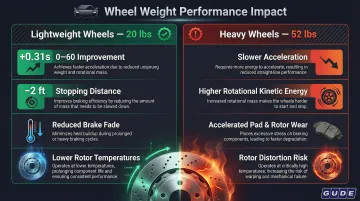
Testing a BMW M3 with 52-lb cast wheels versus 20-lb forged wheels showed a 0.31-second improvement in 31-87 mph acceleration—a meaningful gain for performance driving.
Lighter wheels also improve braking, though the effect is smaller than many expect. Braking requires dissipating kinetic energy from both translational and rotational motion. However, peak deceleration is primarily limited by tire-to-road friction, which barely changes with wheel mass. In controlled 60-0 mph braking tests, the BMW M3 reduced stopping distance by only 2 feet when switching from 52-lb to 20-lb wheels.
The real braking benefit appears during repeated heavy braking. Heavier wheels store more rotational kinetic energy, which converts directly to heat at the brake rotor. Engineering analysis confirms that excessive rotational mass causes higher surface temperatures, producing:
- Accelerated brake fade under sustained load
- Increased pad and rotor wear over time
- Rotor distortion and cracking on track days or mountain descents
Handling and Ride Quality
Lower unsprung weight allows suspension to react more quickly to road imperfections, maintaining tire contact and improving cornering grip. A lighter wheel reduces the inertia the suspension must overcome with every bump and corner, letting the system respond to inputs rather than fighting to keep up.
Instrumented track testing shows that lightweight wheels make steering feel more communicative and responsive. With 20-lb wheels, drivers report the car "wants to dance with you" and provides superior feedback from the front axle. Heavy 52-lb wheels cause steering feedback to drop off, making the car feel lethargic and less eager to change direction.
This happens because a spinning wheel acts as a gyroscope, resisting changes in direction. Reducing rotational inertia directly reduces this gyroscopic resistance, allowing the suspension and steering systems to work more efficiently.
Important nuance: Extremely lightweight or overly stiff wheels can sometimes transmit more road harshness. The goal is optimized weight reduction balanced with appropriate strength and compliance, not the lightest possible wheel at any cost.
Fuel Economy
Real-world testing using a BMW 3 Series compared lightweight 17-inch wheels (17 lbs each) against heavyweight 17-inch wheels (27 lbs each). The lightweight setup achieved 22.8 mpg, while the heavyweight configuration managed only 21.1 mpg—an 8% reduction in fuel efficiency caused entirely by wheel mass.
The fuel economy effect is most pronounced in urban stop-and-go driving, where rotational mass is constantly accelerated and decelerated. On steady-state highway cruising, where rolling resistance and aerodynamic drag dominate, the impact is smaller but still measurable.
That pattern holds across vehicle types: Car and Driver measured a 10% fuel economy drop when upsizing a VW Golf from lightweight 15-inch steel wheels to heavier 19-inch cast aluminum wheels, though this test also included wider tires with higher rolling resistance.
Wheel Weight and Electric Vehicles: Why the Stakes Are Higher
Electric vehicles operate on fixed battery capacity, making them more sensitive to wheel and tire weight than internal combustion engines. Any weight added to rotating components directly reduces range by demanding more energy per mile.
EPA testing data reveals significant range penalties from wheel choice:
- Tesla Model 3 Long Range AWD (2023): 18" Aero wheels deliver 358 miles of range, while 20" Uberturbine wheels drop to 315 miles—a loss of 43 miles (12%)
- Lucid Air Pure AWD (2023): 19" Aero wheels provide 410 miles, while 20" wheels reduce range to 384 miles—a loss of 26 miles (6.3%)
These EPA figures reflect aerodynamic and tire compound differences alongside rim mass — but the direction is consistent. Larger wheels cost range, and the mechanisms explain why.
Why Larger Wheels Reduce EV Range
Bigger wheels create a compounding range penalty through multiple mechanisms:
- Added rotational mass: Larger rims require bigger, heavier tires — every extra pound compounds the energy cost
- Greater rolling resistance: A wider contact patch raises the energy needed to maintain highway speeds
- Reduced regenerative braking efficiency: More rotational inertia means more energy must be recaptured to slow the wheels, reducing overall system efficiency
Virginia Tech research on rotating inertia in EVs found that rotating components account for 8-13% of total energy recovered during deceleration. The catch: regenerative braking only recaptures 60-70% of that energy, so the extra cost of accelerating heavier wheels is never fully paid back.
Design Tension for EV Manufacturers
Larger wheels improve aesthetics and handling, but they directly undercut the range numbers buyers compare on spec sheets. Some OEMs respond with aerodynamic wheel covers or EV-specific designs engineered to keep weight and rolling resistance low without sacrificing appearance.
Wheel Materials and Their Impact on Weight
Manufacturing method is the primary driver of wheel weight. Three processes dominate the market:
| Manufacturing Type | Typical Weight Range | Cost Tier | Best Use Case |
|---|---|---|---|
| Cast Aluminum | 20-27 lbs (17-18" diameter) | Lowest | Daily driving, budget-conscious upgrades |
| Flow-Formed (Rotary-Forged) | 15-18 lbs (17-18" diameter) | Mid-Range | Performance-focused street cars, track use |
| Forged Aluminum | 10-15 lbs (17-18" diameter) | Highest | Dedicated track cars, maximum performance |
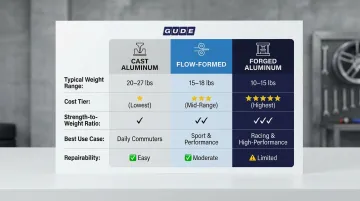
Cast aluminum wheels are made by pouring molten aluminum into a mold — straightforward manufacturing that keeps costs low but leaves more material in the finished product.
Flow-formed (rotary-forged) wheels close much of that gap by stretching and compressing the aluminum barrel after casting. The process aligns the grain structure, delivering roughly 85-90% of forged wheel performance at a fraction of the cost. The Enkei RPF1 — a widely used flow-formed wheel — weighs just 16.05 lbs in 17x8" size, lighter than many premium forged options.
Forged aluminum wheels start from a solid billet compressed under extreme pressure, which tightens the grain structure and produces the best strength-to-weight ratio available. The trade-off is cost: forged wheels are priced well above cast or flow-formed alternatives.
Exotic Materials
Carbon fiber and magnesium alloy represent the extreme end of weight reduction, with some wheels weighing under 10 lbs. The durability trade-offs make them impractical outside of specialized competition use — magnesium corrodes readily, and carbon fiber can shatter on severe impact. Cost puts both options firmly in the motorsport category.
Repairability and Longevity
Material choice also affects how a wheel holds up over time:
- Cast wheels can often be straightened after minor curb strikes or pothole damage
- Forged wheels resist deformation better but are difficult or impossible to repair after significant impact
- Exotic materials (carbon fiber, magnesium) offer minimal repair options — damage typically means replacement
For most street-driven performance cars, flow-formed wheels hit the practical sweet spot: meaningfully lighter than cast, repairable after minor damage, and priced within reach. Reserve forged or exotic options for dedicated track builds where every pound counts.
The Role of Wheel Balance Weights in Sustaining Performance
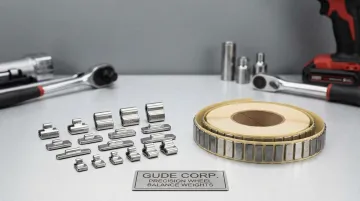
Even a precision-manufactured wheel and tire assembly will have minor weight distribution irregularities. Wheel balancing involves attaching small calibrated weights to the rim to eliminate these imbalances. Without proper balancing, even a lightweight performance wheel will produce vibration, accelerated and uneven tire wear, and reduced handling precision—effectively undoing the performance benefits of going lighter.
Wheel balance weight material matters for both performance and environmental reasons. Traditional lead weights are being phased out due to environmental regulations in many markets, with steel and zinc-alloy alternatives becoming the standard.
GUDE Corp manufactures precision lead-free wheel balance weights built for this shift, serving both OEM and aftermarket applications. Key credentials include:
- ISO9001-certified manufacturing across three facilities in Asia
- Coated steel weights in clip-on and adhesive formats — no lead, no environmental compliance issues
- Over 65 years of automotive supply chain experience
- Partnership with TOHO Group, the #1 wheel weight manufacturer in Japan and #3 globally, supporting North American distribution
Practical Implications for Aftermarket Wheel Upgrades
If you upgrade to lighter aftermarket wheels, proper re-balancing with high-quality balance weights after every wheel or tire change is essential. Without it, the fuel economy, handling, and ride quality gains from lighter wheels don't fully materialize — the imbalance noise and vibration show up first.
How to Choose the Right Wheel Setup for Your Vehicle
Match your wheel choice to your driving use case:
Track and performance drivers: Prioritize forged or flow-formed wheels for maximum weight reduction. The investment pays off in faster lap times, better braking, and more responsive handling.
Daily drivers: Quality flow-formed wheels offer the best value, delivering meaningful weight savings at a fraction of forged wheel pricing. Expect noticeable improvements in ride quality and fuel economy without breaking the budget.
Heavy-duty and off-road applications: Balance weight savings against load rating, durability, and repairability requirements. A lightweight forged wheel may crack on severe impact, while a heavier cast wheel can often be straightened and returned to service.
Don't evaluate the wheel alone — the complete wheel-and-tire assembly weight is what actually moves with the vehicle. Tire weight varies significantly by size and construction, and a heavy tire can negate the gains from a lightweight rim.
Upsizing wheel diameter (going from 17" to 19", for example) typically increases both wheel and tire weight, which can work against the performance goals you're chasing.
Frequently Asked Questions
How does wheel weight affect performance?
Wheel weight affects acceleration, braking, handling, and fuel economy because wheels are rotating mass. Each pound of wheel weight carries roughly twice the performance impact of an equivalent pound of static body weight.
Does wheel weight affect fuel economy (gas mileage)?
Yes, lighter wheels improve fuel economy, most noticeably in stop-and-go driving, where rotational mass cycles continuously. Real-world testing shows up to 8% fuel economy improvement with lightweight wheels. The effect is smaller but still present at highway speeds.
Why do larger wheels reduce EV range?
Larger wheels are heavier, require larger and heavier tires, increase rolling resistance, and demand more energy to accelerate—all of which draw more from a fixed battery capacity. EPA data shows the Tesla Model 3 loses 43 miles (12%) of range switching from 18" to 20" wheels.
What is the 3% rule for tires?
The 3% rule states that a replacement tire's overall diameter should stay within 3% of the original to avoid meaningful impacts on speedometer accuracy, handling calibration, suspension geometry, and clearance.
How much does a wheel weigh?
A typical passenger car wheel weighs between 15 and 30 lbs depending on size and material:
- Steel OEM wheels: 22–28 lbs
- Cast aluminum aftermarket wheels: 20–27 lbs
- Forged performance wheels: 10–15 lbs (same diameter)