Introduction
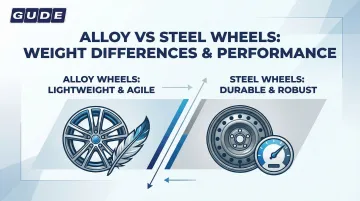
Both alloy and steel wheels are engineered from metal alloys, yet they differ significantly in composition, weight, and real-world performance. Steel wheels use an iron-carbon alloy with stamped construction, while alloy wheels rely on aluminum-nickel blends cast or forged into lighter, more complex shapes.
The weight gap between these two materials is measurable: it affects acceleration, braking distance, fuel consumption, and long-term maintenance costs across passenger vehicles, commercial fleets, and off-road builds alike.
Choosing the wrong wheel type creates real consequences. Heavier steel wheels increase unsprung mass, demanding more energy to accelerate and maintain speed. Lighter alloy wheels improve suspension response and reduce rotating inertia, translating to better handling and fuel economy.
This guide breaks down the weight differences, performance trade-offs, cost implications, and application fit — so you can make the right call whether you're speccing a single vehicle or sourcing for a full fleet.
TL;DR
- Alloy wheels weigh 3–10 lbs less per wheel on passenger vehicles and up to 30 lbs less on commercial trucks compared to steel equivalents
- Lower unsprung weight from alloy wheels improves acceleration, braking, cornering, and fuel economy
- Steel wheels cost 3–4x less, resist impact cracking, and tolerate winter road salt better than alloy wheels
- Wheel weight selection depends on rim material: alloys typically need adhesive stick-on weights, while steel rims accept clip-on weights
- Neither material is universally superior—the right choice depends on application, climate, budget, and vehicle type
Alloy vs. Steel Wheels: Quick Comparison
Weight: Alloy Delivers Measurable Savings Across All Sizes
Alloy wheels weigh significantly less than steel wheels of identical diameter. For passenger vehicles, the difference ranges from 3–10 lbs per wheel depending on size and manufacturing method. In commercial applications, the gap widens dramatically: Alcoa's ULT36 22.5" forged aluminum wheel weighs 36 lbs, while Accuride's equivalent steel wheel weighs 65 lbs—a 29 lb savings per wheel.
Typical weight ranges by size:
- 15-inch wheels: Alloy 9–13 lbs; steel 17–22 lbs
- 16-inch wheels: Alloy 12–17 lbs; steel 17–20 lbs
- 17-inch wheels: Alloy 15–20 lbs; steel 20–25 lbs
- 18-inch wheels: Alloy 17–25+ lbs; steel 22–30 lbs
- 22.5-inch commercial: Alloy 36–39.5 lbs; steel 65–82 lbs
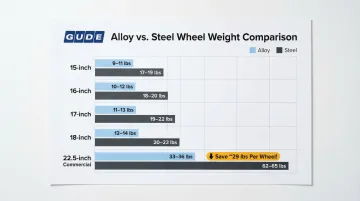
Alloy wheel weight also varies by manufacturing method. Cast aluminum wheels run heavier than forged or flow-formed variants, which compress the metal to improve strength while reducing mass. A heavy 18-inch cast alloy can weigh 25+ lbs — comparable to a basic stamped steel wheel. "Alloy" doesn't automatically mean light.
Durability and Repairability: Steel Bends, Alloy Cracks
Steel's malleability gives it a decisive advantage in impact resistance. Steel wheels bend before they crack, making roadside or trail repair feasible with basic tools. Alloy wheels are harder and more brittle. Sharp impacts from potholes or curbs often produce cracks requiring professional repair or full replacement.
Steel wheel advantages:
- Resists cracking under impact; bends instead
- Can often be temporarily reshaped in the field
- More resistant to deicers, brake dust, and road salt
- Simpler refinishing protocols for fleet maintenance
Alloy wheel vulnerabilities:
- Prone to cracking on hard impacts
- Cosmetic and structural repairs require professional intervention
- Susceptible to galvanic corrosion when protective coatings are breached by road salt
Cost: Steel Wins on Upfront and Replacement Pricing
Steel wheels cost significantly less than alloy equivalents. Alloy wheels can run 3–4x the price of comparable steel wheels, a key consideration for fleet buyers and budget-conscious consumers. Premium forged or flow-formed alloy wheels command even higher pricing due to advanced manufacturing processes.
Cost breakdown:
- Ships as standard equipment on most new vehicles, keeping upfront costs low (steel)
- Costs 3–4x more at purchase, with forged variants priced even higher (alloy)
- Replaces cheaply after damage, reducing total cost of ownership for high-mileage fleets (steel)
What Are Alloy Wheels?
Alloy wheels are manufactured primarily from an aluminum-nickel blend, most commonly produced through casting—pouring molten aluminum into a mold. Higher-end variants use forging or flow-forming processes that compress the metal structure, improving strength while further reducing weight. Lighter wheels reduce unsprung mass, improve suspension response, and lower rotating inertia — each with measurable effects on vehicle dynamics.
The performance benefits tied to alloy wheels' lighter weight are measurable:
- Reduced unsprung mass allows suspension systems to react more quickly to road inputs
- Lower rotating mass means less energy needed to accelerate and decelerate
- Better heat dissipation from the wheel surface improves brake performance on performance cars and tow rigs
That installed-base dominance translates directly to market scale. The global alloy wheels market was valued at $3.17 billion in 2024 and is projected to reach $4.58 billion by 2033, growing at a CAGR of 4.2% — a trajectory that reflects how thoroughly alloy has displaced steel in passenger vehicle production.
What Are Steel Wheels?
Steel wheels are manufactured from an iron-carbon alloy, typically pressed and welded through stamped construction rather than cast. While steel is denser than aluminum, the stamped process limits design complexity—most steel wheels feature simple hole patterns and are available in basic finishes such as black, white, or silver painted or powder-coated surfaces.
Steel wheels offer distinct operational advantages:
- Resist impact cracking better than alloy, making them well-suited for off-road, winter, and heavy-load applications
- Tolerate deicer chemicals and road salt without accelerated corrosion
- Refinish easily under standard maintenance protocols such as TMC RP 240A for commercial fleets
- Cost less to purchase and replace than alloy equivalents
The trade-off is unsprung mass. Steel wheels are heavier, which reduces acceleration, fuel economy, and handling precision relative to alloy alternatives. Fleet operations also need regular refinishing schedules to hold off rust — an ongoing maintenance cost alloy wheels avoid.
Use Cases of Steel Wheels
Steel wheels are commonly used as winter tire setups, allowing drivers to keep separate seasonal wheel sets without risking damage to expensive alloy wheels. They're also standard in commercial trucking fleets where payload capacity is more critical than wheel weight, in off-road applications requiring maximum impact resistance, and as spare wheels on many vehicles.
Fleet data tells the story clearly: roughly 80% of Class 8 tractors run aluminum wheels, while trailers flip that ratio — 80% steel and 20% aluminum. Medium-duty Class 4-6 trucks lean even harder on steel, at around 90%. Fleet operators prioritize cost and durability for trailers and secondary units where weight savings matter less than resistance to damage and low replacement cost.
Alloy vs. Steel Wheels: Which Performs Better?
The Unsprung Mass Multiplier: Why Wheel Weight Matters
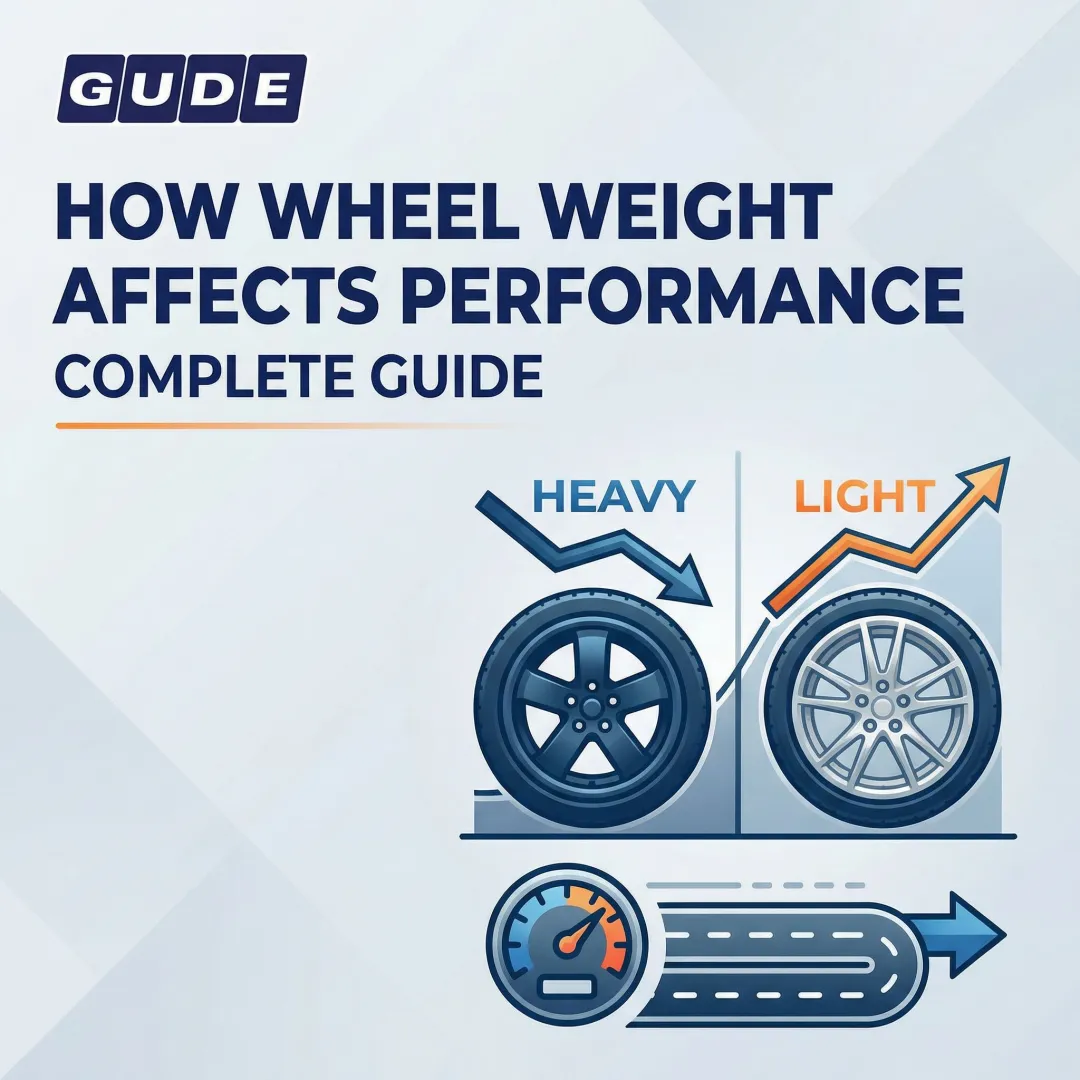
Unsprung mass—the weight of components not supported by the suspension, including wheels, tires, brakes, and axles—has an outsized effect on performance compared to equivalent weight elsewhere in the vehicle. Engineering rules-of-thumb suggest that reducing 1 lb of unsprung or rotating mass yields a dynamic benefit equivalent to removing 2–3 lbs of sprung vehicle weight.
Lighter wheels allow suspension systems to respond faster to road inputs, improve acceleration by reducing rotational inertia, and decrease braking distances by lowering the energy required to decelerate rotating mass.
Weight's Impact on Fuel Economy
Heavier steel wheels increase rolling resistance and demand more energy to accelerate from a stop and maintain speed. In commercial fleets, multiple axle positions multiply that weight penalty across the entire vehicle. MVT Solutions testing found that Alcoa ULT36 aluminum wheels in all wheel positions saved 0.89 gallons per 1,000 miles (0.86%) in fuel compared to steel equivalents.
For fleets running 100,000+ miles annually, these savings compound. A European semi-trailer truck trial showed fuel consumption decreased by 1.29% when replacing steel wheels with Alcoa aluminum wheels, translating to measurable cost reductions over the vehicle's lifespan.
Handling and Braking Performance
Alloy wheels improve cornering responsiveness, reduce braking distance slightly, and allow suspension systems to react more quickly to road inputs due to reduced rotating inertia. The lighter unsprung mass means suspension components track road surfaces more accurately, improving grip and stability during aggressive maneuvers.
The practical difference varies by driver:
- Performance applications: sharper turn-in, better steering feedback, more predictable handling at the limit
- Daily driving: smoother ride quality and more confident braking in emergency situations
Winter and Durability Performance
Steel wheels hold a decisive advantage in harsh conditions. Their resistance to road salt, deicers, and impact damage from potholes and curbs makes them more reliable in winter driving and rough-road environments. Alloy wheels can suffer accelerated corrosion when road salt breaches protective coatings. Preventing this requires strict wash-down protocols and advanced coatings like Accuride's ProShield XGT or Alcoa's Dura-Bright.
Decision Framework: Matching Material to Application
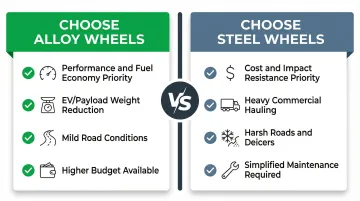
Choose alloy wheels if:
- Performance, fuel economy, and aesthetics are priorities
- Vehicle weight reduction directly impacts payload capacity or range (especially for EVs)
- Operating conditions are mild and road surfaces are well-maintained
- Budget allows for 3–4x higher upfront cost
Choose steel wheels if:
- Cost, impact resistance, and winter driving are primary concerns
- Heavy commercial hauling demands maximum durability
- Harsh road conditions and deicers are common
- Simplified maintenance and repair protocols are required
Regardless of which wheel type you select, proper wheel balance remains essential. GUDE Corp supplies lead-free, ISO 9001-certified wheel weights for both applications: adhesive weights for alloy wheels and clip-on series (MC, P, AW, IAW) for steel and alloy rims.
Real-World Applications and Considerations
A 2012 Howmet/Alcoa study put hard numbers behind what fleet operators already suspected about aluminum wheels at scale:
- Switching from steel to forged aluminum eliminates up to 3,300 lbs per truck, saving 1,612 gallons of fuel and 17.9 tons of CO2 annually
- Mass-restricted vehicles in North America gain 414 lbs of additional payload per haul at the same fuel consumption
- Volume-restricted fleets that can't add payload still see average lifetime fuel savings of more than 520 gallons per truck
Fleet operators facing rising fuel costs and carbon-reduction mandates were the early adopters here. Wheel weight directly affects cost per mile, and the savings were measurable enough to justify aluminum's 3x higher purchase price — lower fuel spend, reduced emissions, and ESG metrics that satisfied board-level reporting requirements.
The best wheel material decision is application-driven, not universal. A long-haul freight operator and a commuter vehicle program have different weight tolerances, payload economics, and maintenance cycles — and the wheel choice should reflect that. Whichever direction you go, balancing performance depends on the quality of the wheel weights used. ISO 9001-certified wheel weights, like those manufactured by Toho Kogyo and distributed through GUDE Corp, ensure consistent fit and balance across both alloy and steel wheel applications.
Conclusion
Alloy wheels deliver measurable performance and efficiency advantages in most passenger and performance applications. Steel wheels remain the rational choice where cost, durability, and harsh-environment resistance matter most. Neither is categorically superior—the right choice depends on operating conditions, budget, and vehicle application.
The right fit depends on how and where the vehicle operates:
- Fleet operators: Weight savings from alloy wheels translate directly into payload capacity and fuel cost reductions
- Everyday drivers: Alloy wheels offer handling and efficiency benefits that justify the higher upfront cost
- Winter or off-road use: Steel wheels' durability and repairability make them the more reliable long-term option
Whichever wheel type you run, proper balancing remains essential. Correct weight placement — using the right clip-on or adhesive weights for the rim profile — preserves the performance advantages of either material and extends tire life.
Frequently Asked Questions
How much lighter are alloy wheels than steel?
Passenger vehicle alloy wheels typically weigh 3–10 lbs less per wheel than steel equivalents, depending on size and manufacturing method. In commercial applications, the gap widens significantly: a 22.5-inch forged aluminum wheel can weigh 36 lbs compared to 65 lbs for steel—a 29 lb savings per wheel.
How much does an average steel wheel weigh?
Common passenger vehicle steel wheels range from 17–20 lbs for 16-inch sizes, with weight increasing for larger diameters. Commercial truck steel wheels weigh more due to larger diameter and load ratings, typically 65–82 lbs for 22.5-inch applications.
How heavy is a 16-inch steel rim?
A typical 16-inch steel rim weighs approximately 18–20 lbs (8–9 kg). Exact weight varies by rim width and manufacturer design, with some models reaching 21–23 lbs depending on construction and application.
How heavy is a 14 inch alloy wheel?
A 14-inch alloy wheel typically weighs 6–6.5 kg (approximately 8.4–8.7 lbs). Smaller diameter wheels are naturally lighter and are commonly used on compact or city cars where weight reduction improves fuel economy.
How much do 18 inch aluminum rims weigh?
18-inch aluminum rims commonly weigh 17–25+ lbs (7.7–11.3+ kg), depending on design complexity and construction method. Forged variants weigh less than cast equivalents at the same diameter.
What is the lightest material for rims?
Forged aluminum offers the best strength-to-weight ratio for rims, with performance models weighing 20–25% less than cast equivalents. For most automotive applications, cast aluminum alloy delivers the best balance of weight savings and cost.