Introduction
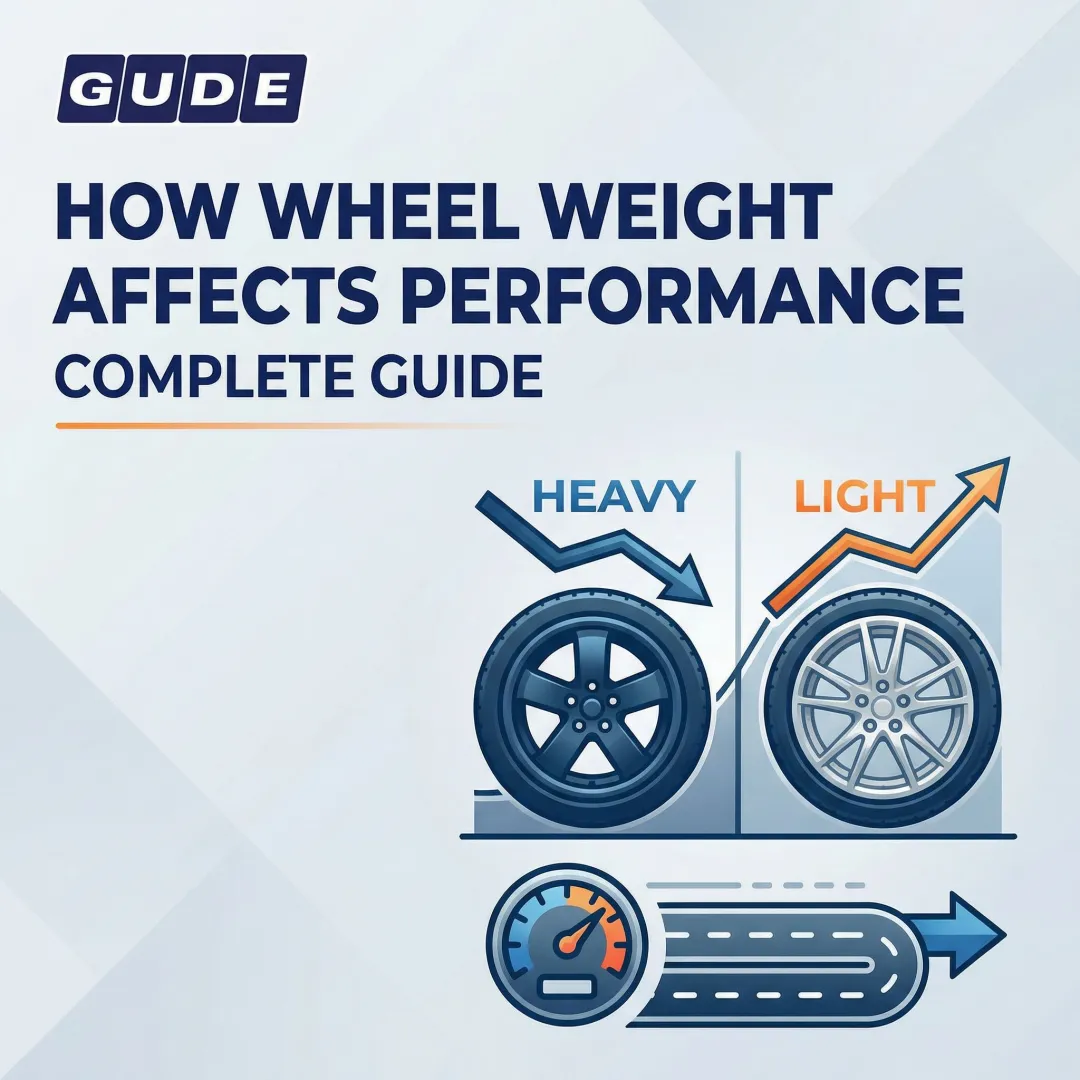
Many Audi owners, technicians, and enthusiasts struggle with understanding how wheel weight affects their vehicle's performance. A 2024 study on unsprung mass dynamics found that increased wheel weight enlarges dynamic tire load variation and suspension travel, directly reducing road-holding capability and ride comfort. Audi OEM wheel weight isn't just a passive specification—it's a critical engineering parameter that governs ride quality, handling precision, braking response, and fuel efficiency.
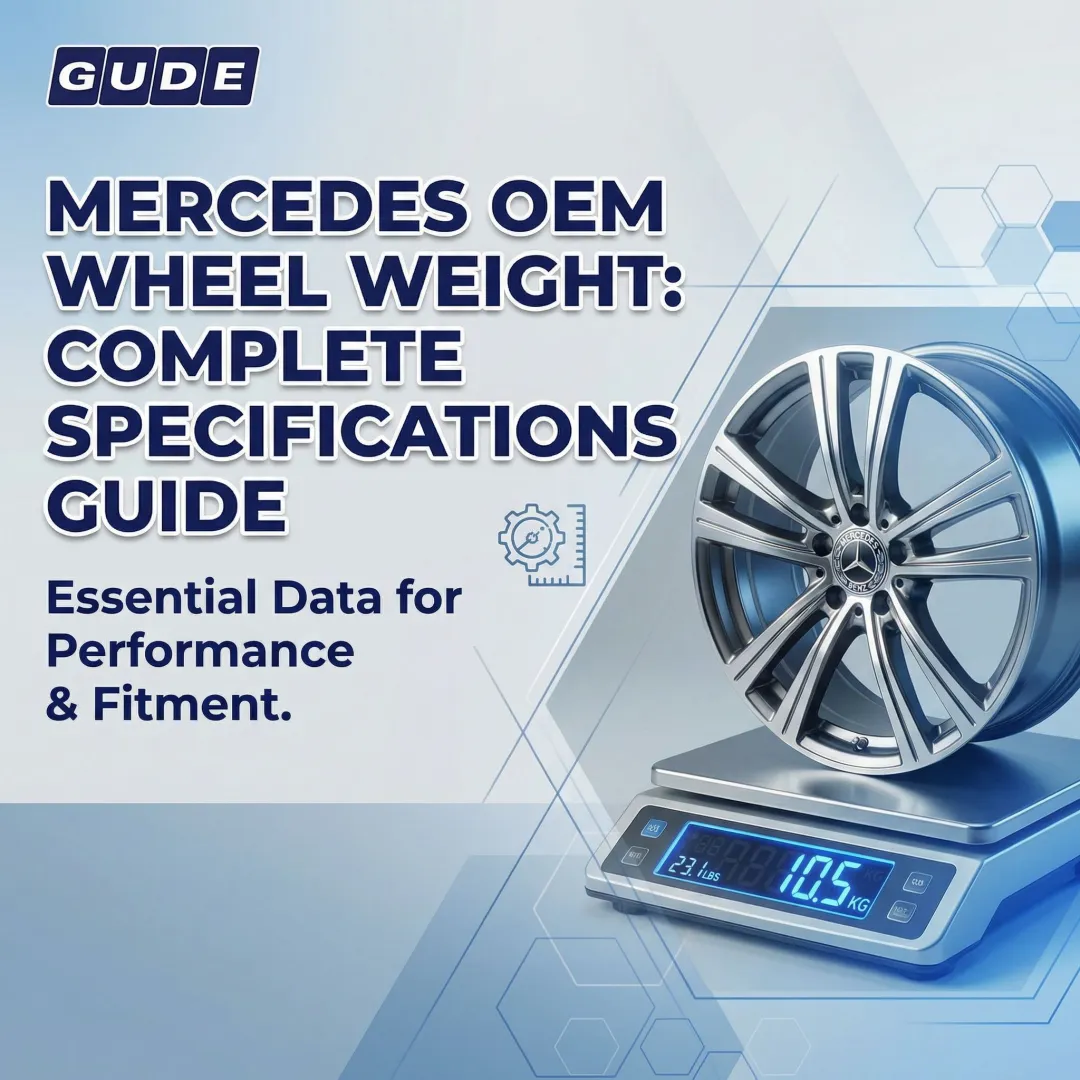
This guide covers OEM bare wheel weights across Audi's model range — from the A3 to the RS and Q lines — including weight ranges by diameter, balancing implications, and what to watch for when replacing or upgrading wheels.
TL;DR
- Audi OEM wheels range from ~18 lbs (small-diameter cast alloy) to over 32 lbs (large SUV wheels)
- Forged wheels weigh 25-35% less than cast equivalents — a 17x7.5 forged wheel can come in at 21.5 lbs versus 29.0 lbs cast
- Manufacturing method, diameter, width, and spoke design drive weight variation across Audi's lineup
- Correct wheel weight data prevents misdiagnosis during balancing and ensures proper weight selection
- Q5 and Q7 wheels on 19-21" fitments regularly exceed 30 lbs each
What Wheel Weight Represents in Audi OEM Wheels
Wheel weight refers to the total unsprung rotating mass of the bare wheel assembly, measured in pounds or kilograms. This measurement excludes the tire, valve stem, TPMS sensor, and balance weights. Unlike sprung mass (the vehicle body supported by the suspension), unsprung mass has a disproportionate effect on suspension response and road-holding.
The physics are straightforward: rotational inertia converts to an equivalent translational mass using the formula M_eff = I/r², where I is the moment of inertia and r is the wheel radius. This means mass at the outer diameter of the wheel has a far greater effect on acceleration and braking than mass near the hub center.
Audi's engineering teams treat wheel weight as a deliberate design parameter, balancing it against structural rigidity, brake clearance requirements, and aesthetic constraints at every stage of development. That balance determines where weight ends up — and how much of it there is.
Why Unsprung Mass Matters
Research shows that front and rear body accelerations increase with unsprung mass at all speeds. This creates measurable degradation in NVH (noise, vibration, harshness) characteristics. The heavier the wheel, the harder the suspension must work — and the less capacity it has left to absorb road irregularities and maintain tire contact.
The practical effects on driving dynamics include:
- Ride quality: Heavier wheels amplify vibration transmitted into the cabin
- Handling response: Increased rotational inertia slows steering inputs and cornering transitions
- Braking distance: Greater rotating mass requires more energy to decelerate
- Suspension wear: Elevated unsprung load accelerates wear on dampers and bushings
Factors That Influence Audi OEM Wheel Weight
Manufacturing Method: The Primary Driver
Two manufacturing methods define the weight range for Audi OEM wheels:
| Method | Process | Alloy | Weight Impact |
|---|---|---|---|
| Cast | Molten aluminum poured into mold; thicker walls required for structural integrity | AlSi7Mg (A356) via low-pressure die casting | Baseline weight |
| Forged | Shaped under high pressure from solid billet; denser grain allows thinner cross-sections | 6082-T6 or 6061-T6 | ~25% lighter than cast equivalent |
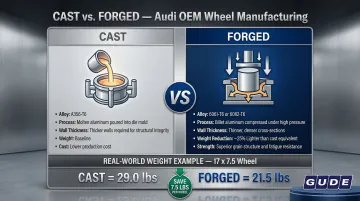
The Audi TT illustrates the gap directly: the 17x7.5 forged wheel weighs 21.5 lbs, while the cast version of the same size weighs 29.0 lbs — a 7.5 lb difference driven entirely by manufacturing method.
Diameter and Width Scaling
Wheel weight doesn't scale linearly with size — it compounds. Larger diameter wheels require more material in the barrel and rim flange to maintain structural rigidity under load. Wider wheels add mass across the entire cross-section.
Approximate weight scaling observed across Audi OEM cast wheels:
- 16" cast wheel (7" width): 18.5–20.6 lbs
- 17" cast wheel (7.5–8" width): 27–29 lbs
- 20" cast wheel (8.5–9.5" width): 28.6–32.4 lbs
The jump from 17" to 20" can add 6–8 lbs even within the same product family, representing a significant unsprung mass penalty.
Spoke Design and Geometry
Spoke count and geometry influence weight. A 5-spoke open design removes more material than a 9-spoke or mesh design. The Audi A4 demonstrates this: the 16x7 5-spoke cast wheel weighs 20.0 lbs, while the 7-spoke version at the same 16x7 size weighs 20.6 lbs — a 0.6 lb difference from spoke geometry alone.
Performance Requirements and Brake Clearance
Audi's S and RS performance trims require sufficient spoke-to-caliper clearance for large brake assemblies. This constraint limits how aggressively material can be removed from spoke cross-sections in cast designs, keeping OEM weights higher than aesthetics alone would require.
The S4 Avus 17x7.5 cast wheel weighs 28.0 lbs, compared to 21.5 lbs for the TT's 17x7.5 forged wheel. That 6.5 lb gap reflects the S4's design priority: brake clearance and structural stiffness over weight reduction.
Audi OEM Wheel Weight by Model: Reference Guide
The following weights reflect bare wheel measurements (no tire, no TPMS, no balancing weights). Minor variation can exist between production runs, regional specifications, and individual wheel condition.
Legacy Audi Models (Pre-2010)
| Model & Style | Size | Construction | Weight (lbs) |
|---|---|---|---|
| Audi A4 5-spoke | 16x7 | Cast | 20.0 |
| Audi A4 7-spoke | 16x7 | Cast | 20.6 |
| Audi A6 10-spoke | 15x6 | Cast | 14.5 |
| Audi A8 | 17x8 | Forged | 21.0 |
| Audi A8 9-spoke | 20x8.5 | Cast | 28.6 |
| Audi S4 Avus | 17x7.5 | Cast | 28.0 |
| Audi S8 Avus | 18x8 | Cast | 27.2 |
| Audi TT | 16x7 | Cast | 18.5 |
| Audi TT | 17x7.5 | Forged | 21.5 |
| Audi TT | 17x7.5 | Cast | 29.0 |
Modern Audi SUV and Performance Models (2010+)
| Model | Part Number | Size | Weight (lbs) | Construction |
|---|---|---|---|---|
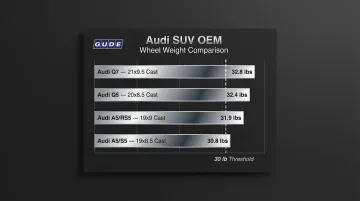
| Audi Q7 (4M) | 4M0601025AK | 21x9.5 | 32.8 | Cast |
| Audi Q5 (8R) | 8R0601025CJ | 20x8.5 | 32.4 | Cast |
| Audi A5/RS5 (F5) | 8W0601025CH | 19x9 | 31.9 | Cast |
| Audi A5/S5 (F5) | 8W0601025CD | 19x8.5 | 30.8 | Cast |
The Most Instructive Data Point
The Audi TT 17x7.5 comparison puts a number to what many technicians already suspect: same size doesn't mean same weight. The cast version comes in at 29.0 lbs; the forged version at 21.5 lbs — a 7.5 lb difference at identical 17x7.5 dimensions. Manufacturing method, not just size, drives that gap.
SUV Platform Weight Realities
As Audi expanded into larger wheel diameters on SUV and crossover platforms (Q5, Q7, Q8), OEM wheel weights on 19-21" options frequently exceed 30 lbs. The Q5's 20x8.5 cast wheel weighs 32.4 lbs, while the Q7's 21x9.5 option reaches 32.8 lbs — weights that translate directly into larger balancing corrections at the shop level, particularly when rotating between winter and summer fitments.
Key Factors That Determine Audi OEM Wheel Weight
Cast vs. Forged: The Engineering Trade-Off
Cast alloy wheels use low-pressure die casting, where molten aluminum slowly fills the mold under controlled pressure, reducing turbulence and producing quality castings. However, the casting process creates material porosity that requires thicker walls to achieve structural soundness.
Forged alloy wheels are shaped under high pressure from a solid billet, producing a denser grain structure with superior mechanical properties:
Material Property Comparison:
| Property | A356-T6 (Cast) | 6061-T6 (Forged) |
|---|---|---|
| Tensile Strength | ≥234 MPa | 290 MPa |
| Yield Strength | ≥165 MPa | 240 MPa |
| Elongation | ≥3.5% | 12-17% |
The higher strength of forged alloys allows engineers to use less material for the same structural integrity, reducing unsprung mass.
Material Composition and Alloy Grade
Standard Audi OEM cast alloys are AlSi7Mg (A356), modified with strontium for improved mechanical properties. Forged OEM options use higher-grade 6082-T6 (Europe) or 6061-T6 (North America) billet aluminum.
Magnesium alloy wheels are not used in production Audi OEM applications. The Audi R8 GT's ultra-lightweight wheels are fully milled forged aluminum, not magnesium — carbon ceramic rotors run extremely hot, and magnesium poses a flammability risk in that environment.
Size Interaction with Design
Alloy grade determines how much material engineers need — but size determines how much surface area that material must cover. Larger diameter wheels require more material throughout: barrel height increases with diameter, and the rim flange must maintain structural rigidity under cornering loads. Wider wheels add mass across the entire cross-section, and both effects accelerate together.
Example: A Q5 moving from 18" to 20" wheels adds approximately 6-8 lbs per wheel, totaling 24-32 lbs of additional unsprung mass for the complete set.
Brake Clearance Constraints
Audi's performance trims (S and RS lines) require sufficient spoke-to-caliper clearance for large brake assemblies. This limits how aggressively material can be removed from spoke cross-sections, keeping OEM weights higher than design-driven considerations alone would suggest.
How Audi OEM Wheel Weight Is Specified, Measured, and Verified
Documentation Sources
Audi documents OEM wheel specifications through part number data, technical data sheets, and homologation records. Verified weight values can be cross-referenced against:
- Audi ETK (electronic parts catalogue) - provides part numbers and fitment
- Independent enthusiast databases - compiled measurement logs
- Manufacturer stamping - part numbers and production codes on the wheel itself
However, ETKA catalogs provide exploded diagrams and OEM part numbers but do not reliably publish bare wheel mass specifications. Technicians must rely on verified secondary databases or physical measurements.
Practical Verification Method
To verify an individual wheel's weight accurately:
- Remove all components: Tire, valve stem, TPMS sensor, center cap, and existing balance weights
- Use calibrated equipment: Floor scale or workshop digital scale capable of 0.1 lb resolution
- Weigh the bare wheel: Record the measurement
- Compare to OEM specification: Cross-reference against the known spec for that part number
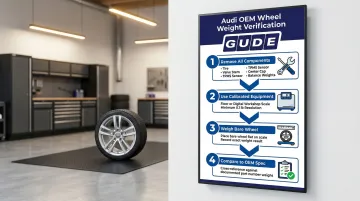
This bare wheel weight, combined with mounted tire weight, gives the total rotating assembly mass—the figure that determines balancing weight requirements.
Balancing Weight Selection Context
Once you have the bare wheel weight, it directly informs the next decision: whether clip-on or adhesive balancing weights are appropriate for that specific Audi wheel profile.
For alloy Audi wheels with polished, painted, or clear-coated finishes, adhesive stick-on weights are the preferred method to avoid rim flange damage or finish marking.
For standard alloy wheel rim profiles, GUDE's AW Series clip-on weights feature a low-profile design engineered for alloy wheel rim flange geometry, minimizing visibility while providing secure attachment. For premium wheels where aesthetics are critical, GUDE's IAW Series offers hidden inner-rim placement, preserving the visible face of the wheel without any outward hardware.
Consequences of Incorrect Wheel Weight Specification
Performance Degradation
Running wheels heavier than OEM specification creates measurable performance penalties:
- Increased unsprung mass slows suspension response to road inputs
- Higher rotational inertia degrades acceleration and extends braking distances
- Harmonic vibration can introduce frequencies the suspension geometry wasn't tuned to handle
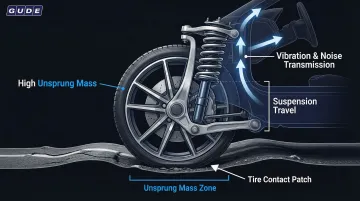
Research shows that increased unsprung mass enlarges wheel dynamic load variation, deteriorating road-holding capability.
Balancing Misdiagnosis
When wheel weight data is unknown or ignored during balancing, technicians cannot accurately assess whether vibration complaints originate from:
- Out-of-balance condition
- Weight mismatch between wheels
- Structural wheel damage
- Tire defects
This leads to misdiagnosis, incorrect corrective actions, and repeat service visits. Those errors often trace back to two persistent assumptions about wheel specification.
Two Misconceptions That Drive Specification Errors
"Same size means same weight" — The Audi TT cast vs. forged example disproves this directly: 29.0 lbs vs. 21.5 lbs at the same 17x7.5 nominal dimension. Manufacturing method, spoke geometry, and alloy grade create substantial weight variation even when the size stamp is identical.
"Heavier means stronger" — Audi's forged OEM options are both lighter and stronger than their cast equivalents. Forged 6061-T6 alloy has a 240 MPa yield strength versus cast A356-T6's 165 MPa — 45% stronger at 25% less weight. Construction method and alloy specification determine durability, not mass.
Frequently Asked Questions
How much do Audi 17 wheels weigh?
Audi OEM 17" wheels typically range from 21-29 lbs depending on construction method and spoke design. The TT's 17x7.5 forged wheel weighs 21.5 lbs, while the cast version of the same size reaches 29.0 lbs. The S4 Avus 17x7.5 cast wheel weighs 28.0 lbs.
How much does a 19 wheel weigh?
Audi OEM 19" wheels generally fall in the 30-32 lb range for standard alloy cast designs. The A5/S5 (F5) 19x8.5 weighs 30.8 lbs and the RS5 19x9 reaches 31.9 lbs, with forged alternatives cutting weight by roughly 25% across platforms.
How much do the Audi Q7 wheels weigh?
Q7 OEM wheels range from 18" to 21" depending on trim and are among the heavier Audi alloy designs due to SUV load requirements. The 21x9.5 cast wheel (part number 4M0601025AK) weighs 32.8 lbs bare, while 18" and 19" Q7 options typically fall in the 28-30 lb range.
How to tell if Audi rims are OEM?
Genuine Audi OEM wheels carry the Audi part number etched or cast into the back of the wheel, often on a spoke or the inner barrel. Look for production date codes and the Audi four-ring logo embossed on the inner surface. Weight serves as secondary verification—a wheel that measures notably heavier or lighter than the documented OEM spec for that part number warrants closer inspection for authenticity.
How do I know what wheel weights to use?
Balancing weight selection (type, size, and placement) is determined by the imbalance measurement from a calibrated wheel balancer, not by OEM wheel weight alone. However, knowing the wheel's bare OEM weight and rim profile is essential for choosing between clip-on or adhesive-style weights. For Audi alloy wheels, adhesive weights or low-profile clip-on options (like GUDE's AW or IAW series) prevent cosmetic damage to polished or coated finishes.
Is 27 lbs light for rims?
27 lbs is within the normal range for larger Audi OEM cast alloy wheels (17-18" diameter, wider width) and is not considered light. The S8 Avus 18x8 cast wheel weighs 27.2 lbs. Forged alternatives at the same size typically weigh 6-8 lbs less. For performance applications, anything above 24 lbs at 17" represents a real unsprung mass penalty compared to forged options.