Introduction
Toyota engineers specify wheel weight down to the ounce — and for good reason. Swapping OEM wheels for larger aftermarket rims or switching from steel to alloy changes the rotating mass that Toyota calibrated for ride comfort, handling response, and load ratings. According to the National Renewable Energy Laboratory, a 10% reduction in vehicle weight produces a 3% to 6% decrease in fuel consumption — which shows how much rotating mass matters for overall efficiency.
This guide covers OEM wheel weight ranges across Toyota's major vehicle lines, the factors driving variation between models and trims, and what changes when wheel weight deviates from factory specifications. You'll learn how to verify published specifications, understand the consequences of upsizing or switching materials, and ensure proper rebalancing when modifications are made.
TLDR
- Toyota OEM wheel weights (bare rim) typically range from 15–30+ lbs depending on model, diameter, and material
- Steel wheels generally weigh more than alloy at the same diameter, though the gap narrows at larger sizes
- Wheel diameter, width, material, and spoke design drive weight differences within the same model line
- Swapping OEM wheels requires full rebalancing — weight type and quantity will likely change with the new rim profile
- Cross-reference Toyota's Technical Information System (TIS) for accurate specs — published estimates vary widely
What Toyota OEM Wheel Weight Represents
Toyota wheel weight refers to the mass of the bare wheel (rim only) as manufactured and shipped from Toyota's OEM supply chain. This figure excludes the tire, valve stem, and balancing weights—components that together form the complete rotating assembly.
Toyota engineers wheel weight as a deliberate design parameter. Each wheel's mass is specified to achieve three goals:
- Optimize unsprung mass for the vehicle platform
- Influence ride comfort and handling response
- Meet load-rating requirements across trim levels
Unsprung mass—the weight of components not supported by the suspension—directly affects how well tires maintain contact with the road surface.
Wheel weight exists as both a design specification (defined in Toyota's engineering documentation and parts catalogs) and a measurable physical attribute. Nominal catalog values may vary slightly due to manufacturing tolerances and casting or forging batch variation, making field verification important before balancing or wheel swap work.
Toyota OEM Wheel Weight Ranges by Model and Configuration
Toyota's wheel weight specifications are model- and trim-specific. Diameter ranges from 15" on base compact trims to 22" on premium Tundra builds — with width, material, and spoke count all contributing to weight variation across the lineup.
Compact Cars and Sedans (Corolla, Camry)
Compact cars and sedans in Toyota's lineup typically run 15"–18" OEM wheels, with base trims equipped with steel and higher trims featuring alloy. A base Corolla on 15" steel will run heavier per wheel than an alloy-equipped higher trim — a gap that narrows as alloy diameter increases.
Typical range:
- 15"–16" steel wheels: 18–22 lbs per wheel
- 16"–18" alloy wheels: 15–20 lbs per wheel
That 3–5 lb delta per corner adds up across all four wheels — a meaningful figure when calculating balancing weight requirements for a full set.
SUVs and Crossovers (RAV4, Highlander, 4Runner)
This segment splits between car-based platforms (RAV4, Highlander) and the truck-derived 4Runner. The 4Runner's heavier platform and stiffer rim flanges push baseline wheel weights above what car-based crossovers require — which also affects the clip profile needed for accurate balancing.
Typical range:
- RAV4 (17"–18" alloy): 18–23 lbs per wheel
- Highlander (18"–20" alloy): 20–26 lbs per wheel
- 4Runner (17"–18" alloy): 22–28 lbs per wheel
Trim-to-trim weight differences within the same model can reach 3–5 lbs, particularly when comparing base alloy wheels to larger premium-trim designs.
Trucks (Tacoma, Tundra)
Toyota's truck lineup carries the heaviest per-wheel weights in the brand's range. The Tundra supports OEM wheels up to 22" on higher trims — producing the greatest mass per wheel of any Toyota model in production.
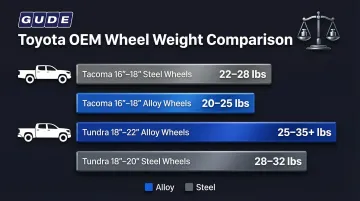
Typical range:
- Tacoma (16"–18" steel): 22–28 lbs per wheel
- Tacoma (16"–18" alloy): 20–25 lbs per wheel
- Tundra (18"–22" alloy): 25–35+ lbs per wheel
- Tundra (18"–20" steel): 28–32 lbs per wheel
The 2000-era first-generation Tundra ran 15"–17" wheels at 20–26 lbs (steel) or 18–23 lbs (alloy). Current-generation models have shifted to larger diameters and heavier assemblies across both steel and alloy configurations.
Steel vs. Alloy OEM Comparison Across Models
Toyota's steel OEM wheels are generally heavier per size than their alloy counterparts on the same vehicle, but the weight delta narrows as alloy size increases.
Comparative summary:
| Model | Steel Wheel | Alloy Wheel | Weight Difference |
|---|---|---|---|
| Corolla (16") | ~20 lbs | ~17 lbs | ~3 lbs |
| Tacoma (17") | ~26 lbs | ~22 lbs | ~4 lbs |
At larger diameters (20"+), cast alloy wheels can approach or even exceed the weight of equivalent-diameter steel wheels, narrowing the traditional weight advantage. At larger diameters (20"+), cast alloy wheels can approach or even exceed the weight of equivalent-diameter steel wheels, narrowing the traditional weight advantage. Toyota's steel-wheel trims — particularly on Tacoma and older Tundra builds — also use a distinctive rim flange profile that requires a matched clip-on weight for proper seating during balancing.
Factors That Influence Toyota Wheel Weight in Real-World Conditions
Material and Construction Process
Cast aluminum alloy wheels—Toyota's most common OEM alloy type—are lighter than steel at smaller diameters, but the gap closes as diameter increases. Forged aluminum wheels offer 20% to 30% weight reduction over cast equivalents at the same structural strength. Forged 6061-T6 aluminum has approximately 33% higher yield strength than cast alloys and superior ductility—though Toyota reserves forged wheels for select performance and premium trims rather than standard OEM fitments.
Wheel Diameter and Width
Diameter and width directly determine material volume. Upsizing from a 16" to an 18" or 20" OEM wheel adds measurable weight regardless of material. Across a five-wheel set (including the spare), that math adds up fast — a 4 lb increase per wheel means 20 lbs of added rotating and unsprung mass, a figure many builders underestimate until they're already committed to the upgrade.
Manufacturing Tolerances and Coating
OEM wheel weights represent nominal catalog values. Real-world variation from casting tolerances, hub bore machining, and protective coating adds minor but real mass.
Common finish-related weight additions include:
- Powder coating adds roughly 5% to wheel weight — on an 18 lb wheel, that's about 0.9 lbs
- Full chrome plating on aluminum adds approximately 1 lb per wheel
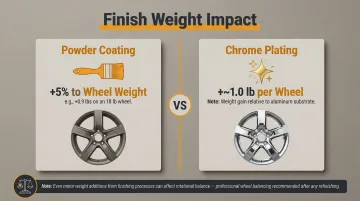
Even small finish-driven weight gains shift the balance point enough to require precise correction — which is why balancing weights with 0.25 oz increments matter more on coated or chromed wheels than many technicians expect.
How Toyota Wheel Weight Is Specified, Documented, and Verified
Specification Sources
Toyota publishes wheel weight data through official channels including parts catalogs, the Toyota Technical Information System (TIS), and vehicle-specific service manuals. TIS is the definitive service support source for all Toyota vehicles marketed in North America from 1990 onward. It provides access to repair manuals, service bulletins, wiring diagrams, and technical specifications.
The difference between "rated" catalog weight and "as-tested" wheel weight matters. Aftermarket data sources vary in accuracy—technicians should verify against OEM documentation when precision matters.
Measurement and Verification Methods
Physical weighing using a calibrated workshop scale is the most reliable field verification method. NIST Handbook 44 (2023) outlines specifications and tolerances for weighing devices, ensuring that field standard weights comply with strict accuracy requirements.
Wheel weight should be measured on the bare rim (without tire, valve stem, or balancing weights) for consistency with OEM specifications. This distinguishes field verification from the precision measurement environments used in OEM validation.
How Wheel Weight Affects Balancing Weight Selection
Once the wheel-tire assembly weight and mass distribution are known, the technician determines how many wheel weights are required. That step is only as accurate as the weights themselves—which is where OEM-spec sourcing matters.
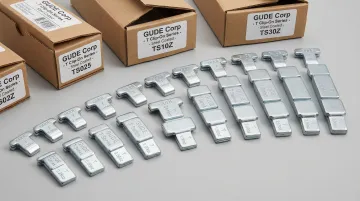
GUDE Corp's T Clip-On Series is manufactured to Toyota OEM rim flange specifications by Toho Kogyo, the #1 wheel weight manufacturer in Japan and Toyota's OEM supplier. All products are lead-free, coated steel, and ISO 9001 certified—built to the same tolerances used in Toyota's own assembly process.
Deviating from OEM Wheel Weight: Upgrade Implications and Rebalancing Requirements
Changing wheel mass—whether through upsizing, switching materials, or running aftermarket wheels—initiates a chain of consequences across vehicle dynamics, powertrain demand, and balance requirements that OEM specifications were designed to prevent.
Unsprung Mass and Handling Consequences
Increasing wheel weight adds to unsprung mass (the rotating and suspension components not supported by the vehicle's springs), which reduces the suspension's ability to keep tires in contact with the road surface. A 2025 SAE study confirms that reduction of unsprung mass reduces fuel consumption for vehicles.
For Toyota trucks and SUVs used in off-road or load-carrying applications, increased unsprung mass degrades ride quality and handling response. The suspension must work harder to control wheel motion, reducing tire contact patch consistency and compromising traction.
Payload, GVM, and Fuel Economy Effects
Heavier wheels directly cut into available payload capacity. The 2024 Tundra's GVWR ranges from 6,990 to 7,780 lbs, while the 2026 Tacoma's GVWR spans 5,605 to 6,305 lbs. A significant increase in per-wheel mass across five wheels (including spare) can quietly erode GVM headroom.
Fuel economy also suffers as the drivetrain must overcome greater rotating inertia. The NREL study found that fuel consumption is approximately a linear function of weight, aerodynamic drag, and rolling resistance—meaning every pound added to rotating mass has a compounding effect on efficiency.
Rebalancing Requirements After Wheel Changes
Any change in wheel weight—including switching to a heavier aftermarket steel wheel, a larger alloy, or a different tire size—requires a full rebalance of each wheel-tire assembly. The new weight distribution will differ from OEM, and the quantity and placement of balancing weights must be recalculated from scratch.
Weight selection matters here. GUDE Corp's T Series clip-on weights are built specifically to Toyota OEM rim flange specifications and are available in 0.25oz to 3.00oz increments—giving technicians the precision needed to restore balance after any Toyota wheel change.
Common Misunderstanding: Alloy Is Always Lighter
Many assume any alloy upgrade will reduce wheel weight versus a steel OEM wheel. At larger diameters, cast alloy wheels can approach or exceed the weight of equivalent steel wheels. Only forged alloy wheels reliably deliver significant weight savings.
Example:
- 17" steel wheel: ~26 lbs
- 20" cast alloy wheel: ~28 lbs
- 20" forged alloy wheel: ~22 lbs
The assumption that "alloy = lighter" breaks down at larger sizes unless you're investing in forged construction.
Frequently Asked Questions
What is the average weight of a car wheel?
The typical bare rim weight for passenger vehicles ranges from roughly 15–30 lbs depending on size and material. Steel wheels trend heavier than alloy at equivalent diameters. This refers to the rim alone, not the full wheel-tire assembly.
How much does a Toyota Tacoma wheel weigh?
Toyota Tacoma OEM wheels typically weigh 20–28 lbs depending on diameter (16"–18") and material (steel vs. alloy). Steel variants run heavier, while alloy options reduce weight by 2–4 lbs at the same diameter. Verify against Toyota's official parts documentation for your specific model year and trim.
How much does a 2000 Toyota Tundra wheel weigh?
First-generation Tundra OEM wheels (2000–2006) typically weighed 20–26 lbs for steel and 18–23 lbs for alloy, with diameters ranging from 15"–17". Current-generation Tundra wheels (18"–22") weigh 25–35+ lbs, reflecting the shift toward larger diameters.
What is the difference in weight between Toyota steel and alloy OEM wheels?
Steel wheels are generally heavier at the same diameter, with differences of 2–5 lbs per wheel. At 20"+ diameters, the gap narrows — cast alloy wheels can approach steel wheel weights.
How does Toyota wheel weight affect balancing weight requirements?
Larger or heavier wheels shift the weight distribution of the wheel-tire assembly, requiring precise balancing to prevent vibration and uneven tire wear. When upgrading from OEM wheels, a full rebalance is required — using weights matched to Toyota's rim flange profile, such as T Series clip-on weights, ensures a correct fit.
Does upsizing Toyota wheels void OEM balance specifications?
Yes. Fitting non-OEM wheels or larger sizes means the factory balance specs no longer apply. A fresh balance is required, and the type and quantity of wheel balancing weights must be determined based on the new assembly's mass distribution and geometry.