Introduction
When selecting aftermarket alloy wheels, many vehicle owners focus on aesthetics—diameter, finish, and spoke design—while overlooking a safety-critical specification: the alloy wheel weight rating (also called load rating). This number determines whether a wheel can safely carry the forces placed on it, not just the vehicle's static weight but dynamic loads from cornering, braking, and rough surfaces.
That rating isn't just a static threshold. When a wheel carries more than its rated load (even briefly, during a hard corner or pothole strike), it accelerates metal fatigue. Research shows overloading significantly shortens alloy wheel fatigue life, raising the risk of spoke fractures and cracking at stress concentrators like spoke-hub junctions.
Understanding the rating — where it comes from, how to calculate your minimum requirement, and where misinterpretation leads to failures — is the difference between a wheel that performs and one that doesn't.
TL;DR
- Alloy wheel load rating is the maximum load a single wheel is certified to support (in kg or lbs), verified through standardized structural tests—not simply the car's weight divided by four
- The stamped number comes from dynamic test procedures (cornering fatigue, radial fatigue, impact)—it's a design certification, not an in-service continuous rating
- To find your minimum requirement, divide the higher GAWR figure from your door jamb sticker by two
- Wheel load rating and tire load index are separate specifications—both must be satisfied for safe operation
- Exceeding the rated load accelerates fatigue and can cause structural failure, especially on lightweight aftermarket alloys
What Alloy Wheel Weight Rating Actually Means
Wheel load rating is the maximum static-equivalent force per wheel that the wheel structure—hub face, spokes, and barrel—is certified to withstand under standardized test conditions without structural failure or permanent deformation beyond allowable limits. According to SAE J2530, the wheel load rating must be no less than one-half of the vehicle's heaviest axle static load.
This is a design certification parameter, not a passive measurement. The rating is assigned after the wheel passes specific physical lab tests simulating real operating loads, reflecting both material properties and structural geometry of that specific wheel design.
Static vs. Dynamic Loads:
A vehicle may weigh 2,000 kg at rest, but during hard cornering, braking, or curb impact, individual wheel loads spike well above each wheel's static share. Lateral load transfer during cornering follows the formula ΔW = (W × Ay × h) / t, where:
- W = total vehicle mass
- Ay = lateral acceleration (g-force)
- h = center of gravity height
- t = track width
A vehicle cornering at 0.9g with a CG height of 0.6m and track width of 1.6m transfers 33.75% of its total mass laterally. Outside wheels end up carrying well beyond their proportional static load.
Factors That Influence the Rating in Practice
Manufacturing Process:
The production method directly sets the achievable load rating for a given wheel weight:
- Gravity-cast wheels typically yield lower ratings
- Low-pressure cast or flow-formed designs increase barrel strength by 15-20% over standard casting
- Forged wheels achieve higher yield strength, allowing designers to either reduce material (saving weight) or increase load capacity (improving safety margin)
Material Strength Comparison:
| Material/Process | Ultimate Tensile Strength (MPa) | Yield Strength (MPa) | Elongation (%) |
|---|---|---|---|
| A356-T6 (Cast) | 228-234 | 152-165 | 3.0-3.5 |
| 6061-T6 (Forged) | 310 | 276 | 12-17 |
Data from MatWeb material databases.
Heat Treatment:
T6 heat treatment (solution heat treatment + artificial aging) pushes aluminum alloy yield strength well past what T4 or as-cast conditions achieve. Research on A356.2 aluminum shows T6 condition raises yield strength from ~103 MPa (as-cast) to ≥152–165 MPa, which directly determines the maximum load rating the finished wheel can carry.
Spoke Geometry:
Spoke geometry, barrel wall thickness, and spoke-to-hub transition design all affect how load distributes under cornering. FEA studies show that optimizing spoke design can increase fatigue life by up to 530% compared to baseline models. This means load rating isn't just a material spec — it reflects the entire engineered geometry of a wheel.
How Load Rating Values Are Established and What the Numbers Mean
The most widely used standard is JWL (Japan Light Alloy Wheel), developed in 1981 and now the recognized global benchmark for passenger car alloy wheels. VIA (Vehicle Inspection Association) serves as the independent verification body that physically tests manufacturer-submitted samples.
Three Key Dynamic Tests
- Cornering Fatigue Test — Wheel and tyre assembly is tilted and rolled on a drum under a defined lateral load for at least 100,000 revolutions to simulate sustained cornering
- Radial Fatigue Test — Applies a radial force equal to 2.25× the wheel's load rating for over 500,000 revolutions, simulating the compressive loads of normal road driving
- Impact Test — A drop-weight strike on the flange evaluates resistance to sudden kerb-type impacts; the primary pass/fail criterion is whether the tyre retains air pressure
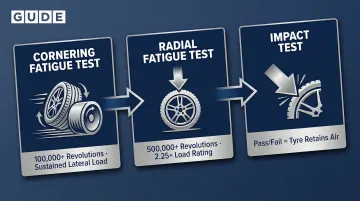
The certified load rating is derived from the test loads these three procedures apply.
Nominal Load Rating Ranges
Typical load rating tiers for passenger car and light truck alloy wheels:
- 17-18" passenger car wheels: 650-750 kg (1,430-1,653 lbs) per wheel
- Light truck/SUV wheels: 900-1,250 kg (1,984-2,756 lbs) or higher
- Heavy-duty light truck wheels: Up to 1,650 kg (3,640 lbs) for specialized applications
These figures apply under standard conditions: correct tyre inflation, vehicle operating within GVWR, and no repeated overloading beyond rated capacity.
Safe Operating Margin and Factor of Safety
Factor of Safety (FoS) describes the ratio between a wheel's certified capacity and its working load. If a wheel is rated at 750 kg and routinely carries 400 kg, the FoS is approximately 1.875. That means the wheel has nearly twice the structural capacity its actual load demands.
OEM and aftermarket wheels handle this margin differently:
- OEM wheels typically carry a conservative FoS of 2.0 to 3.0
- Lightweight aftermarket wheels may run a lower FoS (1.5-2.0) to reduce unsprung weight
- Track-use wheels with tighter margins wear faster under repeated high-load cornering
The stamped rating says the wheel passed the test, not how much headroom exists above that threshold. Track enthusiasts should seek wheels tested at 10-20% above JWL standards to compensate for lower FoS.
How to Find and Verify Your Required Wheel Load Rating
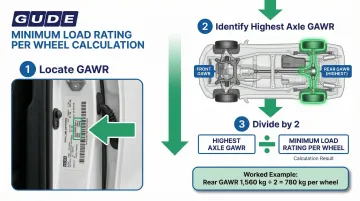
Standard Calculation Method:
- Locate the Gross Axle Weight Rating (GAWR) on the vehicle identification label (door jamb, fuel filler flap, or under the hood)
- Divide the highest axle GAWR (front or rear, whichever is greater) by 2
- This gives you the minimum load rating per wheel required for that axle
Example: If your rear axle GAWR is 1,560 kg (3,439 lbs), your minimum required load rating per wheel is 780 kg (1,720 lbs).
Locating the Wheel's Certified Load Rating:
The load rating is stamped or engraved on the inner barrel or back of a spoke, typically alongside wheel size, offset, and PCD markings. If markings are absent or illegible, treat the wheel as unrated and do not install.
The 105% Rule
Some aftermarket wheel fitment guidelines require that the replacement wheel's load rating equal or exceed 105% of the vehicle manufacturer's original equipment wheel load rating—not just 100%—to provide an adequate safety buffer. This rule provides a small margin above the minimum threshold when substituting aftermarket alloys.
Proper Wheel Setup Beyond Load Rating
Confirming the load rating is only one part of the equation. Once a correctly rated wheel is mounted, accurate dynamic wheel balancing is the next step — ensuring smooth rotation and even load distribution throughout service life.
Wheel weight selection matters here as well. GUDE Corp's AW Series clip-on weights are built to ISO 9001 standards and feature a low-profile clip designed for alloy wheel rim flange geometry, keeping the weight secure without protruding past the spoke face.
What Happens When You Exceed the Rated Load
How Overloading Damages Wheels
Alloy wheels rarely fail instantly under a single overload event — unless it's an extreme impact. Instead, exceeding the rated load accelerates metal fatigue by increasing cyclic bending stress on spokes and the barrel, progressively advancing micro-crack initiation and propagation until fracture occurs.
Common Overload Scenarios
- Hard cornering on track or twisty roads (lateral g-force multiplies effective wheel load)
- Kerb strikes and pothole impacts
- Overloaded cargo on commercial or off-road vehicles
- Lifted suspension that changes load distribution geometry
Safety, Compliance, and Warranty Consequences
An overloaded wheel that fails can cause sudden loss of vehicle control — with serious downstream consequences:
- Fitting wheels below the vehicle's GAWR requirement may void manufacturer warranties
- Coverage gaps can invalidate vehicle insurance
- Running underrated wheels creates a legal roadworthiness violation in many jurisdictions
NHTSA recall 26E010000 involved aftermarket aluminum wheels that cracked after hitting bumps or potholes due to material inconsistencies—demonstrating the real-world consequences of inadequate load capacity.
Common Misunderstandings About Alloy Wheel Weight Ratings
Load Rating Is Not the Same as Physical Wheel Weight
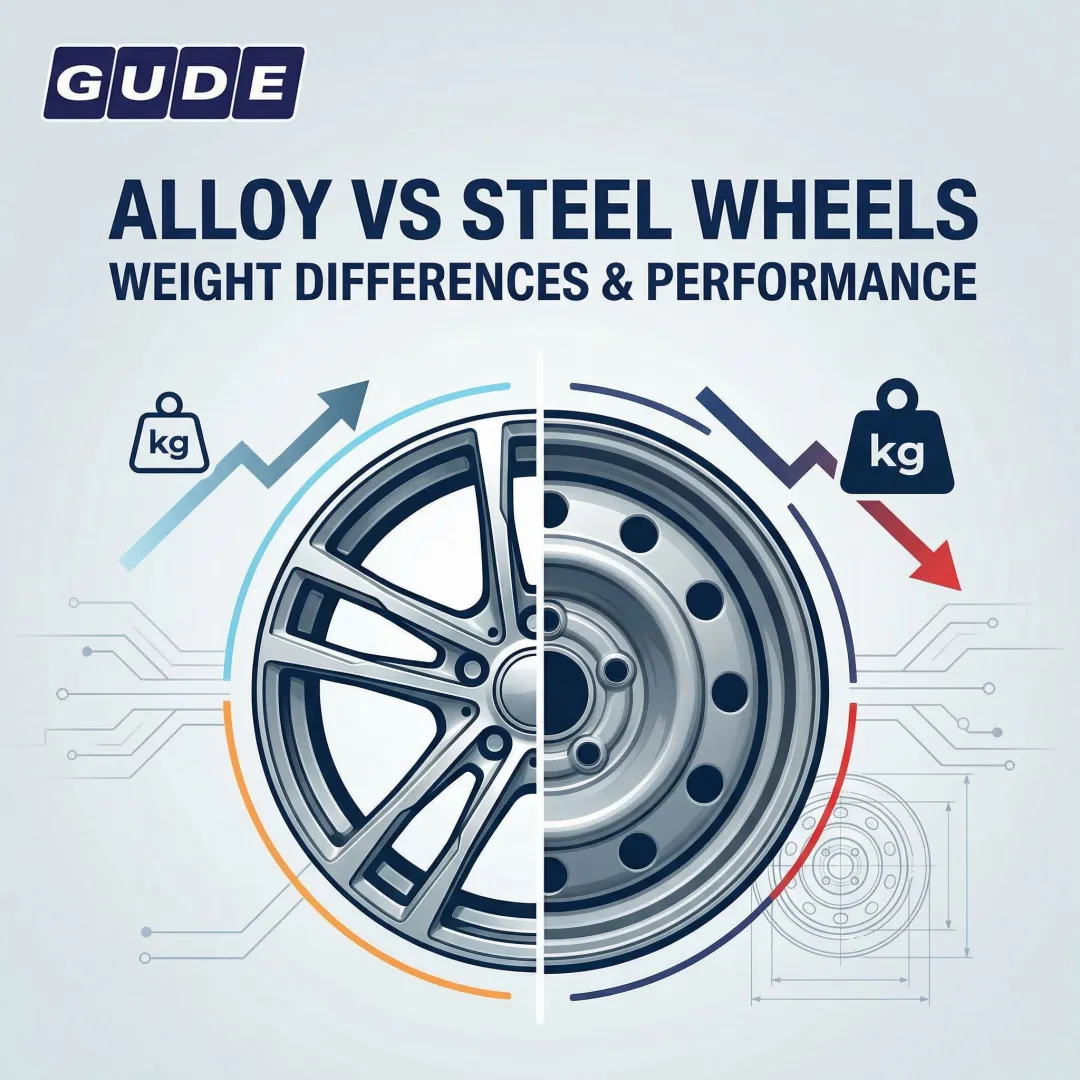
The load rating is the maximum force the wheel can support. The wheel's own mass — its unsprung weight — is a separate specification entirely. A heavier wheel is not automatically more load-capable, and a lighter wheel is not automatically under-rated.
Wheel Load Rating and Tire Load Index Are Separate Requirements
The tire sidewall carries a load index number (e.g., 115 = 1,215 kg / 2,679 lbs) and a speed rating letter. These are tire specifications — not wheel specifications. Both the wheel and the tire must independently satisfy the vehicle's load requirements:
- Wheel load rating: Set by the wheel manufacturer, stamped or cast into the wheel
- Tire load index: Printed on the tire sidewall, dictated by tire construction
Satisfying one does not substitute for the other.
A Higher Load Rating Isn't Always the Right Choice
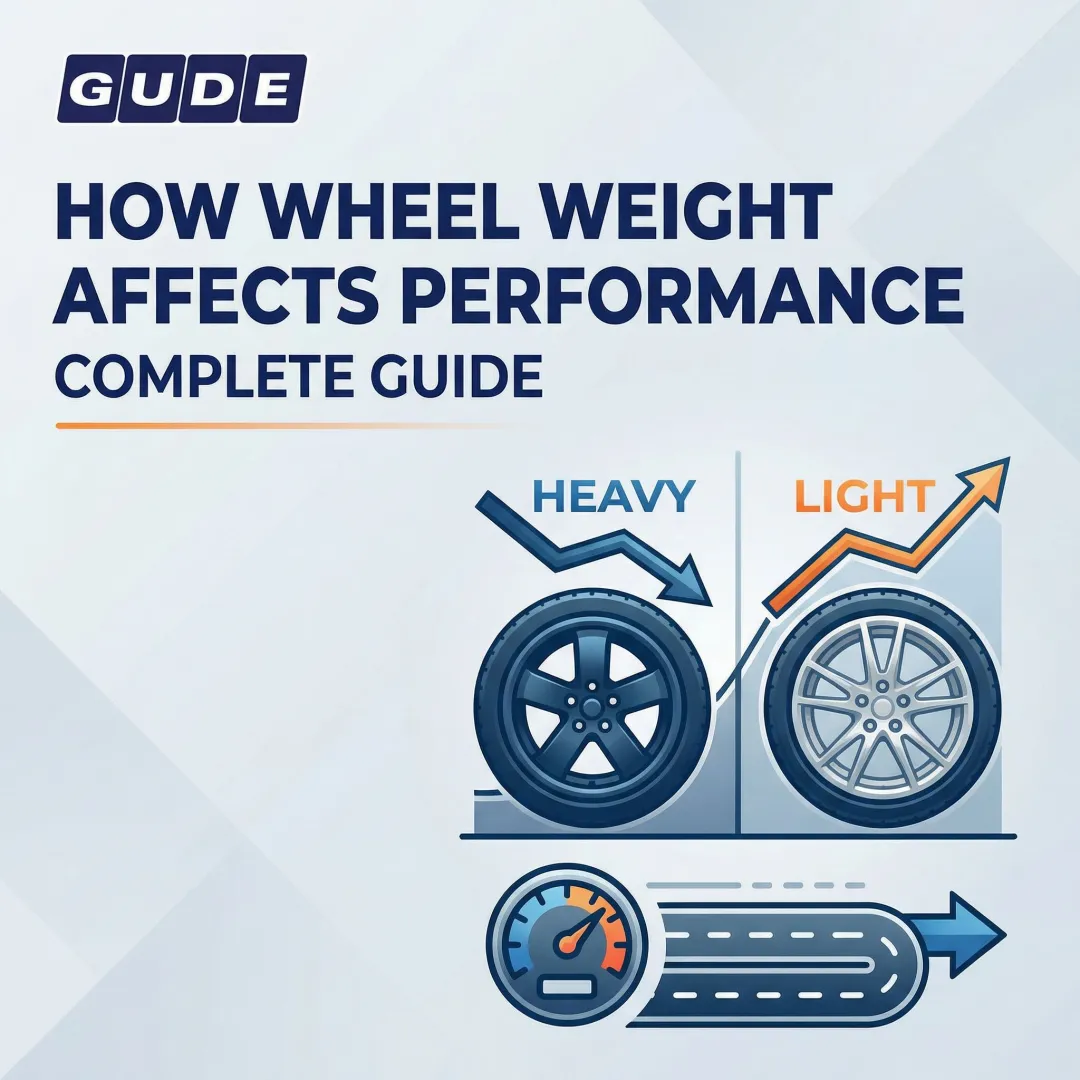
Wheels engineered for a much higher load rating than the vehicle requires are typically heavier, which increases unsprung mass and can negatively affect:
- Ride quality
- Fuel economy
- Handling response
Match the wheel's load rating to the vehicle's axle load requirement — a modest margin above the minimum is fine, but chasing the highest available rating adds weight without a practical benefit.
Frequently Asked Questions
Frequently Asked Questions
Are alloy wheels weight rated?
Yes, alloy wheels carry a certified load rating stamped on the inner barrel, representing the maximum weight the wheel is designed to support as verified by standardized dynamic tests such as JWL/VIA. This rating must meet or exceed the vehicle's per-wheel axle weight requirement.
What is the 105% rule for wheels?
The 105% rule requires a replacement aftermarket wheel's load rating to be at least 105% of the original OEM wheel's rated capacity, not just equal to it. This provides a small safety margin above the minimum threshold.
What load range is 115?
115 is a tire load index (not a wheel load rating), corresponding to a maximum load capacity of 1,215 kg (2,679 lbs) per tire from the standardized load index table. It is a tire specification, separate from the alloy wheel's own stamped load rating.
What does 110T mean on a tire?
110 is the tire load index corresponding to 1,060 kg (2,337 lbs) maximum load capacity. "T" is the speed rating indicating a maximum certified speed of 190 km/h (118 mph). Both are tire sidewall specifications, separate from the alloy wheel's structural load rating.
Can you weigh alloy wheels?
Yes, the physical mass of an alloy wheel can be measured on a scale, but this is entirely different from the wheel's load rating. The load rating describes how much force the wheel can structurally support, not how much the wheel itself weighs.
Before fitting any aftermarket wheel, calculate your minimum load requirement from the GAWR, verify the wheel's stamped rating meets or exceeds that number, and confirm your tire rating covers it independently. Getting both specs right is what keeps the fitment safe.