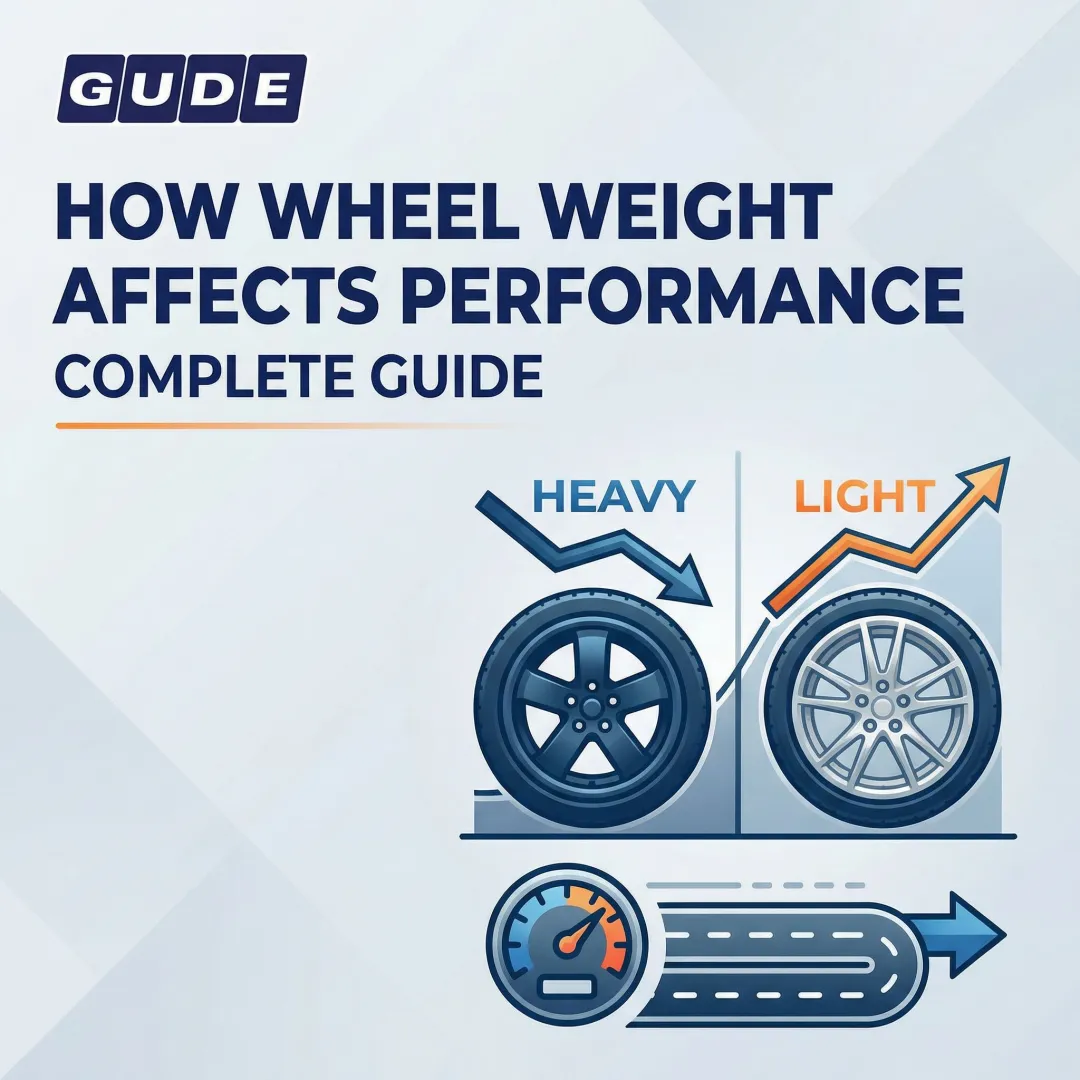

Introduction
Even a small imbalance in a motorcycle tire can trigger handlebar wobble, accelerate uneven tread wear, and create dangerous instability at highway speeds. Continental identifies tire imbalance as a contributing factor to low-speed shimmy and high-speed weave, two oscillation patterns that directly compromise rider control. Yet many riders remain uncertain whether to use balancing beads or traditional wheel weights when mounting new tires.
The choice matters more for motorcycles than for cars. Motorcycle wheels spin at higher speeds, carry less inherent mass, and are far more sensitive to balance errors. Even a minor imbalance that produces mild vibration in a sedan can trigger handlebar shimmy or instability on a bike.
This guide covers how each method works, their practical trade-offs for different motorcycle types and riding styles, and a clear decision framework to help you choose the right balancing solution for your bike.
TL;DR
- Balance beads self-adjust as the wheel spins — best for touring, cruising, off-road, and everyday riding
- Wheel weights are applied after spin balancing, preferred for sport bikes, track use, and precision work
- Beads rebalance automatically throughout the tire's life; weights require recheck if balance shifts
- The right choice depends on motorcycle type, riding style, and maintenance preference
- Both methods are now available in lead-free formulations, meeting current environmental standards
Balance Beads vs. Wheel Weights: Quick Comparison
Here's how the two methods stack up across the factors that matter most to riders and technicians.
| Factor | Balance Beads | Wheel Weights |
|---|---|---|
| Upfront Cost | $25–$35/kit (both wheels, full tire life) | Lower material cost, but $40–$45/wheel for professional rebalancing after removal or repair |
| Balancing Type | Continuous dynamic — self-adjusts as the tire wears or shifts | Static point-of-installation — drifts as the tire wears or if weights detach |
| Installation | Poured in at mounting or through the valve stem; no wheel removal needed | Requires wheel removal and spin balancer; adds labor time |
| Durability | Active for the tire's full lifespan, no replacement needed | Can corrode, loosen, or fall off on rough terrain or at high heat; adhesive weights require clean surface prep to stay bonded |
| Best For | Off-road, touring, cruiser, and daily-use bikes | Sport/track bikes and precision-balance applications |

For high-mileage riders, beads offer better total cost of ownership. Wheel weights remain the preferred choice where exact, technician-controlled balance is required — particularly on sport and track bikes where handling tolerances are tighter.
What Are Balance Beads for Motorcycles?
Balancing beads are tiny high-density beads—commonly made from tempered glass, ceramic, or steel—installed inside the tire cavity. They move freely between the tire and rim to redistribute weight and smooth out vibration automatically.
How the Physics Work
As the wheel spins, centrifugal force drives the beads to the lightest point of the tire—opposite the heavy spot—automatically redistributing weight and smoothing out vibration. Dyna Beads notes that sufficient centrifugal force develops to keep beads in position at approximately 25-35 mph, meaning they actively balance at all normal riding speeds.
Practical Benefits for Riders
- Sits completely inside the tire — no external hardware visible on the wheel
- Stays in place on rough terrain where clip-on or adhesive weights can dislodge
- Rebalances continuously as the tire wears, unlike static wheel weights
- Eliminates scheduled shop visits just for balancing
Known Limitations
Beads aren't the right fit for every application:
- Moisture can cause clumping in wet or muddy off-road conditions — though manufacturers like Counteract apply moisture-resistant coatings to address this
- Less precise than static balancing for high-speed sport or track riding where fine-tuned balance is critical
- Verify compatibility with tubed tires before installation, as not all setups support internal balancers
Use Cases for Balance Beads
Those limitations aside, beads excel in specific riding contexts:
- Off-road and adventure motorcycles — rough terrain can dislodge external weights; internal beads stay put
- Touring bikes and cruisers — long mileage between stops makes a maintenance-free solution practical
- Everyday commuters — set them once and they self-adjust for the life of the tire
A 2023 review in Motorcycle Mojo documented using Counteract beads across multiple motorcycles over an extended period — the standout result was consistent vibration elimination with zero rebalancing stops over high-mileage use.
What Are Wheel Weights for Motorcycles?
Wheel weights are small counterweights attached to the rim of the motorcycle wheel to offset imbalanced weight distribution, applied after measuring imbalance on a spin balancer.
Two Main Types
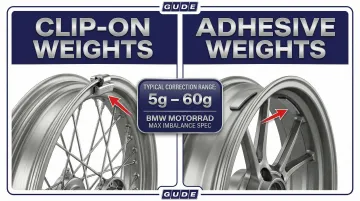
Clip-On Weights
Clamp to the rim edge—standard for spoked wheels on cruisers, dirt bikes, and vintage bikes. More secure attachment, less prone to detachment from heat or vibration.
Adhesive (Stick-On) Weights
Bond to the inside of the rim—preferred for alloy or cast wheels on sport and touring bikes. Provide a cleaner appearance but require proper surface preparation to prevent detachment.
Most motorcycle wheels require between 5g and 60g of total correction weight depending on tire size and wheel material. BMW Motorrad specifies a maximum permissible front-wheel imbalance of 5g and rear-wheel of 25g, with a maximum of 80g in balancing weights applied to the rim.
Spin balancing with wheel weights is widely considered the most accurate balancing method available—it's the industry standard for performance and track applications where precise weight placement directly affects handling.
Common Weaknesses
- Wheel weights can rust over time (especially traditional lead weights)
- May fall off due to heat, vibration, or improper installation
- Require wheel removal for service—adding labor time and cost
The corrosion and environmental concerns tied to traditional lead weights are addressed by coated steel alternatives. GUDE Corp's lead-free clip-on and adhesive weights are ISO 9001-certified and built for long service life, with strong corrosion resistance across both formats.
Use Cases for Wheel Weights
Best for:
- Sport bikes, track-day riders, and performance applications where exact balance is non-negotiable
- Spoked wheel motorcycles (cruisers, classic bikes) where clip-on weights are the most secure attachment
- Any scenario where a professional shop is performing tire mounting and has a spin balancer on hand
MotoAmerica/FIM technical regulations explicitly permit wheel balance weights to be added, changed, or discarded for racing, making them the documented standard for track and performance applications.
Which Balancing Method is Right for Your Motorcycle?
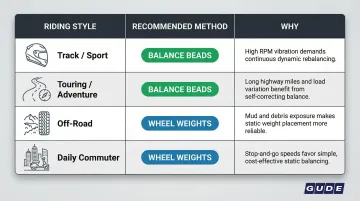
Decision Matrix by Riding Style
| Riding Style | Recommended Method | Why |
|---|---|---|
| Track/Sport | Wheel weights | Precision balance is non-negotiable for high-speed cornering |
| Touring/Adventure | Balance beads | Long-term low-maintenance balance with automatic adjustment |
| Off-Road | Balance beads | Survives rough terrain without falling off |
| Daily Commuter | Either method | Beads reduce shop dependency; weights offer precision |
Wheel Type Compatibility
Spoked Wheels (common on cruisers, enduro, and vintage bikes)
Naturally suited to clip-on wheel weights. Beads also work well but require tubeless setup or tube compatibility verification.
Modern Alloy Wheels (sport and touring bikes)
Work well with adhesive wheel weights or beads. Adhesive weights require proper surface preparation to prevent detachment.
Tubeless vs. Tubed Tires
- Tubeless: Compatible with both beads and adhesive weights
- Tubed: Beads can be used but compatibility must be confirmed with the tube manufacturer—some tube materials are not rated for bead contact
Total Cost of Ownership
Wheel weights appear less expensive upfront but factor in rebalancing costs. Bridgestone and Dunlop state it is essential to balance the tire and wheel assembly each time the tire is removed or replaced.
For high-mileage riders, the cost gap adds up fast:
- Balance beads: ~$25–$35 for both wheels, one-time purchase per tire
- Wheel weight rebalancing: ~$40–$45 per wheel, charged every tire swap
Beads typically cost less over a tire's lifetime for riders who rebalance frequently.
Lead Bans and Eco Considerations
Traditional lead wheel weights have faced regulatory pressure and disposal concerns. The EU banned lead wheel weights under Directive 2000/53/EC, and several U.S. states—including California, Washington, Maine, and New York—have enacted similar bans.
That said, cost isn't the only reason shops are moving away from lead. Lead-free steel wheel weights address these regulations directly. Both wheel weights and balance beads can now be considered environmentally responsible choices.
Hybrid Consideration
Some riders use wheel weights at initial mounting for gross balance correction, then allow beads to handle fine, continuous rebalancing—though this approach is more common in commercial trucking than motorcycle applications.
Conclusion
Balance beads excel for riders who value low-maintenance, continuous self-adjustment, and durability in demanding or high-mileage conditions. Wheel weights remain the precision benchmark for performance and track riders and are a fully viable choice for all motorcycles when high-quality, lead-free options are selected.
The right choice comes down to three factors: motorcycle type, riding context, and maintenance preference. Match your situation to the option below:
- Sport and track riders — wheel weights deliver the static precision these applications require
- Touring, adventure, and off-road riders — balancing beads offer long-term value with a low-maintenance, install-once design
- Daily commuters — either works; choose based on whether you prefer shop precision or DIY simplicity
Frequently Asked Questions
Are tire balancing beads better than wheel weights for motorcycles?
Neither is universally better. Beads outperform wheel weights in low-maintenance, self-adjusting applications (touring, off-road, daily use), while wheel weights offer superior precision for sport and track riding. The best choice depends on your motorcycle type and performance needs.
How many ounces of balancing beads do motorcycle tires need?
Most motorcycle tires require approximately 1-2 oz (28-56g) of balancing beads per tire, though exceptionally wide rear tires (250mm+) may need 3 oz. Always follow the bead manufacturer's application chart for your specific tire diameter and width.
Can you use balancing beads in tubed motorcycle tires?
Balancing beads can be used in tubed tires, but compatibility must be confirmed with the tube manufacturer. Some tube materials are not rated for bead contact, and incompatible combinations risk abrasion or tube failure — check Dynabeads' installation guidelines for compatibility details. Always use new tubes when installing beads.
Do wheel weights fall off motorcycle tires at high speeds?
Properly installed, high-quality wheel weights should not fall off under normal riding conditions. However, adhesive weights can detach if the rim surface was not cleaned before installation or if excessive heat builds up. Clip-on weights are generally more secure and less prone to detachment.
How often do motorcycle tires need to be rebalanced with wheel weights?
Tire manufacturers recommend rebalancing each time the tire is removed or replaced, and immediately if handlebar vibration is felt at specific speeds. Unlike beads, wheel weights do not self-correct as the tire wears, so periodic rechecks are necessary.
What is the most precise way to balance a motorcycle tire?
Spin (dynamic) balancing using a calibrated motorcycle-specific machine with precision wheel weights is the most accurate method available. It's the preferred approach for sport bikes, track days, and any performance application where fine balance tolerances matter — as outlined in Metzeler's technical guidelines.