
Introduction
Uneven tire wear, steering wheel vibration, and premature tire replacement all trace back to the same root cause: how the tire was balanced. For commercial fleets, imbalanced tires can reduce tire life by up to 20% and drag fuel efficiency down by 2-3%.
For automotive service shops handling diverse vehicle types, choosing the wrong balancing method means repeat visits, customer complaints, and lost revenue.
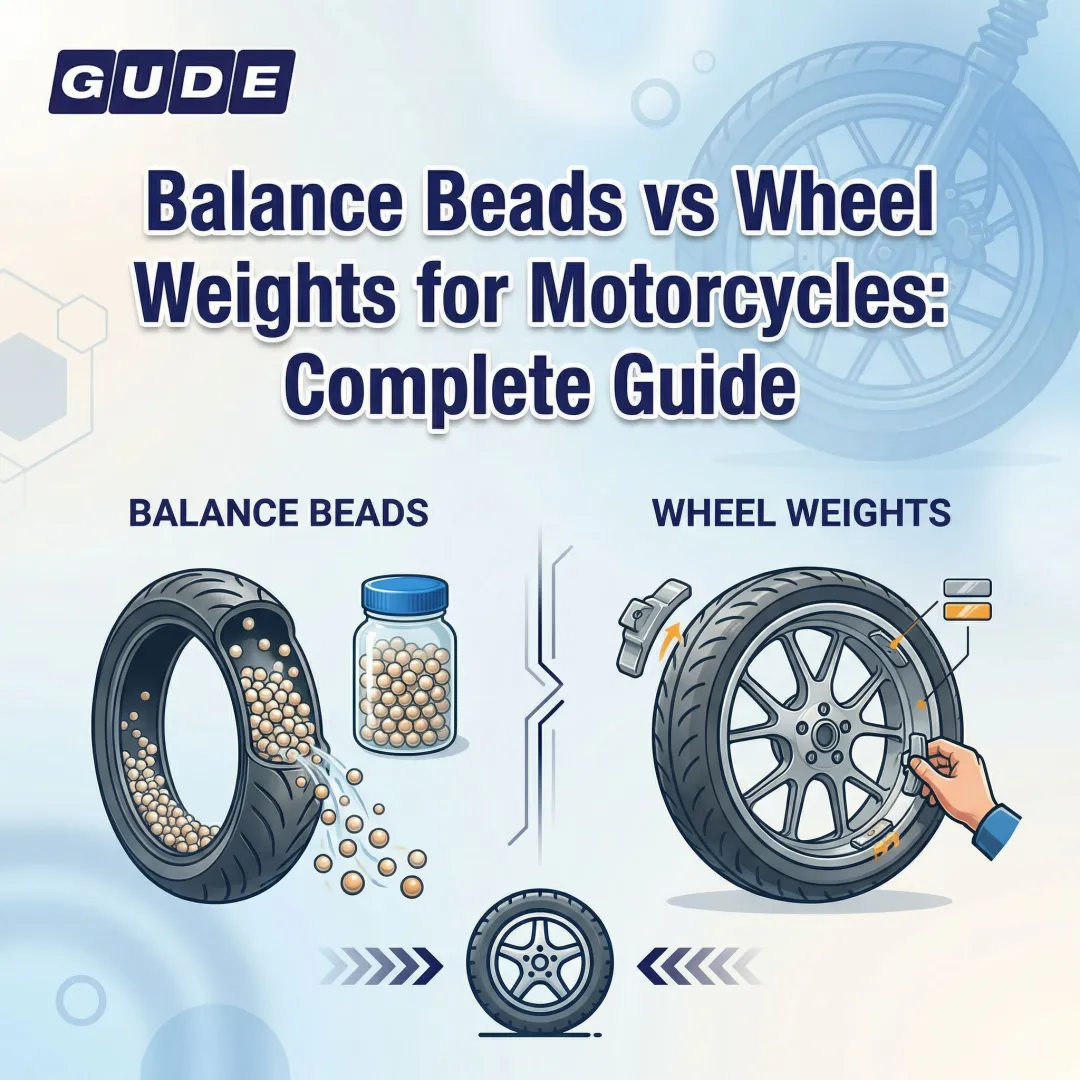
Two approaches dominate the market. Tire balancing beads are a dynamic, internal method gaining traction in trucking and fleet applications. Wheel weights are the industry-standard external counterweight method used in OEM assembly and aftermarket service worldwide. This guide breaks down how each works, where each performs best, and which makes more sense for your vehicles and shop.
TLDR
- Tire balancing beads reposition dynamically inside the tire, making them effective on trucks, RVs, and commercial vehicles
- Wheel weights are externally applied counterweights — the standard for OEM manufacturing and passenger vehicle service
- Beads suit high-mileage fleet applications; wheel weights deliver precision and compatibility with virtually every wheel type
- Lead wheel weights face regulatory bans in nine U.S. states and the EU — lead-free steel is now the compliant standard
- The right choice depends on vehicle type, operating conditions, and whether dynamic adaptability or static precision matters more
Tire Balancing Beads vs. Wheel Weights: Quick Comparison
Here's how the two methods stack up across the factors that matter most to shops, fleets, and manufacturers.
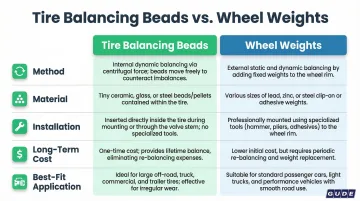
| Factor | Tire Balancing Beads | Wheel Weights |
|---|---|---|
| Method of Balancing | Dynamic and continuous: beads reposition inside the tire as the wheel spins to counteract imbalance in real time | Static: fixed to the rim at a specific point to offset a known imbalance measured by a balancing machine |
| Material | Glass, ceramic, steel, or plastic-coated beads inserted inside the tire or tube | Lead (increasingly restricted), zinc, or steel; available in clip-on or adhesive (stick-on) formats |
| Installation | No wheel removal required in many cases; inserted through the valve stem or during tire mounting | Requires a balancing machine, wheel removal, and professional installation |
| Long-Term Cost | Higher upfront per-tire cost but generally maintenance-free for the tire's lifespan | Lower per-service cost but may need replacement if knocked loose or during rebalancing |
| Best-Fit Application | Commercial trucks, large vehicles, RVs, off-road, and high-mileage fleet applications | Passenger vehicles, OEM manufacturing, alloy wheel fitments, and precision-balanced performance applications |
What Are Tire Balancing Beads?
Tire balancing beads are small granules — typically made from tempered glass, ceramic, or coated steel — placed inside a tire (or tube) that redistribute themselves continuously as the wheel rotates. Unlike a static weight fixed at one point, beads are held in place by centrifugal force while the tire is in motion.
As a heavy spot causes the tire to hop, beads lose contact with the liner momentarily and shift away from that spot due to inertia. This process repeats on every rotation, progressively moving beads away from the heavy spot until vibration is reduced and the tire is balanced.
The core operational advantage: beads adapt to changing conditions — tire wear, load shifts, or road surface variation — without requiring a return to the shop. For fleet operators running long hauls, that means fewer service interruptions and lower rebalancing labor costs.
Material Types and Inner Liner Safety:
- Glass beads (99% soda-lime glass, 1% silicone coating) — smooth, non-abrasive, moisture-resistant (Counteract brand)
- Ceramic beads — superior abrasion resistance and moisture protection
- Coated steel beads — durable, but coating quality is critical to prevent liner damage
- Plastic-coated beads — lightweight but less durable than glass or ceramic
Glass beads are smooth with no sharp edges, making them non-abrasive against the inside liner of the tire. Ceramic and glass options are the safest choice for inner liner contact.
Key Limitations:
Beads work best at highway speeds and on larger, higher-load tires. At low speeds or on smaller passenger tires, the centrifugal force may be insufficient for full rebalancing. Balancing beads have roughly a 75% success rate in small, lighter passenger vehicles due to softer front-end suspensions. Additionally, moisture inside the tire can clump beads together, throwing balance off instead of fixing it.
Dosage Precision Issue:
Using too many beads can cause over-correction and vibration rather than eliminating it. Manufacturers provide weight-per-tire guidelines that must be followed:
- Counteract: 1 ounce of beads per 13 pounds of tire and rim combination (add 2 ounces for dual wheel assemblies)
- MAGNUM+: 1 oz (30 g) of beads for every 10 lb (4.54 kg) of tire
Where Balancing Beads Shine
Primary use cases include:
- Long-haul commercial trucks
- Agricultural equipment
- RVs and buses
- Off-road vehicles
- Any application where tires experience continuous load variation and stopping for rebalancing would create significant downtime cost
Installation is simplified in fleet contexts — beads can often be added through the valve stem without dismounting the tire, cutting labor cost across a large vehicle fleet.
Beads also balance the complete rotating wheel assembly (tire, rim, brake drum, and wheel bearing). That makes them particularly useful for drive and trailer tires, which are rarely balanced using traditional methods.

What Are Wheel Weights?
Wheel weights are externally applied counterweights used to correct measured imbalance by adding mass at a precisely calculated location determined by a balancing machine. They come in two forms: clip-on (attached to the rim flange) or adhesive/stick-on (applied to the inside barrel of the rim). This is the dominant, industry-validated method used across passenger vehicles, commercial vehicles, and OEM production lines worldwide.
Two Main Formats
- Clip-on weights: Grip the rim flange and are common on steel wheels and older alloy designs. Highly secure when properly sized but can scratch alloy rims if mishandled.
- Adhesive weights: Bond to the inner rim surface and are preferred for alloy or cosmetically sensitive wheels. Require a clean, properly prepped rim surface for maximum adhesion — inadequate surface prep is the leading cause of weights falling off after installation.
Material Evolution
The industry has largely moved away from lead due to environmental regulations. Nine U.S. states have banned lead wheel weights, and the European Union banned them in 2005. The EPA estimates that 1.6 million pounds of lead are lost annually when wheel weights fall off during normal driving.
Steel wheel weights have become the industry standard — highest density among cost-effective alternatives, no known environmental hazards, and fully compliant with current regulations. ISO 9001-certified manufacturers supply these to OEM production lines and aftermarket shops alike, with precision matching or exceeding what lead weights delivered.
Durability and Retention
Adhesive and clip-on weights perform reliably when installation conditions are met:
- Adhesive weights need at least 80–85% full tape surface contact with no voids for proper bond strength
- Dust, grease, or tire lube on the rim surface are the leading causes of adhesive weight failure
- Clip-on weights are highly secure when matched to the correct rim flange specification
Wheel weights are compatible with virtually every wheel type and vehicle class, from compact passenger cars to heavy commercial trucks. Precision balancing machines enable correction to within fractions of a gram — the reason this method remains the standard wherever repeatable, verifiable results matter.
Where Wheel Weights Are the Right Call
Dominant use cases include:
- All passenger vehicle applications
- OEM production line tire installation
- Performance and sports vehicles (where precise, machine-validated balance is critical)
- Alloy wheel fitments where aesthetic discretion matters
For automotive service shops handling a diverse vehicle mix — from daily drivers to luxury vehicles to light commercial — wheel weights remain the standard because they work with existing balancing equipment, are universally stocked, and deliver repeatable, verifiable results.
Tire Balancing Beads vs. Wheel Weights: Which Is Better?
The right choice comes down to four variables: vehicle type and tire size, operating environment and mileage profile, whether you need continuous dynamic correction or a one-time precision fix, and whether professional balancing equipment is available.
Performance
For passenger vehicles and performance cars, wheel weights provide a level of precision — validated by machine measurement — that beads cannot match. For large-diameter, high-load tires on trucks and commercial vehicles covering high mileage, beads can maintain balance over longer intervals without service intervention.
An independent SAE J1321 Type II Fuel Consumption Test demonstrated a 2.2% improvement in fuel economy when Counteract Balancing Beads were installed in all 18 wheel positions of a tractor-trailer carrying a maximum load, compared to unbalanced wheels.
Environmental and Regulatory Compliance
In regions where lead wheel weights are restricted or banned, the choice of wheel weight material becomes a compliance issue — not just a performance one. Zinc and steel wheel weights meet these requirements without performance trade-offs, which is why OEM manufacturers and progressive aftermarket shops have standardized on lead-free options.
Cost Over Time
Beads have a higher per-tire install cost but reduce rebalancing service intervals — a meaningful saving in fleet operations. Wheel weights have a lower per-service cost but may require periodic replacement (especially if a weight is knocked loose on rough terrain). External wheel weights also reflect only the tire's condition at a fixed point in time. As tires wear and shed rubber — up to 30 lbs over a commercial tire's life — the original weights no longer provide proper balance.
Situational Recommendations
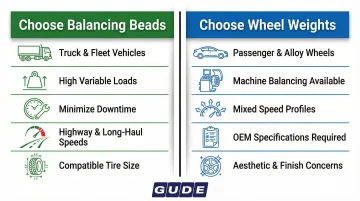
Choose tire balancing beads if:
- Operating a commercial truck fleet, RV, bus, or agricultural equipment fleet
- Tires experience high and variable loads
- Minimizing shop downtime is a priority
- Beads are compatible with the specific tire and wheel combination
- Vehicles primarily operate at highway speeds
Choose wheel weights if:
- Working with passenger vehicles, alloy wheels, or performance vehicles
- Precision machine balancing is available
- The vehicle sees mixed speed profiles including frequent low-speed driving
- OEM specifications require a validated static balancing approach
- Aesthetic considerations matter (adhesive weights on alloy wheels)
For shops and fleet operations that have standardized on wheel weights, supply consistency and material compliance matter at scale. GUDE Corp supplies lead-free coated steel wheel weights — in both clip-on and adhesive formats — to tire shop chains, dealership groups, and OEM assembly lines across North America. Manufactured by Toho Kogyo (the #1 wheel weight producer in Japan, #3 globally) in ISO 9001-certified facilities, they're available in bulk and pallet quantities. Reach the wholesale team at jonathan@gudecorp.com or (463) 464-5500.
Conclusion
Tire balancing beads and wheel weights solve the same problem through fundamentally different mechanisms. The right answer depends on vehicle type, operational context, and performance requirements — not a blanket declaration of one being better. Fleets running large commercial tires on long hauls will often find beads reduce their maintenance burden; passenger vehicle shops and OEM operations will continue to rely on precision wheel weights as the technically superior, universally compatible solution.
Whichever method is chosen, product quality matters. For wheel weights, the shift to lead-free steel isn't just about regulation compliance — it's about performance durability, corrosion resistance, and responsible sourcing. GUDE Corp's ISO 9001-certified, lead-free steel weights reflect exactly that standard. Shops and manufacturers that prioritize quality at the component level see better long-term outcomes in tire wear, fuel economy, and customer retention.
Frequently Asked Questions
Do balance beads actually work?
Yes, balance beads work effectively for larger tires on commercial trucks, RVs, and high-mileage fleet vehicles where dynamic rebalancing is beneficial. However, their effectiveness depends on correct dosage, sufficient speed for centrifugal activation, and compatible tire size.
Are balance beads better than stick-on weights?
Beads and stick-on (adhesive) wheel weights serve different contexts: beads suit large commercial tires requiring continuous dynamic correction, while adhesive wheel weights offer precision, rim safety, and aesthetic discretion that make them preferable for alloy wheels and passenger vehicles.
Can you use balance beads with stick-on (wheel) weights?
Combining both is not recommended — using beads alongside wheel weights can create conflicting correction forces, leading to vibration rather than eliminating it. In most cases, one method should be chosen based on the tire and application.
How long do tire balance beads last?
Quality tire balancing beads are designed to last the full life of the tire, as they don't degrade under normal operating conditions. Coated or ceramic beads tend to outlast uncoated alternatives due to better abrasion resistance.
Can balancing beads damage tires?
Properly selected and dosed beads — such as coated glass or ceramic types — do not damage tires. However, using the wrong type (such as uncoated steel beads) or incorrect quantity can cause inner liner wear, so following manufacturer dosage guidelines is important.
Can you put too much balancing beads in a tire?
Yes — too many beads can cause vibration rather than eliminate it, since excess beads can't reposition freely and create their own imbalance. Always follow the manufacturer's recommended dosage based on the tire's load rating and diameter.