
Introduction
Yes, wheel balancing is required for alloy wheels — and the stakes are higher than with steel wheels. Alloy wheels, constructed from lightweight aluminum or magnesium alloys, are more sensitive to uneven weight distribution than their heavier steel counterparts.
Even a few grams off-balance can cause noticeable vibrations at highway speeds, accelerate tire wear, and stress suspension components over time.
This article covers:
- Why alloy wheels need balancing
- How to identify when your wheels are out of balance
- How the balancing process works
- Which wheel weights are safest and most effective for alloy rims
TL;DR
- Yes, alloy wheels require balancing — no wheel type is exempt
- Their lighter weight actually increases sensitivity to imbalance at highway speeds
- Skipping it causes steering vibration, uneven tire wear, and added suspension wear
- Adhesive stick-on weights are preferred for alloy rims to protect the finish
- Balance wheels when fitting new tires, after impacts, or every 5,000-7,500 miles
Why Alloy Wheels Need Wheel Balancing
No tire or wheel leaves the factory with perfectly uniform weight distribution. Manufacturing variances in casting, rubber distribution, and valve stem placement create small imbalances that become amplified at rotational speeds.
Lighter Construction Amplifies Imbalances
Alloy wheels are significantly lighter than steel wheels. A typical aluminum wheel averages 47 lbs compared to 78 lbs for an equivalent steel wheel. This reduced rotating mass means even a small imbalance — just a few grams — has a proportionally greater impact on ride quality.
Modern vehicles are up to four times more sensitive to static vibration forces than dynamic forces, making proper balancing essential for smooth operation.
The Low-Profile Tire Factor
Low-profile tires commonly paired with alloy wheels make balancing even more critical. These tires feature shorter, stiffer sidewalls that absorb less road vibration, transmitting imbalance forces more directly into the steering column and cabin.
Consequences of Neglecting Balance
Failing to balance alloy wheels creates compounding problems that worsen over time:
- Cuts tire lifespan by up to 20% through accelerated, uneven tread wear
- Damages bearings, bushings, and shock absorbers under constant vibration stress
- Increases rolling resistance, reducing fuel efficiency
- Degrades ride comfort through persistent steering and cabin vibration

The Pre-Balanced Myth
Premium or OEM alloy wheels don't come "pre-balanced." While manufacturing tolerances have improved, every tire-wheel assembly must be balanced after mounting because the tire itself introduces additional weight variation that no factory can predict or compensate for.
Signs Your Alloy Wheels Are Out of Balance
Primary Symptom: Steering Wheel Vibration
The most common indicator is steering wheel vibration at highway speeds, typically between 60-70 mph. If vibration is felt in the seat or floorboard rather than the steering wheel, the imbalance is likely in the rear wheels.
Secondary Warning Signs
Beyond steering vibration, watch for these signs:
- Cupping or scalloping — scooped-out patches of rubber every 3-4 inches around the tire
- Uneven tread depth across the tire surface
- Premature wear on one side of the tread
- Thumping or humming noise at certain speeds
- Rhythmic road noise that changes with vehicle speed
- Reduced ride smoothness on flat roads
- Vibration that worsens as speed increases
When to Check Balance Immediately
Symptoms alone don't always appear before damage accumulates. Schedule a balance check after:
- Hitting a pothole or curb
- Having a flat tire repaired
- Installing new tires
- Noticing a wheel weight has fallen off
- Any impact that could shift weight distribution
How Wheel Balancing Works on Alloy Wheels
The Balancing Process
The process follows four steps:
- Mount the tire-wheel assembly on a computerized spin-balancing machine.
- Spin the assembly — vibration sensors detect the location and magnitude of any imbalance.
- Analyze — the computer identifies two types of imbalance:
| Imbalance Type | Cause | Effect | Correction |
|---|---|---|---|
| Static | Heavy spot in center of assembly | Vertical bounce (up-and-down) | Single-plane weight placement |
| Dynamic | Unequal weight on opposite sides | Lateral wobble (side-to-side) | Two-plane weight placement |

- Correct — small calibrated weights are applied at precise points on the rim. The machine specifies exactly how much weight is needed and where on the circumference to place it.
Special Care for Alloy Wheels
Because alloy finishes scratch easily, technicians must use plastic-coated adapters and tools throughout the process. Before applying adhesive weights, they clean the rim surface with approved solvents to ensure proper bonding.
Advanced Option: Road Force Balancing
Road force balancing simulates the weight of the vehicle pressing down on the tire, detecting irregularities that standard spin balancing cannot — including tire belt defects, flat spots, and sidewall stiffness variations. This method applies up to 1,400 lbs of force against the spinning tire to replicate real-world conditions.
Choosing the Right Wheel Weights for Alloy Rims
Clip-On vs. Adhesive Weights
Clip-on (hammer-on) weights clamp to the rim's outer edge. For alloy wheels, they're generally not recommended — they can scratch anodized or painted surfaces and are visible from outside the wheel.
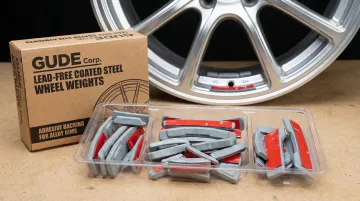
Adhesive (stick-on) weights are the standard choice for alloy rims:
- Sit on the inner barrel, invisible from outside
- Don't risk damaging the rim edge
- Can be precisely placed for better balance
- Require proper surface prep (cleaning, degreasing) for adhesive performance
Material Considerations: The Lead Phase-Out
Traditional lead wheel weights are being phased out globally due to environmental and regulatory concerns:
- United States: Nine states prohibit wheel weights containing more than 0.1% lead
- Canada: National ban on manufacturing and importing lead wheel weights
- European Union: ELV Directive restricts lead in vehicles
Coated steel alternatives offer comparable performance without the toxicity concerns. For shops sourcing compliant weights at scale, manufacturer certification matters.
GUDE Corp supplies lead-free, coated steel wheel weights manufactured by Toho Kogyo — the #1 wheel weight manufacturer in Japan and #3 globally. Production runs across ISO 9001 certified facilities in Japan and Vietnam. Adhesive weights are available for both OEM and aftermarket applications, with adhesive backing rated for long-term retention on alloy rims.
Quality and Precision Matter
Low-quality or improperly sized weights can lose adhesion over time or fail to correct imbalances accurately, leading to repeat service calls. Sourcing from certified manufacturers reduces both failure rates and comebacks.
Proper installation also requires meeting 85% adhesive "wet-out" per SAE J1986 standards — meaning 85% of the adhesive surface must make full contact with the rim. Skipping surface prep (cleaning and degreasing) is the most common reason this threshold isn't met.
How Often Should You Balance Alloy Wheels?
General Maintenance Guidelines
Balance alloy wheels:
- Every new tire installation: Always balance when mounting new tires
- Every tire rotation: Typically every 5,000–7,500 miles
- After significant impacts: Deep potholes, curb strikes, or collisions
Performance, Highway Driving, and Preventive Care
Performance vehicles and those driven regularly at highway speeds need more frequent balance checks. At 70 mph, even a quarter-ounce imbalance generates enough rotational force to produce noticeable vibration — an issue that barely registers at city speeds.
That's why routine balancing matters even when nothing feels wrong. Chronic imbalance puts repeated stress on alloy rims, and alloy wheels are expensive to replace. Staying on a consistent schedule protects both the tire and the wheel before symptoms appear.
Frequently Asked Questions
Is wheel balancing required for alloy wheels?
Yes, wheel balancing is required for alloy wheels and is actually more important than for steel wheels. Alloy wheels' lighter weight makes them more sensitive to imbalance, directly affecting ride quality, tire longevity, and suspension component life.
Do alloy wheels need to be balanced differently than steel wheels?
The balancing process is largely the same, but alloy wheels require more careful handling to avoid surface damage. Technicians should use plastic-coated adapters and typically apply adhesive stick-on weights instead of clip-on weights to protect the rim's finish.
What type of wheel weights should be used on alloy rims?
Adhesive stick-on weights placed on the inner rim barrel are the safest and best-looking option for alloy rims. Lead-free steel weights are preferred due to environmental regulations and health considerations.
What happens if alloy wheels are not balanced?
Unbalanced alloy wheels cause steering wheel vibration, cupped or uneven tread wear (reducing tire life by up to 20%), reduced fuel efficiency, and increased stress on suspension components. These problems become more costly to address the longer they're ignored.
Can clip-on wheel weights be used on alloy rims?
While clip-on weights can be used, they risk scratching or chipping the alloy rim's surface and are more visually noticeable. Most technicians and manufacturers recommend adhesive weights for alloy rims for both protection and aesthetics.
How often should alloy wheels be balanced?
Balance alloy wheels at every new tire installation, every tire rotation (every 5,000–7,500 miles), and after any hard road impact. Vehicles driven frequently at highway speeds may benefit from more regular balance checks.