Introduction
Specify the wrong replacement wheel on a Mercedes-Benz, and you've already changed the car. A single pound of excess unsprung mass measurably affects suspension response, steering precision, and tire contact patch consistency — variables Mercedes engineers control tightly from the factory. Yet wheel weight is one of the most routinely overlooked specifications when technicians order replacements or set up balancing procedures.
Mercedes OEM wheels span a wide range of sizes, materials, and construction methods across passenger car classes (C, E, S), SUV platforms (GLE, GLS), and AMG performance variants. A 19" C-Class wheel weighs considerably less than a 21" GLE wheel, and AMG forged Monoblock wheels weigh less than equivalent standard cast alloys. Larger AMG SUV fitments, however, can exceed standard passenger car weights on diameter alone.
This guide breaks down typical weight ranges by class and size, the engineering factors behind those numbers, how AMG wheels compare, and what wheel weight means for balancing specifications.
TL;DR
- Mercedes OEM wheels typically weigh 20–35 lbs for passenger cars, with larger SUV and AMG fitments reaching 40+ lbs
- Wheel weight varies by diameter (17" to 21"+), width, material (cast vs. forged), and model class
- AMG forged wheels run lighter per size than cast OEM wheels — though larger AMG SUV fitments can still outweigh smaller passenger car wheels
- Heavier wheels are more sensitive to imbalance and require precise balance weight placement
- Always verify wheel weight against Mercedes part specifications or physical measurement
What OEM Wheel Weight Represents in a Mercedes-Benz System
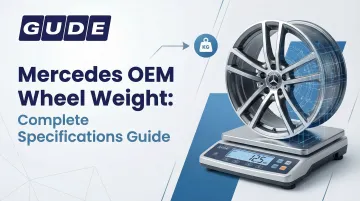
OEM wheel weight is the mass of the bare wheel—rim only, without tire or balance weights—as manufactured and approved by Mercedes-Benz for a specific vehicle configuration. This is distinct from gross wheel-and-tire assembly weight, which includes the tire, valve stem, and balance weights.
In vehicle dynamics, wheel weight constitutes unsprung mass—the portion of total vehicle weight not supported by the suspension. Mercedes engineers target specific wheel weight windows because unsprung mass directly affects how quickly the suspension responds to road inputs. Research demonstrates that every 10% reduction in unsprung mass contributes to an approximate 6% reduction in RMS sprung mass acceleration, improving ride quality and handling precision.
Deviating from OEM wheel weight specs—such as fitting heavier aftermarket wheels—changes suspension response, steering feel, and tire contact patch behavior. Wheel weight is a design-fixed parameter for OEM fitments, determined by the wheel's diameter, width, spoke design, and alloy composition. The only way to change it is to substitute the wheel entirely.
Typical Weight Ranges Across Mercedes Models and Wheel Sizes
Mercedes OEM wheel weight is governed primarily by rim diameter, width, and the platform's load class. Always confirm weights against Mercedes-Benz part documentation or measure physically — catalogue values vary by trim and model year.
Passenger Car Classes (C, E, S-Class)
Standard cast aluminum alloy wheels in passenger car classes typically fall within predictable ranges:
C-Class (17"–19" fitments):
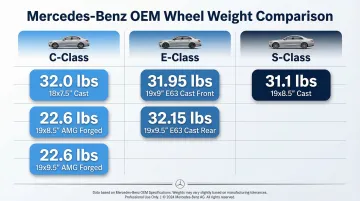
- 18x7.5" cast alloy: approximately 32.0 lbs
- 19x8.5" AMG forged: approximately 22.6 lbs
- 19x9.5" AMG forged: approximately 22.6 lbs
E-Class and S-Class (17"–20" fitments):
- 19x9" E63 AMG cast (front): 31.95 lbs
- 19x9.5" E63 AMG cast (rear): 32.15 lbs
- 19x8.5" S-Class cast: 31.1 lbs (14.14 kg)
The minimal weight difference between 9" and 9.5" widths on the same platform highlights how spoke design and backpad thickness influence mass as much as barrel width. AMG forged wheels on the C-Class can save nearly 10 lbs per corner compared to standard 18" cast wheels.
SUV and Van Classes (GLE, GLS, Sprinter)
Larger diameter and higher load-rated wheels in SUV classes fall significantly heavier than passenger car fitments:
GLE and GLS (19"–22" fitments):
- 20x9" GLE cast: 36.1 lbs (16.38 kg)
- 21x9" GLE cast: 37.4 lbs (17.00 kg)
- 22x11.5" GLS AMG forged: 36.6 lbs (16.64 kg)
Even when using advanced forging techniques, the sheer size and load requirements keep SUV wheel weights above 36 lbs. The 22" GLS AMG forged wheel weighs more than a standard 18" C-Class cast wheel despite superior construction methods.
Sprinter commercial wheels (22.5" aluminum fitments):
- Standard steel wheels: 24.9–27 lbs
- Lightweight forged aluminum options: varies by load rating (up to 1,215 kg capacity)
22.5" Sprinter wheels are in a separate weight category, built to different structural load standards. Those distinctions matter when evaluating the balancing tolerances that apply across each platform.
Safe Operating Context for Weight Specification
A wheel that weighs significantly more or less than the OEM-spec wheel for that position changes suspension geometry loading and the balancing correction needed. Substituting wheels outside these tolerance windows alters the dynamics Mercedes engineers designed for:
- Passenger cars: ±2–3 lbs acceptable when swapping within the same size class
- SUV platforms: ±3–5 lbs acceptable given higher base mass and load ratings
- Commercial vans (Sprinter): confirm against load-rating spec, not just diameter
Key Factors That Determine Mercedes OEM Wheel Weight
OEM wheel weight is the output of several interacting design variables. Understanding them allows technicians and buyers to predict whether a given wheel will be heavier or lighter than another.
Rim Diameter and Width
Each additional inch of diameter and each additional inch of width increases material volume and therefore mass, all else equal. The relationship is directly proportional: a 20" wheel requires more aluminum than a 19" wheel of the same width and spoke design. Similarly, a 9.5" width requires more material than an 8.5" width at the same diameter.
Material and Alloy Composition
Mercedes uses three primary construction methods across OEM wheels:
Gravity cast aluminum:
- Heaviest per unit volume
- Standard fitments on base and mid-level trims
- Molten aluminum poured into molds; prone to porosity (micro air pockets that reduce structural integrity)
Low-pressure cast aluminum:
- Mid-weight construction
- More common on E-Class and S-Class
- Molten aluminum injected under pressure; reduced porosity
Forged aluminum:
- Lightest construction method
- Used on AMG Monoblock and select performance variants
- Solid aluminum billet shaped under extreme hydraulic pressure (up to 10,000 tons)
- Eliminates porosity and aligns metal grain structure
Flow-forming achieves a 30% reduction in barrel thickness compared to standard casting, offering 15–25% weight reduction over standard cast wheels.

Spoke Design and Cross-Section Geometry
Spoke count, spoke width, and hollow vs. solid cross-sections all influence total wheel mass. Mercedes treats spoke geometry as a controlled engineering variable — not just an aesthetic choice — balancing weight reduction against structural stiffness requirements.
Multi-spoke designs carry more material at the spoke junctions than split-5-spoke designs at the same diameter, making spoke count a meaningful differentiator when comparing wheels across trim levels.
Manufacturing Tolerances and Quality Grade
ISO 9001-certified OEM production holds tight tolerances on wall thickness and material distribution. Wheel-to-wheel variation within an OEM batch is typically under 0.5 lbs — a level of consistency that broader aftermarket manufacturing tolerances rarely match at the same stated size.
Model Year and Platform Generation Effects
Weight reductions are measurable across Mercedes platform generations. The W213 E-Class, W223 S-Class, and W167 GLE all use optimized alloy profiles that run lighter than their predecessors at the same diameter.
The W213 E-Class illustrates this directly: select trim levels introduced flow-formed barrels that were not offered on the W212 generation, trimming mass without changing the wheel's nominal size or appearance.
AMG vs. Standard Mercedes OEM Wheels: Weight and Construction Differences
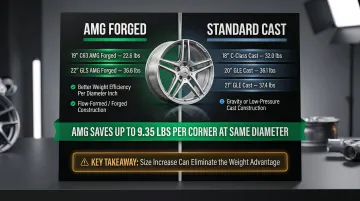
AMG wheels are often lighter than equivalent standard OEM wheels — but only when comparing the same diameter. Once wheel size increases, that advantage can disappear entirely.
AMG Monoblock Forged Wheels
AMG Monoblock wheels—found on AMG GT, C63 AMG, and E63 AMG—use flow-formed or fully forged construction that produces lower weight per diameter compared to equivalent cast OEM wheels. A 19" AMG forged wheel for the C63 weighs approximately 22.6 lbs, while a standard 18" C-Class cast wheel weighs approximately 32.0 lbs—a nearly 10 lb reduction per corner.
Weight efficiency comparison:
- 19" AMG forged (C63): 22.6 lbs
- 19" standard cast (E63): 31.95 lbs
- Weight savings: 9.35 lbs per wheel (29% reduction)
AMG Multi-Piece and Cross-Spoke Wheels on SUV Platforms
AMG performance packages on SUV models (GLE63, GLS63) often involve larger diameter wheels (21"–22") that may weigh more in absolute terms than the standard SUV OEM wheel—even if the material is higher quality—due to the size increase. A 22" AMG forged wheel for the GLS weighs approximately 36.6 lbs, which exceeds the weight of a 19" passenger car wheel despite superior construction.
The takeaway: AMG wheels deliver better weight efficiency (lbs per inch of diameter) than cast OEM equivalents, but a larger-diameter AMG wheel will still outweigh a smaller standard wheel in absolute terms.
Verification and Documentation
AMG wheel weights should be sourced from official Mercedes-AMG parts documentation or physically verified. To confirm accurate specs:
- Look up the Mercedes part number (format: A###########)
- Cross-reference weight data against OEM parts portals or Mercedes-AMG documentation
- Treat aftermarket catalog listings as approximate — they often contain errors
- Physically weigh wheels when precision matters for balancing applications
How Wheel Weight Influences Balancing Requirements and Vehicle Performance
The relationship between wheel weight and balance correction is direct. A heavier wheel has greater rotational inertia — small mass imbalances generate larger vibration forces at speed. Larger Mercedes OEM wheels (19"–21"+) are therefore more sensitive to balancing accuracy than smaller fitments and require precise weight placement.
Performance implications of excessive unsprung mass:
- Slower suspension response to road inputs
- Reduced steering feedback precision
- Increased tire contact patch variation
- Higher energy absorption in the wheel assembly rather than the suspension
Each of these effects works against what Mercedes engineers designed for — which is why matching OEM wheel weight when substituting wheels matters just as much as matching size.
Balancing Weight Specifications
Mercedes-Benz follows specific OEM balancing protocols to meet NVH standards. Mercedes supplies balancing weights in 5-gram increments — 5g, 10g, 20g, 45g, and 60g — under part numbers such as 171-401-14-94 (20g) and 171-401-19-94 (45g).
For modern alloy wheels, adhesive (stick-on) weights are preferred over traditional clip-on weights. Adhesive weights preserve the wheel's aesthetic and eliminate the risk of clip scratches or galvanic corrosion. Using balance weights not rated for the correct rim flange profile — or using an incorrect amount due to misidentified wheel weight — compromises balance quality.

GUDE Corp supplies lead-free, ISO 9001-certified wheel balance weights suited for alloy wheel service, including clip-on series (AW, IAW, FN) for specific rim flange profiles and adhesive stick-on weights in gray and black coatings. All products are manufactured by Toho Kogyo — the #1 wheel weight manufacturer in Japan — and available in bulk and pallet quantities for tire shop chains, dealership groups, and distributors. For rim flange compatibility questions and wholesale pricing, contact Jonathan McVety at (463) 464-5500 or jonathan@gudecorp.com.
Common Misconceptions About Mercedes OEM Wheel Weight
Assuming Uniform Weight Across Same Nominal Size
The most frequent error: assuming that a published nominal weight (e.g., "19-inch Mercedes OEM wheel = 22 lbs") applies uniformly across all variants at that size. In practice, different trim-level wheels at the same nominal diameter can vary by several pounds depending on spoke design, alloy batch, and OEM supplier.
Example:
- 19x9" E63 AMG cast wheel: 31.95 lbs
- 19x8.5" C63 AMG forged wheel: 22.6 lbs
- Difference: 9.35 lbs despite similar diameter
Weigh wheels directly rather than relying on generic specs whenever precision balancing is required.
Confusing Wheel Weight with Wheel-and-Tire Assembly Weight
Owner forums frequently report combined assembly weights as "wheel weight," overstating the bare rim mass. A 19" Mercedes wheel with a 245/40R19 tire might weigh 55 lbs total, but the wheel itself weighs only 32 lbs.
To isolate wheel weight for specification purposes:
- Remove tire, valve stem, and all balance weights
- Weigh the bare rim on a calibrated scale
- Compare against Mercedes part documentation
This distinction matters for both balance weight calculation and suspension load analysis — using assembly weight instead of bare rim mass will skew your results.
Frequently Asked Questions
How much do Mercedes OEM wheels weigh?
Mercedes OEM wheels typically weigh 20–35 lbs for passenger car alloys (17"–19"), with SUV and commercial fitments (20"–22"+) ranging higher, often 35–40+ lbs. The actual figure depends on diameter, width, spoke design, and vehicle class. Always verify the specific part number's documented weight or physically weigh the wheel for precision balancing applications.
How much does a Mercedes OEM 20x10 wheel weigh?
A 20x10 OEM fitment sits toward the upper end of the passenger car weight range. A verified 20" GLE cast wheel at 9" width weighs approximately 36.1 lbs; a 10" width at the same diameter typically adds 2–3 lbs, placing it around 38–39 lbs. Weights vary by model and spoke design.
How much does a Mercedes OEM 22.5-inch aluminum wheel weigh?
22.5" aluminum wheels are specific to Mercedes Sprinter and commercial van applications, not passenger cars. Standard Sprinter steel wheels weigh 24.9–27 lbs, while lightweight forged aluminum options vary by load rating (up to 1,215 kg capacity).
Are AMG wheels lighter than standard Mercedes OEM wheels?
AMG Monoblock forged wheels are typically lighter per size than equivalent cast OEM wheels (for example, a 19" AMG forged wheel weighs approximately 22.6 lbs versus 32 lbs for a standard cast 18" wheel). However, AMG packages on larger SUV models often specify 21"–22" diameters that weigh more in absolute terms than smaller standard fitments. Size matters as much as construction method when comparing.
Is 27 lbs light for Mercedes OEM wheels?
For a 19" or 20" Mercedes alloy, 27 lbs is within the standard mid-range: lighter than the typical 31–32 lb cast wheels but heavier than AMG forged variants at 22–23 lbs. It would be considered heavy for a 17"–18" fitment but lighter-than-average for a 21"+ SUV or AMG platform wheel. Context depends on diameter, width, and manufacturing method.