Introduction
You've just invested in a premium ceramic coating for your wheels to protect them from brake dust, road salt, and contaminants. Now you're facing a critical question: will wheel weights still stick to that slick, hydrophobic surface?
Standard adhesive wheel weights will not reliably bond to a ceramic-coated rim barrel. The coating's low-surface-energy properties — the same ones that repel brake dust and road grime — also prevent pressure-sensitive adhesives from gripping securely. At highway speeds, that means weights can detach mid-drive, triggering vibration, uneven tire wear, and handling issues.
Understanding why this happens — and what to do about it — starts with the chemistry of ceramic coatings. This guide covers the adhesion science, the correct order of operations (balance first, coat second), and practical solutions for wheels that are already coated and need rebalancing.
TLDR
- Ceramic coatings create a hydrophobic, low-friction surface — adhesive wheel weights won't bond reliably to them
- Always mount tires and balance wheels before applying ceramic coating
- If wheels are already coated, prep the surface (light abrasion) before applying new adhesive weights, or use clip-on weights
- High-quality adhesive weights hold best when applied to clean, uncoated wheel surfaces
- Ceramic coating is still highly recommended for wheels — just apply it at the right stage
Why Ceramic Coating Prevents Wheel Weights from Sticking
The Chemistry of Low Surface Energy
Automotive ceramic coatings use siloxane and silane chemistry to bond at a molecular level with the wheel surface, creating a hard, hydrophobic layer. Premium wheel coatings like IGL ecocoat wheel achieve water contact angles exceeding 95°, which indicates a strongly hydrophobic, low-energy surface. According to adhesion science, materials with surface energy below 36 dynes/cm are classified as "low surface energy" (LSE) substrates — on these surfaces, liquids and adhesives bead up rather than spreading to make intimate contact.
Why Adhesive Wheel Weights Fail
Pressure-sensitive adhesive (PSA) wheel weights rely on achieving at least 85% wet-out — the adhesive must flow into microscopic surface irregularities to form a mechanical and chemical bond. Ceramic-coated barrels offer neither the porous texture nor the high surface energy required for this wet-out. Standard acrylic adhesives exhibit poor peel and shear strength on LSE substrates, making them unable to hold under centrifugal force and heat cycles.
Real-World Consequences
That adhesion gap has real consequences on the road. At highway speeds, a 1.0 oz weight on a 15-inch wheel traveling at 80 mph experiences approximately 19.2 Newtons of centrifugal force pulling it away from the barrel. Weights detach when the adhesive can't bond — centrifugal force, heat cycles, and vibration all accelerate the failure. Shop techs see this play out in four predictable ways:
- Noticeable vibration at highway speeds
- Uneven tire wear patterns
- Handling instability and safety risk
- Need for immediate rebalancing
Why Clip-On Weights Are Different
This adhesion issue is specific to adhesive (stick-on) weights applied to the coated inner barrel. Clip-on weights that mechanically grip the rim flange are largely unaffected by the coating's low-friction properties — they rely on spring steel tension, not adhesive bonding. However, many modern alloy wheels lack the visible outer flange required for clip-on weights, making adhesive weights the only viable option.
The Right Sequence: Balancing Wheels Before Ceramic Coating
The Correct Order of Operations
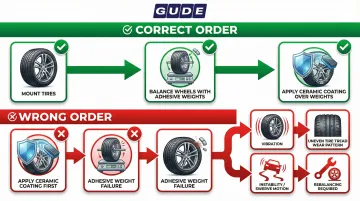
Mount tires → Balance wheels → Apply ceramic coating
Never coat bare wheels before tires are mounted and balanced. Professional detailing guidance confirms this sequence: have the tire shop mount and balance the wheels with adhesive weights applied to the clean, uncoated barrel, then take the wheels home to apply the ceramic coating.
Why This Sequence Works
Once weights are bonded to the clean, decontaminated alloy surface, the ceramic coating is applied over the entire assembly — including the weights — effectively sealing them in place. This locks in the adhesive bond and extends the hydrophobic protection uniformly across the entire wheel surface.
Many enthusiasts want to coat brand-new wheels straight out of the box to avoid contaminating the surface with tire mounting lubricant. That instinct is understandable — but the risk of weight failure far outweighs the inconvenience of cleaning the surface after mounting.
Proper Surface Preparation After Tire Mounting
Before applying ceramic coating:
- Degrease the barrel thoroughly using a dedicated wheel prep or panel wipe product
- Remove all tire mounting lubricant, soap residue, and fingerprints
- Use products like Gtechniq Panel Wipe (pure alcohols and solvents) or Gyeon Prep to dissolve oils and leave a 100% decontaminated surface
- Ensure the coating adheres correctly to both the wheel and the already-bonded weights
The adhesive weight itself also matters. Weights manufactured to ISO 9001 standards — like those produced by Toho Kogyo, which supplies OEM assembly lines including Toyota — use adhesive backing rated for heat cycles, road salt, and sustained vibration. Applied to a properly prepared, uncoated surface before ceramic coating, they hold through real-world driving conditions without lifting.
What to Do If Your Ceramic-Coated Wheels Need Rebalancing
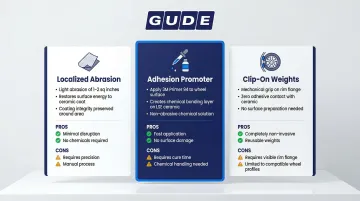
When a wheel weight falls off during a tire rotation — or a shop needs to rebalance after a tire replacement — the inner barrel is already coated and standard adhesive weights won't stick. Three approaches work reliably in this situation.
Option 1: Surface Preparation (Localized Abrasion)
The shop (or you) can lightly abrade the specific spot where the new weight will be placed:
- Use fine-grit sandpaper (600-800 grit) or a dedicated surface prep product
- Abrade just the small area where the weight will sit to break through the ceramic layer
- This restores surface energy at that localized spot, allowing the adhesive to form a proper bond
- Affects only 1-2 square inches — overall coating integrity stays intact
Option 2: Adhesion Promoters
For low surface energy (LSE) coatings, chemical primers can improve adhesion:
- 3M Tape Primer 94 creates a bonding layer that bonds to LSE materials on one end and adhesives on the other
- Independent testing on treated wheels showed that primer wipes significantly increased shear adhesion of wheel weight tape
- Apply the primer to the exact spot where the weight will be placed
Option 3: Clip-On Weights
Clip-on weights attach mechanically to the rim flange — no adhesive required:
- Immune to the slickness of ceramic coating
- Practical workaround when surface prep isn't feasible
- Drawbacks to consider: more visible than tape weights, incompatible with flangeless alloy wheels, and may not fit low-profile tire setups
Critical Communication
Always inform your tire technician that the wheels have a ceramic coating before any balancing work. Without that heads-up, a technician may press adhesive weights directly onto the coated surface — guaranteeing early failure.
Adhesive vs. Clip-On Wheel Weights: Which Works Better on Coated Wheels?
Retention Mechanisms
| Weight Type | How It Attaches | Best For Ceramic-Coated Wheels? |
|---|---|---|
| Adhesive (Stick-On) | Pressure-sensitive adhesive bonds to inner barrel | ✅ Yes — if applied before coating, or if surface is prepped post-coating |
| Clip-On (Hammer-On) | Spring steel clip mechanically grips rim flange | ✅ Yes — unaffected by coating, but requires visible flange |
Adhesive Quality Matters
Not all adhesive wheel weights are created equal. Weights manufactured to tighter tolerances with industrial-grade adhesive backing — like those from ISO 9001-certified facilities — offer:
- Greater peel strength (measured via ASTM D3330)
- Better resistance to heat and moisture
- More reliable retention when surfaces are less than perfectly prepared
Weights from Toho Kogyo — which manufactures GUDE Corp's adhesive line and supplies OEM automobile manufacturers in Japan — meet these specs, with adhesive compound tested for year-round retention on both alloy and steel rims.
Wheel Design Limitations
The automotive industry trend toward "flangeless" alloy rims eliminates the machined outer lip required for clip-on weights. This forces technicians to use adhesive weights on the inner barrel — making application timing before coating critical.
Caring for Your Ceramic Coating After Wheel Balancing
What to Avoid
To protect both the coating's integrity and the adhesive weight bond:
- Avoid acidic or high-pH wheel cleaners (below pH 5.0 or above pH 9.0) — these degrade the coating
- Skip steel wool and stiff brushes; they scratch the surface
- Don't aim high-pressure spray directly at weight edges, which can loosen the adhesive bond
- Remove brake dust promptly — extended iron particle exposure breaks down the coating
Recommended Maintenance Habits
These three habits cover the full maintenance cycle for coated wheels:
| Maintenance Task | Frequency | Purpose |
|---|---|---|
| pH-neutral wash | Weekly | Remove brake dust before it bonds to the coating |
| Iron remover decontamination | Annually | Dissolve embedded iron particles from brake wear |
| SiO2 booster spray | Every 3-4 months | Refresh hydrophobic properties and extend coating life |
Coating Longevity
With proper care, quality ceramic coatings on wheels can last 1-2 years or longer:
- Gtechniq C5 Wheel Armour: 1-2 years, heat resistant to 600°C
- Gyeon Q2 Rim EVO: Up to 18 months, heat resistant to 800°C
- Ceramic Pro Wheel & Caliper: 36-month warranty, heat resistant to 750°C
Watch for water beading to diminish — that's the earliest sign the coating needs a SiO2 booster refresh before full reapplication becomes necessary.
Frequently Asked Questions
Will wheel weights stick to ceramic coating?
No, standard adhesive wheel weights will not reliably stick to a ceramic-coated surface because the coating creates a low-surface-energy barrier (below 36 dynes/cm) that prevents proper adhesive wet-out. Apply weights before coating, or lightly abrade the coated surface before applying new weights post-coating.
What to avoid after ceramic coating?
Avoid harsh chemical wheel cleaners (pH below 5.0 or above 9.0), abrasive scrubbing tools like steel wool, and high-pressure spray directed at wheel weight edges or coating seams. These can degrade the coating or compromise adhesive weight retention over time.
Is it good to ceramic coat your wheels?
Yes, ceramic coating makes wheels dramatically easier to clean, reduces brake dust adhesion, adds chemical resistance to road salt and contaminants, and can last 1-2 years or more — as long as the wheels are balanced before the coating is applied.
What's better, balancing beads or weights?
Balancing beads (placed inside the tire) avoid the ceramic coating adhesion issue entirely since they don't contact the coated rim surface. However, beads are not recommended as the sole balancing method for low-profile passenger tires (aspect ratio 65 or below) because they cannot correct lateral imbalance as precisely as static wheel weights.
Does 10 lbs per tire make a difference?
Wheel balance is measured in fractions of an ounce, not pounds. Even a small imbalance of 0.5 oz (14 grams) can cause noticeable vibration at highway speeds. Standard digital wheel balancers round imbalance readings to the nearest 0.25 oz. That's why a weight falling off a ceramic-coated wheel, even a small one, should be addressed promptly.
Need high-quality adhesive or clip-on wheel weights for your shop? GUDE Corp supplies ISO 9001-certified, lead-free wheel weights manufactured by Toho Kogyo in bulk, wholesale, and pallet quantities. Contact our team at (463) 464-5500 or jonathan@gudecorp.com for wholesale pricing and technical support.