

Introduction
A wheel that's off balance by as little as 0.25 oz will shake a steering wheel at highway speeds, chew through tires unevenly, and put unnecessary stress on bearings and suspension bushings. Wheel weights — small metal counterweights clipped or adhered to the rim — correct this by offsetting heavy spots in the tire-wheel assembly.
Getting the placement right matters as much as getting the weight right.
The central question many tire technicians face is: can those weights go on the inboard side of the wheel? The answer is yes in most cases, but the correct approach depends on wheel design, weight type, clearance constraints, and vehicle application. Get it wrong and you're looking at weights that shed mid-drive, clips that gouge the rim, or a customer back at the counter with the same vibration complaint.
TLDR
- Wheel weights can be placed inboard—modern two-plane balancing often requires it
- Adhesive weights are the standard for inboard placement on alloy wheels lacking an inboard flange
- Clip-on weights work inboard only on wheels with a compatible flange, primarily steel wheels
- Always verify clearance from brake calipers, TPMS sensors, and suspension components
- Lead wheel weights are banned in nine U.S. states—lead-free alternatives are required for compliance
What Are Inboard and Outboard Wheel Weight Placement Planes?
Defining the Two Balancing Planes
Modern wheel balancers calculate imbalance at two distinct planes:
- Outboard plane: The visible face of the wheel seen from outside the vehicle
- Inboard plane: The side facing the brake assembly and suspension components
This approach is called dynamic or two-plane balancing, defined by ISO 1940-1:2003 as a condition requiring two complementary unbalance vectors to completely represent total unbalance. The balancer measures both planes independently because placing all correction weight on one plane cannot fully correct dynamic imbalance.
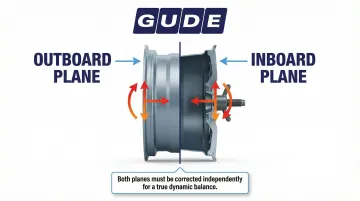
Why Two-Plane Balancing Matters
Dynamic imbalance causes the wheel to wobble or shimmy even at moderate speeds. Research shows that steering wheel vibration from unbalanced wheels peaks significantly at speeds between 62 mph and 75 mph, which corresponds to the resonance frequency of the wheel assembly. Both planes must be addressed for a truly smooth ride.
Physical Location of Inboard Placement
Inboard placement means the weight is applied to the inner barrel or inner flange of the wheel, hidden from external view and positioned close to the brake rotor and caliper assembly. Wheel geometry, particularly offset and backspacing, determines how much space is available on the inboard plane. High-offset wheels or custom fitments may have very limited space on the inboard plane, requiring careful distribution of correction weight across both planes.
Can Wheel Weights Be Placed Inboard? The Direct Answer
Yes, wheel weights can and often should be placed inboard. The wheel balancer will indicate when inboard correction is needed; ignoring this reading and placing all weight outboard produces an incomplete balance that leaves the vibration issue unresolved.
The Key Variable: Inboard Flange Presence
Whether the wheel has an inboard flange determines the weight type you'll use:
- Steel wheels typically have a pronounced inboard flange that accepts standard clip-on weights
- Modern alloy wheels often have little or no inboard flange, making clip-on placement impossible—adhesive weights become the only viable option
The Evolution in Wheel Design
As OEM and aftermarket wheels have moved to lower-profile, large-diameter alloy designs, the inboard flange has been reduced or eliminated. Aluminum alloy wheels now account for over 62% of new passenger vehicle installations globally, and many modern alloy wheels lack inboard and outboard flanges entirely, making adhesive weights the mandatory standard for inboard correction.
The Clearance Concern
Inboard placement must account for proximity to several components that sit close to the wheel's inner face:
- Brake calipers and rotors
- TPMS sensors
- Suspension arms and control links
The risk is real. Toyota recalled 2007–2012 FJ Cruisers after incorrectly positioned wheel weights on alloy wheels contacted brake caliper tubes, causing fluid leaks and loss of braking performance.
The balancer's laser or indicator marks the exact target position. Technicians must still verify that position clears all nearby components before applying any weight. The machine tells you where to aim; physical clearance confirmation is always the final check.
Clip-On vs. Adhesive Wheel Weights: Which Works Inboard?
When Clip-On Weights Are Viable Inboard
Clip-on weights work inboard only when the inboard flange profile matches one of the standard clip-on weight styles. SAE J1986 standardizes balance weight and rim flange profiles. Common profiles include:
- P: Standard-width passenger car steel wheels
- T: Light-truck steel wheels with thicker flanges
- MC: Most North American domestic alloy wheels
- FN: Most Japanese alloy wheels
- AW / IAW: European and some Asian alloy wheels
Using the wrong clip profile on an inboard flange risks rim scratching, loose fit, or ejection at speed.
When Adhesive Weights Are Required Inboard
For any alloy wheel without a defined inboard flange, tape-on adhesive weights are the only safe option. The adhesive approach also enables hidden placement—weights can be positioned behind spokes or on the inner barrel away from view—which is increasingly important as consumers invest in custom wheels.
Surface Preparation: The Make-or-Break Factor
The inner barrel must be thoroughly cleaned of brake dust, grime, and old adhesive residue before a new tape-on weight is applied. Skipping this step is the most common cause of adhesive weight failure in service.
Proper application requires:
- Cleaning with 50/50 isopropyl alcohol/water mix or dedicated prep solvent
- Application in temperatures between 60°F and 110°F (15°C - 43°C)
- Firm pressure (approximately 21 lbs/90 N force) to achieve proper adhesive "wet-out"
Cold weights lose flexibility, and cold wheels develop condensation, reducing short-term adhesion. Dust, tire lube, or skin oils prevent chemical bonding, leading to weight detachment.

Not all adhesive weights hold equally well inboard, where brake heat and road debris exposure are greater than on the outboard face. GUDE Corp's adhesive wheel weights — manufactured by Toho Kogyo, the #1 wheel weight producer in Japan and #3 globally — use industrial-grade permanent adhesive backing rated for year-round service, with ISO 9001-certified production ensuring consistent bond strength and corrosion resistance across the full weight range.
Inboard Wheel Weight Placement: Challenges and Best Practices
Three Most Common Inboard Placement Mistakes
- Applying a clip-on weight to a flange profile it doesn't match — results in poor retention and potential rim damage
- Placing an adhesive weight on an uncleaned surface — leads to premature weight detachment
- Ignoring clearance checks — a weight positioned where it contacts brake or suspension components at full lock or full droop is a safety hazard
Best Practice Sequence for Inboard Placement
For clip-on weights:
- Use the balancer's stop-and-lock feature to prevent wheel rotation after reading
- Confirm the inboard weight location visually and physically before applying
- Test-fit the clip before final seating with a soft-tip hammer
- Verify the clip profile matches the flange geometry
For adhesive weights:
- Clean the inner barrel with solvent and allow to dry
- Apply weight with firm, sustained pressure
- Re-spin the wheel to verify the balance was corrected
- Confirm clearance from brake components at all rotation positions
Plane Separation Rule
Following the steps above gets the weight in the right place — but placement only works if both planes are correctly separated. When inboard and outboard weights are both needed, the two planes must be far enough apart for the balancer to calculate a valid dynamic correction. Balancer manufacturers like Hunter Engineering will actively reject inputs (blinking digits) if the planes are too close together.
On motorcycle wheels or very high-offset custom wheels where adequate separation isn't possible, the solution is to prioritize the plane with the larger imbalance reading and use a single-plane (static) balance as a fallback rather than forcing a dynamic calculation the hardware cannot reliably solve.
Lead-Free Wheel Weights for Inboard Use: Regulations and Material Choices
The Regulatory Landscape
Nine U.S. states have enacted laws banning the installation of lead wheel weights: California, Illinois, Maine, Maryland, Minnesota, New Jersey, New York, Vermont, and Washington. These states represent approximately 33% of all registered vehicles in North America. This applies equally to inboard and outboard placement—a lead weight installed inboard is still subject to state law.
In December 2024, the EPA declined to proceed with federal TSCA rulemaking, citing that state-level bans and voluntary OEM phase-outs have already effectively removed lead weights from new vehicles.
Lead-Free Alternatives: Material Trade-Offs
| Material | Characteristics |
|---|---|
| Steel | Environmentally safe and recyclable; requires premium powder coating to prevent corrosion; lower density than lead (larger volume for same mass) |
| Zinc | Soft and malleable like lead; highly corrosion-resistant; lower density than lead; emerging environmental scrutiny |
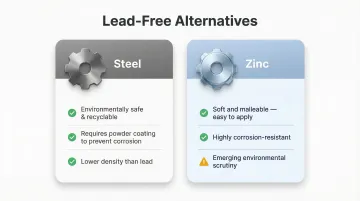
Steel is the most widely recommended replacement — and when sourcing for inboard use specifically, the clip-on series matters. GUDE Corp's IAW (Inner Alloy Wheel) series is built for hidden inboard placement, while the AW series covers standard alloy wheel applications. Both use powder-coated steel construction and are manufactured in ISO 9001-certified facilities.
Frequently Asked Questions
Can wheel weights be placed inboard?
Yes, wheel weights can be placed inboard, and modern two-plane balancing often requires it. Adhesive weights are the standard for inboard placement on alloy wheels, while clip-ons work only where a compatible inboard flange is present.
What states have banned lead wheel weights?
Nine U.S. states prohibit lead wheel weights: California, Illinois, Maine, Maryland, Minnesota, New Jersey, New York, Vermont, and Washington. These bans cover all placement locations, including inboard, so lead-free weights are required for compliant service in these states.
Does 10 lbs per tire make a difference?
Even a fraction of an ounce of imbalance can cause vibration and uneven wear. Ten pounds per tire is a massive imbalance that needs correction, but it may also signal a deeper issue with the tire or wheel worth investigating before adding weight.
What is the difference between inboard and outboard wheel weight placement?
Outboard is the visible face of the wheel; inboard faces the brake and suspension side. Modern wheel balancers measure both planes separately to achieve true dynamic balance, correcting both up-and-down force and side-to-side wobble.
Can clip-on wheel weights be used on the inboard side?
Clip-on weights can be used inboard only if the wheel has a compatible inboard flange—common on steel wheels but increasingly absent on modern alloy wheels, where adhesive weights are the correct alternative.
How do I prevent inboard wheel weights from falling off?
Clean the mounting surface thoroughly before applying adhesive weights—oil, dust, or moisture will compromise adhesion. For clip-ons, confirm the weight matches the flange profile and seat it fully using the correct installation tool.