Introduction
A scraping or ticking noise after a tire rotation. A callback job where the brakes "check out fine." On Toyota vehicles, the culprit is often simpler than it looks: a wheel weight contacting the brake caliper.
Toyota models run tighter wheel-to-caliper clearances than most platforms, and an oversized or misplaced weight closes that gap fast. Technicians routinely misdiagnose this as a brake or suspension issue — burning diagnostic time on a problem that's right in front of them.
This guide covers the cause, a quick in-bay fix, and the right weight profile to keep it from coming back.
TL;DR
- Wheel weights rub brake calipers due to incorrect placement, oversized clip profiles, or using the wrong weight type for the wheel design
- Rhythmic scraping or ticking synced with wheel rotation, vibration, and visible caliper scoring are the telltale signs
- Remove the wheel, reposition or replace the offending weight, verify clearance, and reinstall
- Adhesive or low-profile clip-on weights sized to Toyota's rim flange spec prevent the problem from recurring
Why Wheel Weights Rub Brake Calipers on Toyota Vehicles
Wheel weights are small counterbalancing components clipped or adhered to the wheel rim to eliminate vibration from uneven tire-wheel assembly weight. On Toyota vehicles—particularly the Camry, RAV4, Corolla, and Tacoma—compact wheel well geometry leaves minimal clearance between the inboard rim flange and the caliper body.
That tight fitment is what makes weight placement so consequential on these platforms.
Three main reasons weights rub the caliper:
- Incorrect inboard placement — the weight is positioned too far inboard on the rim flange, extending into the caliper's travel zone
- Oversized clip profile — a clip-on weight's hook or body is too tall or wide for the available clearance
- Weight migration — the weight has shifted after installation due to poor adhesion, incorrect clip engagement, or rim damage
These causes aren't theoretical. Toyota's own recall and TSB documentation confirms tight clearances are a recurring concern across multiple model lines:
- 2024–2025 Toyota Tacoma (4WD, 16-inch brakes with 17-inch wheels): NHTSA Recall 25V-058 notes tight clearance between brake hoses and wheels, where mud and dirt buildup on the interior of the wheels can contact and wear brake hoses
- 2007–2012 Toyota FJ Cruiser (TRD High Performance Brake Kit with 16-inch alloy wheels): NHTSA Recall C0R warns that incorrect wheel balance weight location can interfere with the outer brake tube, causing damage
- 2016–2018 Toyota Tundra & 2017–2018 4Runner: Southeast Toyota TSB SET-18-001/002 provides accessory wheel balance guidance, specifying that technicians must set weight positions correctly and avoid stacking weights to prevent interference
Aftermarket or generic weights are a frequent root cause here — they're often not matched to specific rim geometry and may not account for Toyota's tighter fitment requirements. Weights built to Toyota OEM rim flange specifications, such as GUDE Corp's T Series (manufactured by Toho Kogyo, the OEM supplier to Toyota), are engineered to fit within these clearance tolerances from the start.
Signs That a Wheel Weight Is Contacting Your Toyota's Brake Caliper
Auditory Symptoms
The most recognizable symptom is a rhythmic metallic ticking, scraping, or clicking sound that cycles in sync with wheel rotation — unlike brake pad wear indicators or rotor noise, this occurs even when brakes are not applied.
The sound increases in frequency as speed rises and may temporarily disappear when brakes are lightly applied, as caliper movement shifts the contact point.
Tactile and Visual Cues
- Vibration felt through the steering wheel or floor at certain speeds
- Visible scuff marks, scoring, or paint transfer on the face of the brake caliper when the wheel is removed
- Deformed or cracked weight — the rubbing weight can fracture or detach, leaving a loose metal fragment in the wheel well
A real-world example: NHTSA Recall 24V-911 documents 2024 Toyota RAV4 and 2025 Lexus NX vehicles where loose caliper mounting bolts allowed the caliper to move and contact the wheel's inner radius. Dealer inspections observed "scrape marks around the inner radius of the wheel" and "wheel weights had become detached from the left front wheel."
What NOT to Confuse This With
| Noise Source | Character | Key Identifier |
|---|---|---|
| Brake pad wear indicator | High-pitched squeal | Only when braking; pad worn to ~2 mm |
| Warped rotor | Brake pedal pulsation | No noise while coasting |
| Wheel bearing | Low grumble or raspy hiss | Changes pitch when turning |
| CV joint | Click or pop | Primarily during cornering |
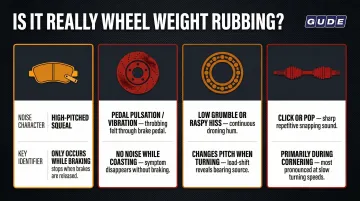
Rhythmic noise that tracks wheel speed and occurs without braking? Remove the wheel first and check for weight-to-caliper contact before diagnosing anything else.
Step-by-Step Fix: Resolving Wheel Weight Rubbing on Toyota Brake Calipers
These five steps walk through diagnosis, weight removal, repositioning, clearance verification, and final confirmation — in that order. Don't skip ahead to removal until you've confirmed contact is the actual cause.
Step 1: Safely Raise the Vehicle and Remove the Wheel
- Use a floor jack and jack stands rated for the vehicle's weight
- Engage the parking brake
- Follow Toyota's jacking points (consult your owner's manual to avoid underbody damage)
- Once the wheel is removed, visually inspect the inboard face of the wheel and the full circumference of the rim flange for contact marks, shiny rub spots, or deformed weights before touching anything
Step 2: Locate and Assess the Offending Wheel Weight
- Inspect all weights on both inboard and outboard flanges
- Look for weights positioned close to the caliper body, showing signs of contact (scuffing, bending), or shifted from their original placement
- Check whether the weight is clip-on (hook-style) or adhesive tape
- Note: Clip-on weights on the inboard flange are the most common offenders on Toyota models due to the hook extending toward the caliper
Step 3: Remove and Reposition or Replace the Weight
Start with clean removal, then decide whether to reposition or replace:
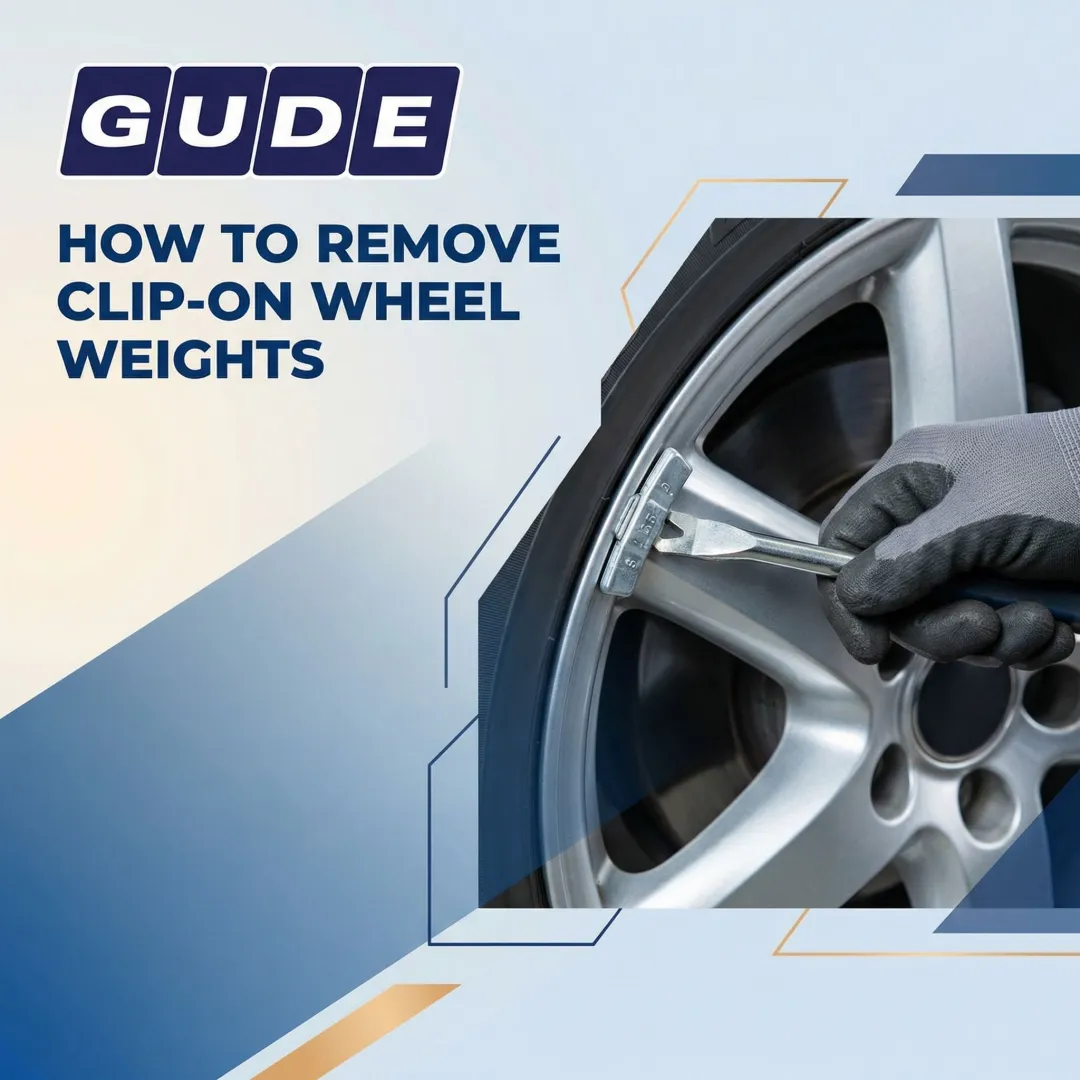
- Use a wheel weight removal tool (not a screwdriver) to prevent rim damage on clip-on weights
- For adhesive weights, use a plastic pry tool and adhesive remover to strip the tape without leaving residue
- Move the weight to a rim flange section that maintains the same balance correction with adequate caliper clearance
- In most Toyota applications, shifting the weight slightly outboard or to a lower-profile mounting zone resolves contact
- If the weight is deformed, cracked, or the clip is unreliable, replace it with a compatible weight of the same gram value
- Do not stack multiple small weights to compensate — a taller stack profile worsens clearance, not fixes it
- Consider switching to GUDE's T Series clip-on weights, built to Toyota OEM rim flange specifications, or a low-profile adhesive weight
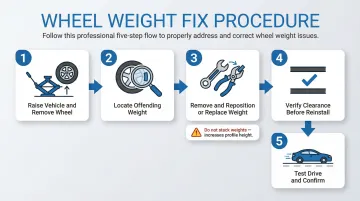
Step 4: Verify Clearance Before Reinstalling the Wheel
- Reinstall the wheel finger-tight and manually rotate it to check for any remaining contact between the new weight position and the caliper
- There should be a visible and unobstructed gap
- Torque the lug nuts to Toyota's specified torque value using a calibrated torque wrench in a star pattern:
| Toyota Model | Lug Nut Torque Spec |
|---|---|
| Camry (2018–2024) | 76 ft-lbs (103 N-m) |
| RAV4 (2019–2024) | 76 ft-lbs (103 N-m) |
| Corolla (2019–2024) | 76 ft-lbs (103 N-m) |
| Tundra (2022–2024, Steel wheels) | 154 ft-lbs (209 N-m) |
| Tundra (2022–2024, Aluminum wheels) | 97 ft-lbs (131 N-m) |
Step 5: Test Drive and Confirm Resolution
- Perform a controlled test drive, accelerating through the speed range where the noise or vibration was previously present
- Verify the symptom is fully resolved
- If the noise persists after confirmed weight clearance, the caliper or rotor may show surface damage. Escalate to a professional brake inspection before returning the vehicle to service.
Choosing the Right Wheel Weight Profile for Your Toyota
Not all wheel weights are dimensionally the same. Profile height—how far the weight protrudes from the rim flange—varies by manufacturer and material. On Toyota vehicles with tight inboard clearances, a lower-profile weight is critical to prevent future contact.
Two Main Weight Categories
1. Clip-on steel or zinc weights for alloy and steel rims
- Available in multiple profiles (MC, P, T, AW, IAW, FN series)
- Clip height and hook depth vary by series
- T Series (Toyota-specification) and AW Series (alloy wheel, low-profile) are engineered for tighter clearances
2. Adhesive tape weights for alloy rims
- Applied flat to the inboard barrel of the rim
- Often provide the best clearance solution on models like the RAV4 and Camry where caliper proximity is tightest
- No clip hook extending toward the caliper
Why Precision Manufacturing Matters
Not every weight within a given series performs identically — source quality determines whether clearance is predictable or a guessing game.
Poorly manufactured weights from uncertified sources may have variable heights and clip thicknesses that make clearance unpredictable. ISO 9001-certified manufacturers like GUDE Corp produce wheel weights to consistent dimensional tolerances — a meaningful difference when fitting tight-clearance Toyotas.
GUDE's T Series clip-on weights are built to Toyota OEM rim flange specifications. They're manufactured by Toho Kogyo, which holds over 65% OEM market share in Japan and supplies automobile manufacturers including Toyota directly. That lineage ensures the clip profile and weight body height are matched to Toyota's exact clearance requirements.
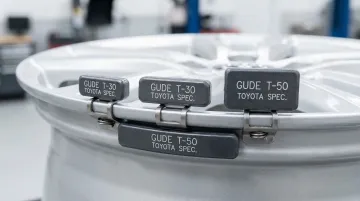
Lead-Free Weight Profile Differences
Lead-free zinc and steel wheel weights (the current industry and regulatory standard) can sometimes have slightly different profiles than legacy lead weights. This is because steel density (~7.8 g/cm³) and zinc density (~7.14 g/cm³) are lower than lead density (~11.34 g/cm³), requiring more physical volume to achieve the same mass.
Technicians switching to lead-free weights should verify that the new weight profile clears the caliper, particularly when servicing older Toyota models previously balanced with lead weights.
Practical tip: Test-fit the weight against the rim before committing to placement. Hold it in position, reinstall the wheel hand-tight, and rotate to check clearance before full torque and road testing.
Common Mistakes to Avoid and Preventive Maintenance Tips
Critical Mistakes
- Reusing a deformed or shifted weight without investigating why it moved
- Using a generic or unmatched weight with a taller profile than the Toyota application requires
- Skipping the clearance verification step before reinstalling the wheel
- Assuming the noise is brake-related without removing the wheel to inspect
Preventive Practice
On any Toyota tire rotation or rebalancing job, add these two steps to your reinstall checklist:
- Verify inboard weight placement before seating the wheel
- Confirm caliper clearance with the wheel fully mounted
It takes less than a minute and catches clearance issues before the vehicle leaves the bay.
Addressing Root Causes
If a vehicle repeatedly has weights migrating or contacting the caliper, the underlying issue may be:
- Rim damage or a bent flange
- Incorrect rim-to-tire fitment
- Poor-quality weights with inferior adhesives or improperly fitted clips
Resolve these structural issues first. Swapping the weight alone won't hold if the underlying fitment or rim condition is the real problem.
Frequently Asked Questions
Why is my brake caliper rubbing?
Brake caliper rubbing can have several causes including a stuck caliper piston, worn brake pads, or—in the context of wheel balancing—a wheel weight placed too close to or in contact with the caliper body. Remove the wheel and inspect both the brake components and the inboard rim flange for signs of contact.
How to tell if wheel weights are bad?
Look for rhythmic ticking or scraping that matches wheel rotation, new vibration after a balance service, a visibly bent or cracked weight, or a detached weight loose in the wheel well. Removing the wheel for a direct visual inspection is the most reliable confirmation.
Can wheel weights damage brake calipers if left in contact?
Yes, prolonged contact between a wheel weight and caliper can cause surface scoring, paint damage, and in severe cases, gouge the caliper body. If the rubbing is ignored, the weight may also fracture and become a loose projectile. Early inspection prevents costly caliper replacement.
Which Toyota models are most commonly affected by wheel weight and caliper clearance issues?
The Toyota Camry, RAV4, Tacoma, and 4Runner are most frequently cited in service forums and TSBs due to their combination of tight wheel well clearances and large brake assemblies. Treat these as high-risk any time a wheel balance is performed.
Should I use clip-on or adhesive wheel weights on my Toyota?
For Toyota models with tight inboard caliper clearance, adhesive tape weights applied to the flat inner barrel of the rim are generally the safer choice—they sit flush and add no clip-hook height. Confirm fitment against the specific rim profile before committing to either type.
How often should wheel weights be checked after a balance service?
Inspect wheel weights at every tire rotation (typically every 5,000–7,500 miles) and immediately if vibration or ticking develops after a balance service. Verifying clearance at reinstall adds seconds to the job and avoids the caliper damage that follows from ignored contact.