Introduction
Tire balancing is one of the most routine services in automotive maintenance, yet the amount of weight a technician adds reveals more about a wheel assembly than most people realize. Those clip-on weights or adhesive strips aren't just correcting a wobble — they're measuring how far the assembly strays from true balance.
Most drivers and even some technicians don't realize there are defined industry limits for balancing weight. Exceeding those limits signals a deeper problem that won't be solved by adding more metal to the rim. A tire requiring excessive weight is showing symptoms of manufacturing defects, wheel damage, or improper mounting—issues that demand investigation, not just more correction.
This guide covers normal balancing weight ranges, accepted maximums by vehicle type, the root causes of excessive imbalance, and how to respond when those limits are exceeded.
TL;DR
- Passenger car tires typically need 0.25–1.5 oz of balancing weight; anything above 2–3 oz warrants investigation
- Commercial vehicles follow TMC RP 214 guidelines: maximum 15 oz for highway steer tires, 19 oz for drive/trailer positions
- High weight requirements point to tire defects, wheel damage, or improper mounting rather than normal imbalance
- When weight exceeds limits, remount the tire 180 degrees, check wheel runout, and inspect for defects before adding more weight
What Is a Normal Amount of Tire Balancing Weight?
A brand-new, well-manufactured tire mounted on a true wheel should require very little correction weight. The amount needed depends entirely on how evenly mass is distributed in the tire and wheel assembly—essentially, how far the assembly deviates from perfect symmetry.
Typical weight ranges by vehicle category:
- Passenger cars and light trucks: 0.25–1.5 oz (7–42 grams) per wheel is standard; weights approaching 2–3 oz raise questions about assembly quality
- Medium-duty and commercial trucks: Higher baseline ranges due to larger, heavier assemblies—typically 8–14 oz for standard commercial tires, 16–20 oz for wide-base configurations
Modern balancing machines measure two types of imbalance:
- Static imbalance — uneven weight in one plane, causing up-and-down vibration; corrected with weight on a single rim plane
- Dynamic imbalance — uneven distribution across two planes, causing side-to-side wobble; requires weight on both inner and outer rim planes
Total correction weight is a direct measure of mass asymmetry in the assembly. A low number means a well-matched tire and wheel; a high number signals a problem with one or both components.
As tires wear, balance shifts. A typical 295/75R22.5 commercial drive tire loses over 30 pounds of tread rubber during its lifecycle, shifting the weight balance. Additional weight during rebalancing is normal—but a dramatic increase on a previously balanced tire should prompt immediate inspection.
How Much Wheel Weight Is Too Much? Limits by Vehicle Type
Industry bodies have established specific maximum balance weight limits that technicians should treat as hard thresholds, not loose guidelines.
Commercial Vehicle Limits (TMC RP 214)
The American Trucking Associations' Technology and Maintenance Council publishes Recommended Practice 214, which sets strict maximum external balance weights for commercial assemblies:
| Application | Steer Axle Maximum | Drive/Trailer Maximum |
|---|---|---|
| Highway tires (19.5" and larger) | 12–15 oz | 16–19 oz |
| On/off-highway service | 14–17 oz | 18–21 oz |
| Wide-base tires (e.g., 445/50R22.5) | 22 oz | 26–28 oz |
These limits exist because excessive weight requirements indicate severe out-of-round conditions, improper mounting, or component failure—not just routine imbalance.
Passenger Car Practical Thresholds
Unlike commercial vehicles, passenger cars have no single governing standard. In practice, though, 2–3 oz (56–85 grams) per wheel is the upper threshold before investigation is required. Many experienced technicians use 1.5 oz as a practical "flag" weight—anything above that deserves a closer look.
Modern balancers typically round to the nearest 0.25 oz, and residual imbalances below that increment are generally vibration-free for passenger applications.
The Underlying Principle
When a tire requires excessive weight, adding more only treats the symptom. The balancing machine is measuring a real structural issue: a heavy spot, a bent wheel, or a manufacturing defect. Stacking weights beyond accepted limits only masks the problem — and weights can detach at highway speeds, causing road hazards and wheel damage.
When limits are exceeded, the correct fix is remounting — not adding more weight. Here's the standard procedure:
- Deflate the tire and break the bead
- Rotate the tire 180 degrees on the rim
- Remount and rebalance
This offsets the tire's heavy spot from the wheel's heavy spot, often eliminating the excess weight requirement entirely.
What Causes a Tire to Need Excessive Balancing Weight?
Excessive weight requirements trace back to identifiable root causes. Adding more weight without diagnosing the underlying issue compounds the problem rather than solving it.
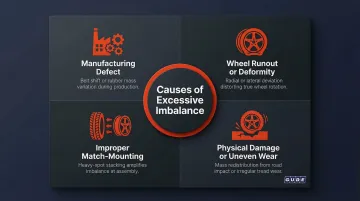
The four most common causes:
- Manufacturing defect or variation: Some tires leave the factory with slight mass asymmetry even within tolerances. Significant defects — internal belt shift, uneven rubber distribution, or curing irregularities — create heavy spots requiring unusual correction weight. This is grounds for warranty return.
- Wheel runout or deformity: A bent or out-of-round wheel introduces compound imbalance that no amount of weight can fully resolve. Radial runout (deviation from a perfect circle) and lateral runout (deviation from a flat plane) must be measured before blaming the tire.
- Improper match-mounting: When the tire's high spot and the wheel's high spot align during mounting, the imbalance compounds. Proper technique involves marking and aligning high spots to cancel each other out. Most manufacturers mark tires with yellow dots (lightest point) or red dots (high point of radial force variation) to guide alignment.
- Physical damage or uneven wear: Potholes, curb strikes, flat spots from extended parking, and aggressive wear patterns all alter mass distribution post-installation. A tire that previously balanced with 0.5 oz may require 3+ oz after significant road damage.
Industry runout tolerances:
| Wheel Type | Radial Runout | Lateral Runout |
|---|---|---|
| Passenger aluminum | 0.030 in max | 0.030 in max |
| Passenger steel | 0.040 in max | 0.045 in max |
| Commercial aluminum | 0.030 in max | 0.030 in max |
| Commercial steel | 0.070 in max | 0.070 in max |
Wheels exceeding these limits cannot be balanced effectively and must be replaced or repaired.
What to Do When a Tire Requires Too Much Weight
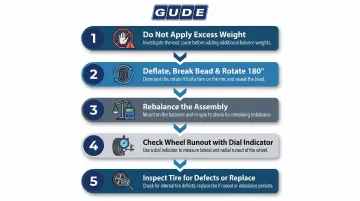
Follow this step-by-step diagnostic protocol when a tire exceeds acceptable weight thresholds:
Do not apply the excess weight and return the vehicle to service. This masks the underlying problem and creates safety risks.
Deflate and break the bead, then rotate the tire 180 degrees on the rim. Lubricate the bead and rim, remount, and inflate to proper pressure.
Rebalance the assembly. If required weight drops to within limits, the root cause was heavy-spot stacking—problem solved.
If weight remains excessive after remounting, check wheel runout. Use a dial indicator to measure radial and lateral runout against manufacturer specifications.
If the wheel is true and the tire still requires excess weight, inspect the tire for defects. Look for belt separation, uneven rubber distribution, or manufacturing irregularities. Consider returning it to the manufacturer or replacing it.
Once you've worked through those steps, two additional cautions are worth keeping front of mind.
Never stack multiple clip-on weights or adhesive strips beyond balancing machine recommendations to "force" a balance. Excessive weight on the outer flange can fly off at highway speeds. On hardened aluminum alloys and specialty coated wheels, clip-on weights can fail to grip the flange adequately and may detach under load—always verify the weight type is rated for the specific rim material.
Fleet maintenance teams should document balance weight history per tire. Any unit that suddenly requires more weight than its baseline is flagging a problem that warrants investigation before it causes a blowout or forces premature removal.
Choosing the Right Wheel Weight Matters More Than You Think
Not all wheel weights are created equal. The precision, material composition, and adhesion quality directly affect balancing accuracy and whether that balance holds over time.
Clip-On vs. Adhesive Weights
Choosing between clip-on and adhesive weights comes down to wheel type and placement:
- Clip-on weights attach to steel rim flanges via spring steel clips — cost-effective and widely available, but incompatible with coated aluminum wheels where premature detachment is a real risk
- Adhesive (stick-on) weights bond to the inner barrel of alloy and cosmetically sensitive wheels, requiring clean, degreased surfaces; when installed correctly, quality adhesive weights hold throughout the vehicle's lifespan
The Lead-Free Transition
Many states now restrict or ban lead wheel weights due to environmental contamination. The EPA estimated that 1.6 million pounds of lead are lost annually when weights fall off vehicles. Nine states have enacted bans:
- California, New York, Minnesota, Illinois, Maine
- Vermont, Washington, New Jersey, and Maryland
In December 2024, the EPA declined to pursue a federal ban, noting that state-level action and voluntary OEM transitions (95% of U.S. automakers no longer install lead weights on new vehicles) have sufficiently mitigated the risk.
Coated steel weights have become the practical replacement. They match lead's density for precise balancing, and polymer coatings prevent galvanic corrosion on alloy wheels — a failure mode that lead weights don't handle well. GUDE Corp's coated steel weights are manufactured by Toho Kogyo across ISO 9001-certified facilities in Japan and Vietnam, built to OEM specifications used by Toyota and other major automakers.

For tire shops and fleet operations navigating state compliance requirements, coated steel is now the default — not a compromise.
Frequently Asked Questions
What is the maximum balance weight for a passenger car tire?
While there's no universal passenger car standard, industry practice treats 2–3 oz (56–85 grams) per wheel as the upper threshold. Beyond this point, technicians should investigate the root cause—checking wheel runout, remounting the tire, and inspecting for defects—rather than simply adding more weight.
What happens if too many weights are put on a tire?
Excessive weights can fall off at highway speeds, creating road hazards and potential vehicle damage. They also mask underlying tire or wheel defects that worsen over time, causing vibration, uneven wear, or failure.
Why does a tire suddenly need more balance weight than before?
A sudden increase in required weight usually indicates a wheel weight has fallen off, the tire has sustained damage (pothole, curb strike, flat spot), or the tire has developed uneven wear. All of these warrant inspection before rebalancing to address the root cause.
Is 3 oz too much weight to balance a tire?
For a passenger car tire, 3 oz is at or above the threshold where further investigation is needed. Rather than accepting the balance as-is, a technician should inspect for root causes before adding more weight.
Can tire balance weights fall off, and what should I do?
Yes, weights can detach due to corrosion, improper installation, or impact. When they do, the tire immediately goes out of balance—drivers will feel vibration at highway speeds. Have the tire rebalanced promptly to prevent uneven wear and potential damage to suspension components.
Do lead-free wheel weights balance as effectively as lead weights?
Yes. Lead-free weights made from coated steel or zinc are fully effective for tire balancing and are increasingly mandated by environmental regulations. High-quality lead-free weights from reputable manufacturers meet or exceed the performance standards of traditional lead weights while eliminating environmental contamination risks.