
Introduction
Aluminum wheels now dominate the global automotive market, capturing 81.6% of wheel market revenue in 2024. Yet many shops still apply steel-wheel balancing protocols to aluminum fitments — a mismatch that causes real, costly damage.
Aluminum wheels demand stricter balancing protocols than steel. The wrong weight type or installation method produces three distinct failure modes:
- Cosmetic damage from aggressive clip-on weight installation on soft aluminum flanges
- Galvanic corrosion when incompatible weight materials react with anodized or painted finishes
- Inaccurate balance readings from improper centering, leading to vibration and premature tire wear
Aluminum's thinner flanges don't always fit standard clip-on weights, and its coated surfaces react chemically with lead and bare metals — problems steel wheels simply don't present.
TL;DR
- All aluminum wheels need balancing—manufacturing tolerances and valve stem holes create imbalance in every assembly
- Dynamic (two-plane) balancing is the shop standard for most aluminum wheel fitments
- Road force balancing goes further, diagnosing tire and rim uniformity issues on performance or low-profile fitments
- Adhesive (tape-on) weights protect the rim's finish and hide behind spokes
- Lead-free, coated weights prevent galvanic corrosion on alloy surfaces
- Correct wheel mounting—using the right collet or lug-centric adapter—matters as much as the balancing method itself
Why Aluminum Wheels Require Specialized Balancing
Physical Properties That Demand Different Protocols
Aluminum behaves differently from steel in ways that directly affect how wheels must be balanced. The alloy surface is softer and scratches under mechanical stress that steel tolerates without issue. Flanges are thinner—often under 3/16 inch—making standard clip-on weights incompatible or outright damaging. Protective finishes (anodized coatings, powder coatings, chrome plating) also react chemically with dissimilar metals, particularly lead and uncoated steel.
Three Distinct Failure Modes
Cosmetic damage occurs when clip-on weights compress soft aluminum flanges, cracking protective coatings and leaving permanent indentations on premium wheels.
Galvanic corrosion accelerates when lead or uncoated steel weights contact aluminum. The dissimilar metals form an electrochemical cell: road salt acts as the electrolyte, current flows from the anodic aluminum toward the noble metal weight, and the rim begins to pit aggressively. Clear coats blister, bubble, and peel around the weight.
False balance readings result from improper centering. Traditional high-taper cones fail to fit modern aluminum wheel bores correctly, introducing centering errors that produce inaccurate weight calculations, leading to over-weighting and repeat comebacks.

The sections below outline the best balancing methods for aluminum wheels, ranked by precision and alloy compatibility, followed by guidance on weight selection that prevents these failures.
Best Wheel Balancing Methods for Aluminum Wheels
Aluminum wheels demand more care than standard steel rims during balancing — the surface finish scratches easily, clip-on weights risk cosmetic damage, and even minor imbalance shows up as vibration at highway speeds. Each method below addresses a different layer of that problem, from basic radial correction to full runout optimization.
Static (Single-Plane) Balancing
Static balancing measures up-and-down (radial) force imbalance on a single plane. Originally performed with bubble balancers, computer balancers now perform it digitally in single-plane mode. This method is acceptable when hiding all weight on the inner barrel for cosmetic reasons—common on show wheels or custom fitments where outer weights would be visible.
Static balancing alone does not correct lateral (side-to-side) forces. A statically balanced aluminum wheel can still shimmy at highway speeds if dynamic imbalance exists.
| Attribute | Detail |
|---|---|
| Best For | Narrow tire-wheel assemblies or cosmetically driven placements where all weight must be hidden on the inner barrel |
| Weight Placement | Single plane, typically on the inner barrel using adhesive tape-on weights |
| Key Limitation | Does not correct dynamic (lateral) imbalance; should not be the sole method for modern wide-profile aluminum wheels |
Dynamic (Two-Plane) Balancing
Dynamic balancing measures both radial (up/down) and lateral (side-to-side) forces simultaneously. A computer wheel balancer spins the assembly and calculates weight amounts and placement locations on both the inner and outer planes of the wheel. This is the industry standard for aluminum wheels.
A dynamically balanced wheel is also statically balanced — one procedure covers both planes. For aluminum, this method must use tape-on adhesive weights placed carefully to ensure brake caliper clearance of at least 1/8 inch.
| Attribute | Detail |
|---|---|
| Best For | All modern aluminum and alloy wheel applications; the recommended baseline for any aluminum wheel service |
| Weight Placement | Two planes: inner barrel and outer edge, using adhesive tape-on weights or coated clip-on weights where the inner flange permits |
| Key Limitation | Detects weight imbalance only—does not identify out-of-round tires or radial runout that can still cause vibration post-balance |
Road Force Balancing
Road force balancing adds a large roller pressed against the spinning tire to simulate road-load conditions, measuring radial runout (deviation from roundness) in both the tire and the wheel. This allows technicians to detect belt separations, flat spots, and match mounting opportunities that standard dynamic balance would miss.
For high-performance and luxury aluminum wheels, road force balancing is the most complete diagnostic available. It reduces the total weight needed, delivers a smoother ride, and identifies when a tire or wheel should be replaced rather than over-weighted.
| Attribute | Detail |
|---|---|
| Best For | High-performance, luxury, or large-diameter aluminum wheels where vibration complaints persist after standard dynamic balancing |
| Weight Placement | After match mounting, weights are minimized and placed per dynamic balance calculation—adhesive weights only for aluminum |
| Key Limitation | Requires specialized road force balancing equipment; higher service cost than standard dynamic balancing |

Match Mounting
Road force balancing identifies runout — match mounting acts on it. The technician aligns the tire's high runout spot (marked by a colored dot on the sidewall) with the wheel's low runout spot (typically at the valve stem), minimizing combined runout before any weights are applied.
When both red and yellow dots appear on a tire, the red dot takes priority—it marks the highest point of radial force variation (stiffest spot), while the yellow dot indicates the lightest weight point. Aligning the red dot to the valve stem delivers better ride quality results than weight balancing alone.
Match mounting reduces the total amount of wheel weight required to achieve balance, which is especially important for aluminum wheels where excess weight application—particularly clip-ons on the outer flange—risks surface damage and cosmetic issues.
| Attribute | Detail |
|---|---|
| Best For | New tire-wheel assemblies on aluminum wheels, especially where runout is high or the assembly requires excessive weight to balance |
| Application | Used with road force balancing; align tire dot to valve stem as baseline, then fine-tune using road force roller measurements |
| Benefit | Reduces required balancing weight by finding optimal tire-to-wheel orientation, minimizing vibration risk and weight-related cosmetic damage |
Choosing the Right Wheel Weight for Aluminum Wheels
For aluminum wheels, weight material and attachment method are as critical as the balancing method itself. Using the wrong weight type causes galvanic corrosion, damages protective coatings, and can lead to weights falling off, creating safety risks and customer callbacks.
Adhesive (Tape-On) Weights — Recommended for Aluminum
Adhesive tape-on weights are the preferred choice for aluminum wheels:
- Self-adhesive backing causes no mechanical stress to the rim flange
- Weights can be positioned in hidden locations behind spokes
- Strips cut to precise gram increments for accurate placement
Lead-free, coated steel formulations are essential to prevent galvanic corrosion on alloy surfaces. Nine U.S. states strictly prohibit lead wheel weights, and the EU banned lead weights under the End-of-Life Vehicles Directive.
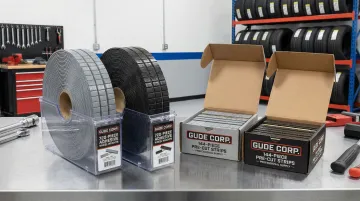
GUDE Corp's adhesive weights are lead-free coated steel, ISO 9001 certified, and available in gray and black finishes — in 720-piece rolls for high-volume shops or 144-piece boxes with 24 pre-cut strips for organized inventory management.
3M guidelines require a 15–43°C application temperature and 5 psi of roller pressure to achieve 80% minimum wet-out. Clean the surface with solvent before application to remove brake dust and old adhesive — contaminated surfaces cause premature weight loss.
| Attribute | Detail |
|---|---|
| Material Options | Lead-free steel, zinc, or zinc-alloy (ZAMA); avoid lead-based weights on aluminum due to galvanic corrosion risk |
| Placement | Inner barrel behind spokes (hidden), or inner/outer barrel as directed by computer balancer; ensure minimum 1/8-inch brake caliper clearance |
| Key Consideration | Surface must be cleaned with solvent before application; contaminated surfaces cause premature weight loss |
Clip-On Weights — Limited Use on Aluminum
Where adhesive weights aren't practical, clip-on weights can be used on the inner flange of aluminum wheels — with important restrictions.
Clip-on weights are acceptable only when the rim flange is at least 3/16 inch deep, and only with coated or alloy clips. Bare steel or standard clip-on weights will corrode and damage the alloy rim's protective finish. Never use clip-on weights on chrome or decorative flanges.
Some shops use a hybrid approach — clip-on on the inner flange combined with adhesive on the outer — though this is not recommended for high-end aluminum or chrome wheels.
GUDE Corp's clip-on series for aluminum applications:
- AW Series — low-profile clip for outer rim placement, minimizing visibility on custom wheels
- IAW Series — inner-edge clip for hidden placement on premium wheels
Both use coated steel with spring steel clips, manufactured to ISO 9001 standards.
| Attribute | Detail |
|---|---|
| Acceptable Scenario | Inner flange of aluminum wheel only, flange depth ≥ 3/16 inch; not suitable for chrome wheels or decorative outer flanges |
| Clip Type Required | Coated or alloy clip specifically rated for aluminum—standard steel clips cause corrosion at the contact point |
| Risk if Wrong | Coating damage, galvanic corrosion, weight loss over time, customer complaints, and potential wheel damage |
How to Prevent Wheel Damage During Balancing
Proper Wheel Mounting on the Balancer
Precise wheel balancing relies on accurate center mounting. Use the correct centering cone size for hub-centric aluminum wheels, or a lug-centric adapter plate for aftermarket alloy fitments.
Contrary to popular belief, both hub-centric and lug-centric wheels locate from the hub bore. Traditional high-taper cones often fail to seat properly in modern aluminum wheel bores — causing false balance readings and over-weighting.
Surface Protection Steps
Aluminum finishes scratch easily, so every contact point matters:
- Use plastic tools only to remove old adhesive weights — metal scrapers damage protective coatings
- Clean the wheel surface with solvent before applying new tape-on weights to lock in adhesion
- Fit rubber or plastic protectors on all balancer arms and tools that contact the rim
Post-Installation Verification
After weight placement, confirm adequate brake caliper clearance (minimum 1/8 inch for adhesive weights). Respin the assembly to verify a zero-balance reading before reinstalling on the vehicle. This final spin catches any centering errors that static inspection will miss.
Conclusion
The best results for aluminum wheels come from pairing the right balancing method—dynamic as the standard, road force for performance applications—with the correct wheel weight type: lead-free adhesive weights that protect the finish, resist corrosion, and hold securely without rim damage. Cutting corners on either the method or the weight type shows up quickly as vibration, uneven wear, or finish damage on premium aluminum rims.
For tire shop chains, dealership groups, and OEM suppliers sourcing lead-free wheel weights at volume, GUDE Corp supplies ISO 9001-certified adhesive and clip-on weights manufactured by Toho Kogyo — the #1 wheel weight producer in Japan and #3 globally, with 65 years of production expertise. Contact Jonathan McVety at jonathan@gudecorp.com or (463) 464-5500 to discuss wholesale pricing and OEM or aftermarket fitment options.
Frequently Asked Questions
Do aluminum wheels need balancing?
Yes, all aluminum wheels need balancing. Manufacturing tolerances, valve stem placement, and slight tire weight variations create imbalances in every wheel-and-tire assembly. Left uncorrected, these imbalances cause steering wheel vibration, cupped tire wear patterns, and premature component failure.
What's better, balancing beads or weights?
Traditional wheel weights offer precise, measured correction determined by a calibrated computer balancer, making them the professional standard. The U.S. Tire Manufacturers Association does not endorse internal balancing products, and beads fail to adjust properly in soft passenger-car suspensions.
How much does alloy wheel balancing cost?
Standard dynamic balancing runs $15–$25 per wheel at most tire shops; road force balancing costs $30–$50 per wheel due to specialized equipment. Rates vary by region and shop type—luxury dealerships and performance shops typically charge more.
What are the signs of unbalanced wheels?
Steering wheel vibration (especially between 50–70 mph), cupped or scalloped tire wear patterns, vehicle pulling to one side, and increased road noise. Symptoms worsen with speed and become more pronounced in front wheels due to steering feedback. Persistent vibration after balancing suggests the need for road force measurement.
Do alloy wheels need alignment and balancing?
Yes, both services are needed but serve different purposes. Balancing corrects weight distribution within the tire-wheel assembly to eliminate vibration. Alignment corrects the wheel's geometric angle relative to the vehicle to prevent pulling and uneven wear. New alloy wheel installation is a practical time to schedule both.