Introduction
A single overloaded axle can cost you thousands of dollars in fines, trigger an out-of-service order, and jeopardize your operating authority. That's true even when your total truck weight stays under the federal 80,000-pound ceiling.
Fleet managers and owner-operators face a real compliance gap: federal law establishes baseline weight limits for Interstate highways, but every state layers its own rules on top for non-Interstate routes. Cross a state line without knowing those regulations and your driver may be out of compliance before the first delivery.
According to the Federal Highway Administration, weight violations are among the most frequently cited infractions at weigh stations nationwide, with fines calculated per pound over the legal limit in most states. Knowing how federal axle limits, state-specific exceptions, and the Federal Bridge Formula interact is the difference between a clean inspection and a costly out-of-service order.
TLDR
- Federal Interstate limits: 80,000 lbs. GVW, 20,000 lbs. single axle, 34,000 lbs. tandem axle
- States set higher or lower limits on non-Interstate highways—always verify each state on your route
- Exceeding any axle limit triggers fines and permit requirements, even if GVW is legal
- The Federal Bridge Formula requires heavier loads to spread across more axles or longer spacing
- Overweight permits are required whenever any axle exceeds legal limits — even if total GVW is under 80,000 lbs.
Federal Axle Weight Limits: The National Baseline
Federal law under 23 U.S.C. §127 establishes maximum weight limits on the Interstate Highway System, creating a floor that states cannot lower without risking the loss of federal highway funding. These limits apply to all commercial vehicles operating on Interstate routes and serve as the compliance baseline for cross-country freight operations.
Core Federal Weight Limits:
- Single Axle: 20,000 lbs. maximum
- Tandem Axle: 34,000 lbs. maximum
- Gross Vehicle Weight (GVW): 80,000 lbs. maximum
All three limits must be satisfied simultaneously. A truck that weighs 78,000 lbs. total but carries 22,000 lbs. on a single axle is in violation, regardless of staying under the GVW ceiling.
Enforcement agencies measure actual weight at weigh stations — not the manufacturer's Gross Vehicle Weight Rating (GVWR). Compliance is determined by what your truck scales at the moment of inspection.
Axle Groups Explained
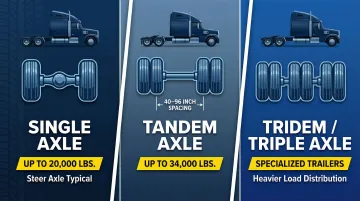
Understanding axle group classifications is critical for load planning and compliance. The three primary axle group types are:
- Single Axle: Carries weight independently; typically the steer axle on a tractor (12,000–15,000 lbs. in practice)
- Tandem Axle: Two consecutive axles spaced 40–96 inches apart, common on tractor drive axles and trailer axles
- Tridem/Triple Axle: Three consecutive axles used on specialized trailers to distribute heavier loads
Each axle group type carries different legal weight ceilings, and load planners must account for all three simultaneously.
Legal vs. Permitted Weight:
- Legal Weight: The maximum weight allowed without a permit under federal or state statute
- Permitted Weight: Weight above legal limits, authorized by a state-issued overweight permit for non-divisible loads (such as construction equipment or machinery)
- Axle Weight Limit: A per-axle cap that applies independently of total GVW — violating this limit requires a permit even if GVW stays under 80,000 lbs.
Freight Weight by Trailer Type
Actual cargo capacity depends on tractor weight (typically 32,000 lbs. for a standard day cab) subtracted from the 80,000-pound GVW ceiling, leaving approximately 48,000 lbs. of available freight capacity for most configurations. That said, trailer type directly affects usable payload:
- 53-ft Dry Van: 45,000–48,000 lbs. typical freight capacity
- 53-ft Refrigerated (Reefer): 42,000–45,000 lbs. (heavier trailer and refrigeration unit reduce capacity)
- 48-ft Flatbed: 46,000–48,000 lbs. (lighter trailer increases capacity but load distribution is critical)
Drivers must verify actual axle weights after loading, as shipper-stated weights often exclude packaging, pallets, and dunnage that add hundreds of pounds to the final load.
How the Federal Bridge Formula Works
The Federal Bridge Formula (FBF) was enacted in 1975 to protect bridge infrastructure by ensuring that heavier loads are distributed across multiple axles or longer wheelbases. The formula prevents dangerous load concentration at any single bridge span point, which accelerates structural fatigue and increases the risk of bridge failure.
The Formula:
W = 500 [LN/(N-1) + 12N + 36]
Where:
- W = Maximum allowable weight in pounds
- L = Distance in feet between the outer axles of the group being measured
- N = Number of axles in the group
What This Means for Drivers
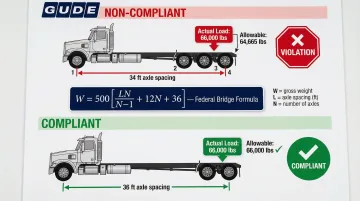
Longer axle spacing allows more weight. For example, if you have two consecutive tandem axle sets (four axles total), each tandem can carry 34,000 lbs. only if the distance between the first axle of the first tandem and the last axle of the second tandem is at least 36 feet. Shorter spacing forces you to reduce weight on one or both axle groups.
Critical Compliance Rule
A truck can be under 80,000 lbs. GVW and still violate the Bridge Formula if axle spacing is insufficient. Consider this: a truck weighing 76,000 lbs. with two tandem axle groups spaced only 30 feet apart exceeds the formula's allowable weight for that spacing and will be cited at a weigh station.
Practical Example
Suppose your loaded trailer scales at 78,000 lbs. total, with 12,000 lbs. on the steer axle, 34,000 lbs. on the drive tandem, and 32,000 lbs. on the trailer tandem. The distance between the first drive axle and the last trailer axle is 34 feet. Plugging into the formula:
W = 500 [(34 × 4)/(4-1) + 12 × 4 + 36] = 500 [45.33 + 48 + 36] = 64,665 lbs.
Your actual weight on those four axles is 66,000 lbs. (34,000 + 32,000), exceeding the formula by 1,335 lbs. Sliding the trailer axles forward two feet increases L to 36 feet, raising the allowable weight to 66,000 lbs. and bringing you into compliance without unloading cargo.
Legal Axle Weight Limits by State
The following table lists standard "regular operation" weight limits for all 50 states and the District of Columbia on Interstate highways, sourced from the FHWA Compilation of State Truck Size and Weight Laws. States may permit higher weights on designated non-Interstate routes through specific statutes or commodity exemptions.
| State | Max GVW (lbs.) | Single Axle (lbs.) | Tandem Axle (lbs.) | Tridem Axle (lbs.) |
|---|---|---|---|---|
| Alabama | 80,000 | 20,000 | 34,000 | N/A |
| Alaska | FBF-governed | 20,000 | 34,000 | N/A |
| Arizona | 80,000 | 20,000 | 34,000 | N/A |
| Arkansas | 80,000 | 20,000 | 34,000 | N/A |
| California | 80,000 | 20,000 | 34,000 | N/A |
| Colorado | 80,000 | 20,000 | 36,000 | N/A |
| Connecticut | 80,000 | 22,400 | 34,000 | N/A |
| Delaware | 80,000 | 20,000 | 34,000 | N/A |
| District of Columbia | 80,000 | 20,000 | 34,000 | N/A |
| Florida | 80,000 | 20,000 | 40,000 | N/A |
| Georgia | 80,000 | 20,000 | 34,000 | N/A |
| Hawaii | 80,000 | 20,000 | 34,000 | N/A |
| Idaho | 80,000 | 20,000 | 34,000 | N/A |
| Illinois | 80,000 | 20,000 | 34,000 | N/A |
| Indiana | 80,000 | 20,000 | 34,000 | N/A |
| Iowa | 80,000 | 20,000 | 34,000 | N/A |
| Kansas | 80,000 | 20,000 | 34,000 | N/A |
| Kentucky | 80,000 | 20,000 | 34,000 | N/A |
| Louisiana | 80,000 | 20,000 | 34,000 | N/A |
| Maine | 80,000 | 22,400 | 34,000 | N/A |
| Maryland | 80,000 | 20,000 | 34,000 | N/A |
| Massachusetts | 80,000 | 22,400 | 34,000 | N/A |
| Michigan | 164,000 | 20,000 | 34,000 | N/A |
| Minnesota | 80,000 | 20,000 | 34,000 | N/A |
| Mississippi | 80,000 | 20,000 | 34,000 | N/A |
| Missouri | 80,000 | 20,000 | 34,000 | N/A |
| Montana | 131,060 | 20,000 | 34,000 | N/A |
| Nebraska | 80,000 | 20,000 | 34,000 | N/A |
| Nevada | 80,000 | 20,000 | 34,000 | N/A |
| New Hampshire | 80,000 | 22,400 | 34,000 | N/A |
| New Jersey | 80,000 | 20,000 | 34,000 | N/A |
| New Mexico | 86,400 | 21,600 | 34,320 | N/A |
| New York | 80,000 | 22,400 | 34,000 | N/A |
| North Carolina | 80,000 | 20,000 | 34,000 | N/A |
| North Dakota | 80,000 | 20,000 | 34,000 | N/A |
| Ohio | 80,000 | 20,000 | 34,000 | N/A |
| Oklahoma | 80,000 | 20,000 | 34,000 | N/A |
| Oregon | 80,000 | 20,000 | 34,000 | N/A |
| Pennsylvania | 80,000 | 20,000 | 34,000 | N/A |
| Rhode Island | 80,000 | 22,400 | 34,000 | N/A |
| South Carolina | 80,000 | 20,000 | 34,000 | N/A |
| South Dakota | 80,000 | 20,000 | 34,000 | N/A |
| Tennessee | 80,000 | 20,000 | 34,000 | N/A |
| Texas | 80,000 | 20,000 | 34,000 | N/A |
| Utah | 80,000 | 20,000 | 34,000 | N/A |
| Vermont | 80,000 | 22,400 | 34,000 | N/A |
| Virginia | 80,000 | 20,000 | 34,000 | N/A |
| Washington | 105,500 | 20,000 | 34,000 | N/A |
| West Virginia | 80,000 | 20,000 | 34,000 | N/A |
| Wisconsin | 80,000 | 20,000 | 34,000 | N/A |
| Wyoming | 80,000 | 20,000 | 34,000 | N/A |
Notable State Exceptions to Watch
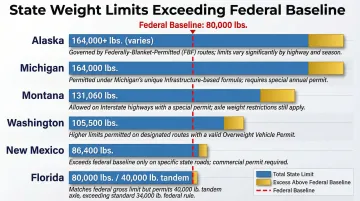
Several states set limits above the federal baseline — useful for carriers hauling heavier loads, but a compliance risk for multi-state routes:
Alaska: No defined GVW ceiling. Weight limits are governed entirely by axle group limits and the Federal Bridge Formula, requiring careful calculation for every load configuration.
Michigan: Permits up to 164,000 lbs. GVW on designated Interstate routes under grandfather provisions dating to pre-1956 state law. This massive capacity applies only to specific highway segments and requires multi-axle configurations.
Washington: Allows 105,500 lbs. GVW on non-Interstate state highways, providing a significant advantage for intrastate freight operations but requiring strict route planning to avoid Interstate segments.
New Mexico: Permits 86,400 lbs. GVW on Federal Designated routes without an overweight permit, with elevated single-axle (21,600 lbs.) and tandem-axle (34,320 lbs.) limits. Maximum weight per tire is capped at 600 lbs. per inch of tire width.
Montana: Allows divisible loads up to 131,060 lbs. GVW on non-Interstate highways, but any load exceeding 80,000 lbs. must comply with the Federal Bridge Formula. Specialized configurations like eight-axle B-Trains can reach 137,800 lbs. under the Montana/Alberta Memorandum of Understanding.
Florida: Maintains the 80,000 lb. GVW cap but permits 40,000 lbs. on tandem axles — 6,000 lbs. higher than the federal standard. A 10% enforcement tolerance effectively allows single axles to scale at 22,000 lbs. and tandem axles at 44,000 lbs. before triggering violations.
Seasonal Weight Restrictions ("Frost Laws"):
Several northern states impose temporary weight reductions during spring thaw periods (typically March through May) when road surfaces are most vulnerable to heavy loads. Affected states include Michigan, Minnesota, Wisconsin, and parts of the Northeast. Carriers must check state DOT websites for active seasonal postings before dispatching, as violations during restricted periods draw steeper fines.
Why Axle Weight Limits Matter
Safety
Overloaded axles compromise vehicle control and increase crash risk. Excess weight on a single axle extends stopping distances, raises the center of gravity (increasing rollover risk), and places dangerous stress on tires that can lead to blowouts at highway speed. According to the Federal Motor Carrier Safety Administration, trucks with weight violations are significantly more likely to be involved in crashes, particularly those involving brake failure or loss of control.
Infrastructure
Concentrated axle loads accelerate pavement cracking and bridge structural fatigue faster than almost any other road use factor. The American Association of State Highway and Transportation Officials estimates that a single overloaded axle can cause as much pavement damage as thousands of properly loaded vehicles.
Federal weight limits exist specifically to protect the billions of dollars taxpayers invest in highway infrastructure. When overloaded trucks operate unchecked, states are forced to accelerate costly repair cycles.
Legal and Financial Consequences
Overweight fines vary widely by state but are typically calculated per pound over the legal limit. In some jurisdictions, fines can reach thousands of dollars for a single incident. For example, a truck 5,000 lbs. over the legal axle limit in states like Virginia or Pennsylvania may face fines exceeding $3,000, plus the cost of offloading cargo or obtaining an emergency permit.
Repeat violations trigger escalating consequences:
- Increased roadside inspection frequency
- Carrier safety rating downgrades
- Potential suspension or revocation of operating authority
Overweight permits must be obtained in advance for every roadway segment on the route. Retroactive permits are not available, and operating without one compounds the original violation.
How to Stay Compliant with Truck Weight Laws
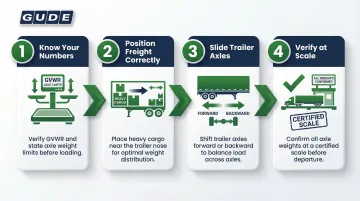
Know Your Numbers Before Loading
Before any load leaves the dock, verify three things:
- Confirm your truck's GVWR (the manufacturer's maximum safe operating weight) and per-axle limits for every state on your route
- Use certified portable axle scales or a public weigh station to verify axle weights immediately after loading
- Never rely solely on the shipper's stated load weight — pallets, packaging, dunnage, and fuel can add thousands of pounds to the final scale reading
Distribute and Adjust Load Strategically
Sliding trailer axles forward or backward shifts weight between axle groups. Moving the trailer axles forward transfers weight from the drive axles to the trailer axles; sliding them rearward pushes weight back onto the drives. Even a few inches of adjustment can bring an overloaded tandem axle into compliance without unloading cargo.
On tractors with a sliding fifth wheel, repositioning the coupling point shifts weight between the steer axle and drive axles. Moving the fifth wheel forward reduces steer axle weight and increases it on the drives — a critical adjustment when the steer axle approaches its 12,000–15,000 lb. safe operating range.
Load positioning matters before the first strap goes on. Heavier freight placed closer to the trailer nose increases drive axle loading and reduces pressure on the trailer axles. Positioning weight toward the rear does the opposite. Getting placement right upfront often eliminates the need for any post-loading adjustments.
Proper Wheel Maintenance Supports Accurate Axle Load Management
Unbalanced wheels cause uneven tire wear that compounds over time when axles operate near their weight limits. Tires experiencing accelerated wear due to imbalance are more susceptible to failure under heavy loads, increasing the risk of roadside breakdowns and safety incidents. Keeping wheels properly balanced with lead-free steel wheel weights — sourced in bulk for fleet maintenance programs — helps protect tire integrity and maintain consistent rolling performance across all axles, particularly on trucks that regularly run close to legal weight limits.
Frequently Asked Questions
What are the legal axle weight limits for commercial vehicles?
Federal law sets single-axle limits at 20,000 lbs., tandem-axle limits at 34,000 lbs., and a maximum GVW of 80,000 lbs. on the Interstate System. Individual states may set different limits on non-Interstate highways, with some allowing significantly higher weights.
What is the maximum legal weight for a commercial vehicle?
The federal maximum GVW is 80,000 lbs. on Interstate highways. However, states like Michigan (164,000 lbs.), Montana (131,060 lbs.), and Washington (105,500 lbs.) permit higher weights on designated routes. Loads exceeding legal limits require a state-issued overweight permit for each roadway segment.
Does the DOT regulate vehicle weight by GVWR or by actual weight?
Enforcement agencies measure actual gross weight and per-axle weight at weigh stations, not the manufacturer's GVWR. GVWR is a design limit indicating the maximum safe operating weight but does not substitute for statutory weight limits.
When does vehicle weight require a CDL?
A CDL is generally required when a vehicle's GVWR, or the combined GVWR of a vehicle combination, exceeds 26,001 lbs. FMCSA regulations also require a CDL for vehicles transporting hazardous materials or designed to carry 16 or more passengers.
How can I tell my vehicle's axle weight rating?
The axle weight rating (GAWR) is found on the vehicle's certification label, typically located inside the driver's door jamb. The GAWR reflects the maximum load the axle assembly is designed to carry, and is separate from the statutory weight limits enforced at weigh stations.
How many axles are required for a 120,000 lb load?
At 120,000 lbs., a truck typically needs seven or more axles, with spacing calculated to satisfy the Federal Bridge Formula. The exact configuration also depends on state-specific permitted weight rules for the route.