Introduction
Not all commercial vehicles operate under the same rules. A Class 2 delivery van and a Class 8 semi-truck share the road, but they face entirely different licensing, registration, and compliance requirements.
Misclassifying a vehicle comes with direct costs:
- Wrong license class for the driver
- Unexpected fines at weigh stations
- Incorrect insurance coverage
- Permit violations that can halt operations
The Federal Highway Administration's (FHWA) 8-class weight system is the framework that determines what you pay, who can drive, and whether your fleet stays compliant.
This guide covers the FHWA's 8 weight classes, key weight terms, regulatory thresholds, and how to determine which class applies to your fleet.
TL;DR
- Commercial vehicles in the U.S. are classified into Classes 1–8 by the FHWA based on Gross Vehicle Weight Rating (GVWR)
- Three duty groups: Light-Duty (Classes 1–2, ≤10,000 lbs), Medium-Duty (Classes 3–6, up to 26,000 lbs), Heavy-Duty (Classes 7–8, 26,001+ lbs)
- Vehicles over 10,000 lbs GVWR in interstate commerce require a USDOT number
- Classes 7–8 operators require a Commercial Driver's License (CDL)
- Federal interstate limits are 80,000 lbs gross vehicle weight, 20,000 lbs single axle, and 34,000 lbs tandem axle
What Are Commercial Vehicle Weight Classes?
Commercial vehicle weight classes are a standardized FHWA classification system that sorts every commercial vehicle in the U.S. into one of eight categories (Classes 1 through 8) based on its Gross Vehicle Weight Rating (GVWR).
GVWR is the maximum allowable total weight of a fully loaded vehicle as set by the manufacturer, including the vehicle itself, cargo, fuel, passengers, and any accessories. Under 49 CFR § 571.3, GVWR means "the value specified by the manufacturer as the loaded weight of a single vehicle."
GVWR is not the same as the vehicle's actual weight — it's a rated capacity. You'll find it on the Safety Compliance Certification Label on the driver's door jamb, per 49 CFR § 567.4.
This classification system is a working regulatory tool. The following stakeholders rely on GVWR class to determine which rules, fees, and requirements apply to a vehicle:
- Insurers — to set coverage tiers and commercial policy requirements
- DOT and FMCSA — to enforce safety regulations and driver licensing thresholds
- State DMVs — to assign registration fees and weight-based taxes
- Fleet managers — to ensure compliance and route vehicles correctly
Why Commercial Vehicle Weight Classes Matter
Regulatory Consequences
A vehicle's class determines whether a CDL is required, whether a USDOT number must be registered, and whether the vehicle must stop at weigh stations or carry overweight permits. According to the FMCSA's 2024 Pocket Guide to Large Truck and Bus Statistics, the vehicle Out-of-Service (OOS) rate for 2023 was 22.6%, resulting from 450,477 vehicle inspections with OOS violations.
Financial Implications
Registration fees, insurance premiums, and fuel costs all increase with vehicle class. Heavier classes face higher operating costs and greater compliance overhead. Overweight violations carry severe financial penalties that vary by state:
- Texas: $100 to $10,000 under TRANSP § 621.506, with violations over 40,000 lbs incurring $7,000-$10,000 fines
- Florida: $0.05 per pound for each pound of excess weight under F.S. § 316.545
- California: $20 to $250+ under CVC § 42030, scaling by pounds overweight
What Goes Wrong Without Proper Class Awareness
These penalties add up fast — but fines aren't the only risk. Misclassified or ignored weight ratings create operational and legal exposure at every level:
- Drivers operating a Class 7 vehicle without a CDL face hours-of-service and licensing violations
- Fleets that skip DOT registration may be operating illegally without realizing it
- Vehicles cited for axle weight violations even when total gross weight stays under the federal limit
The NHTSA warns that exceeding GVWR voids manufacturer safety ratings and creates direct legal liability for the operator.
The 8 Commercial Vehicle Weight Classes Explained
The three duty groupings — light, medium, and heavy — are more than organizational shorthand. Each boundary between groups triggers specific regulatory requirements that determine how a vehicle is licensed, operated, and taxed. Here's how all 8 classes break down.
Light-Duty Commercial Vehicles: Classes 1 and 2 (GVWR up to 10,000 lbs)
- Class 1 (0–6,000 lbs GVWR): Mini pickups, compact SUVs, small cargo vans
- Class 2 (6,001–10,000 lbs GVWR): Full-size pickups, utility vans, minibuses
Many light-duty vehicles serve both personal and commercial purposes.
Neither class requires a CDL or USDOT number — no special licensing is needed for most commercial use, which keeps the barrier to entry low for small businesses and sole proprietors.
Tax treatment is worth noting for Class 2. Vehicles over 6,000 lbs GVWR may qualify for enhanced Section 179 deductions. The One Big Beautiful Bill Act (OBBBA) reinstated 100% bonus depreciation for vehicles acquired after January 19, 2025. For 2026, the maximum Section 179 deduction is $2,560,000, with a $32,000 cap for "Heavy SUVs" rated between 6,001 and 14,000 lbs GVWR.
Best Suited For: Local deliveries, contractor use, last-mile logistics, small tradespeople.
Limited payload capacity makes these vehicles a poor fit for regular heavy cargo hauling.
Medium-Duty Commercial Vehicles: Classes 3 Through 6 (GVWR 10,001–26,000 lbs)
| Class | GVWR Range | Typical Vehicles |
|---|---|---|
| Class 3 | 10,001–14,000 lbs | Box trucks, 3/4-ton pickups |
| Class 4 | 14,001–16,000 lbs | City delivery trucks, large walk-in vans |
| Class 5 | 16,001–19,500 lbs | Bucket trucks, largest walk-in vans |
| Class 6 | 19,501–26,000 lbs | Single-axle straight trucks, beverage trucks, school buses |
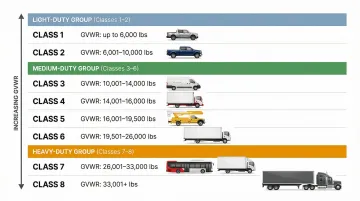
The 10,001 lb threshold is the first major regulatory step-up. Under 49 CFR § 390.5T, vehicles at or above this GVWR used in interstate commerce generally require a USDOT number. A CDL is still not required for Classes 3–6 unless the vehicle carries hazmat requiring placarding or transports 16 or more passengers (including the driver).
Best Suited For: Regional delivery fleets, municipalities, utility companies, food and beverage distribution.
One important caveat: compliance requirements differ significantly across this group. A Class 3 box truck and a Class 6 straight truck sit at opposite ends of a 16,000 lb range — operators should verify requirements at the specific GVWR level, not just the broad medium-duty category.
Heavy-Duty Commercial Vehicles: Classes 7 and 8 (GVWR 26,001 lbs and Above)
- Class 7 (26,001–33,000 lbs): Moving vans, tow trucks, refuse trucks
- Class 8 (33,001 lbs and above): Semi-trucks, cement mixers, fire trucks, large refrigerated vehicles
Class 8 is the category most regulated by the FMCSA. According to industry data, the U.S. Class 8 truck population reached 3.82 million to 3.93 million trucks in operation.
A CDL is required for all Class 7 and 8 vehicles. Federal axle weight limits under 23 U.S.C. § 127 set the Interstate maximums:
- 20,000 lbs on a single axle
- 34,000 lbs on a tandem axle group
- 80,000 lbs gross vehicle weight
Loads beyond these limits require state-specific overweight permits. Note that a vehicle can be "over legal" on an axle group even when total gross weight stays under 80,000 lbs — weight distribution across axles matters as much as gross weight.
Best Suited For: Long-haul freight, construction, heavy industrial operations, municipal services.
The trade-off is complexity. Higher regulatory overhead, greater operational cost, and the requirement for CDL-licensed drivers make Class 7 and 8 vehicles the most demanding to manage in any fleet.
What Your Weight Class Means for Compliance and Operations
CDL Requirements
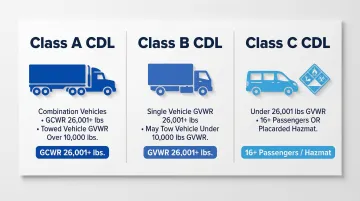
49 CFR § 383.91 establishes CDL requirements:
- Class A CDL: Combination vehicles with a GCWR of 26,001 lbs or more, provided the GVWR of the vehicle(s) being towed exceeds 10,000 lbs
- Class B CDL: Any single vehicle with a GVWR of 26,001 lbs or more, or any such vehicle towing a vehicle not exceeding 10,000 lbs GVWR
- Class C CDL: Vehicles under 26,001 lbs that transport 16+ passengers (including driver) or placarded hazmat
USDOT Number Registration
The FMCSA requires a USDOT number for commercial vehicles with a GVWR over 10,000 lbs operating in interstate commerce. States like California, Texas, and Florida mandate USDOT numbers even for intrastate-only operations. California additionally requires a Motor Carrier Permit (MCP) and CA Number.
Federal Weight Limits and the Bridge Formula
On the Interstate Highway System, the federal ceiling is 80,000 lbs gross, 20,000 lbs single axle, 34,000 lbs tandem axle. The Bridge Formula B governs weight-to-axle-spacing ratios to protect bridges and can require a lower gross weight depending on axle configuration.
Plain-Language Example:
For a 5-axle vehicle combination with 51 feet between the extreme outer axles:
- Formula: W = 500 × ((LN / N-1) + 12N + 36)
- Calculation: 500 × ((51 × 5) / (5 - 1) + (12 × 5) + 36) = 500 × 159.75 = 79,875 lbs
- Rounded to the nearest 500 lbs, the maximum allowable weight is 80,000 lbs
Weigh Station Obligations and Penalties
Commercial vehicles over 10,000 lbs must typically stop at open weigh stations. California CVC § 2813 requires all commercial vehicles to stop when signs are displayed; failure to stop is a misdemeanor. Violations—including axle overloads, gross overweight, and documentation issues—can result in fines, load redistribution orders, or impoundment.
Wheel Maintenance Demands for Classes 5–8
Compliance obligations don't end at the scale house. Classes 5 through 8 vehicles operate under constant high-load conditions, and that stress translates directly into accelerated component wear — including tires.
Proper wheel balancing is one of the more overlooked maintenance factors in heavy fleet operations. Imbalanced wheels on vehicles running 100,000+ miles annually cause:
- Uneven tire wear that shortens replacement intervals
- Increased rolling resistance and fuel consumption
- Vibration stress on wheel bearings and suspension components
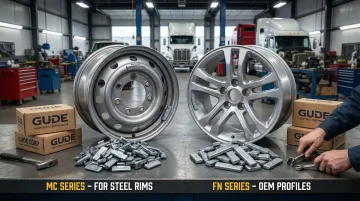
For fleet maintenance operations sourcing wheel weights in bulk, GUDE Corp supplies lead-free, corrosion-resistant clip-on weights — including the MC series for standard steel rims and the FN series for OEM-specific rim profiles — manufactured to ISO 9001 standards by Toho Kogyo, the #1 wheel weight manufacturer in Japan.
How to Choose the Right Weight Class for Your Fleet
Match Class to Operational Payload Needs
Start by calculating the maximum loaded weight you will regularly carry (cargo + passengers + equipment), then select a vehicle whose GVWR exceeds that figure by a reasonable margin. Use the formula:
Max Payload = GVWR − Curb Weight
Exceeding GVWR voids manufacturer safety ratings and creates direct legal liability. Ford's warranty and Ram's warranty both explicitly exclude damage caused by overloading.
Account for Regulatory Overhead at Each Threshold
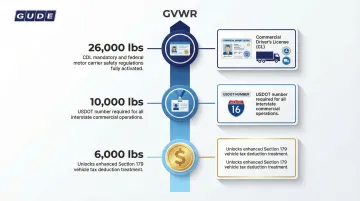
The 6,000 lb, 10,000 lb, and 26,000 lb GVWR marks each trigger new compliance layers:
- 6,000 lbs: Enhanced Section 179 tax treatment begins
- 10,000 lbs: USDOT number registration required for interstate commerce
- 26,000 lbs: CDL requirement begins
If you're buying near any of these thresholds, confirm the compliance requirements before finalizing the purchase — the cost of retrofitting your operations is almost always higher than planning ahead.
Verify Before Finalizing
- Check the door jamb Safety Compliance Certification Label for the manufacturer-assigned GVWR
- Confirm CDL licensing and DOT registration requirements with your state DOT and FMCSA
- If vehicles will cross state lines, review per-state weight limits and permit requirements before beginning operations
Conclusion
Commercial vehicle weight classes govern safe operation, legal compliance, and cost management for every vehicle on the road — from a Class 1 pickup to a Class 8 semi-truck. For fleet operators, knowing exactly where your vehicles land relative to the key GVWR thresholds at 6,000, 10,000, and 26,000 lbs translates directly into better purchasing decisions and fewer compliance surprises.
The critical thresholds to keep on hand:
- 6,000 lbs GVWR — triggers stricter emissions and safety equipment requirements
- 10,000 lbs GVWR — the boundary between light-duty and medium-duty classifications
- 26,000 lbs GVWR — requires a CDL and activates federal motor carrier regulations
Get the classification right from the start, and the regulatory path becomes far more predictable.
Frequently Asked Questions
What are the weight classes for commercial vehicles?
The FHWA classifies commercial vehicles into Classes 1 through 8 based on GVWR, grouping them into light-duty (Classes 1–2, up to 10,000 lbs), medium-duty (Classes 3–6, 10,001–26,000 lbs), and heavy-duty (Classes 7–8, 26,001 lbs and above).
What is the difference between GVWR and tare weight?
GVWR is the manufacturer-rated maximum total weight of a fully loaded vehicle, while tare weight (also called curb weight) is the weight of the vehicle itself with no cargo or passengers. The difference between the two equals the vehicle's maximum payload capacity.
What's the maximum weight for non-CDL commercial vehicles?
Vehicles with a GVWR of 26,000 lbs or under generally do not require a CDL (Classes 1–6). This makes 26,000 lbs the practical upper boundary for non-CDL operation, with exceptions for hazmat loads and passenger transport.
Do vehicles with a GVWR over 10,000 lbs need a DOT number?
Vehicles used in interstate commerce with a GVWR over 10,000 lbs are generally required to register for a USDOT number with the FMCSA. Check current FMCSA rules for intrastate operations — states like California, Texas, and Florida mandate USDOT numbers even for local use.
What is considered a light commercial vehicle?
Light commercial vehicles are Classes 1 and 2, with a GVWR of up to 10,000 lbs. They typically include full-size pickups, compact cargo vans, and small utility vehicles used for local work or deliveries.
Can you write off 100% of a 6,000 lb vehicle?
Under IRS Section 179 and bonus depreciation rules, vehicles with a GVWR over 6,000 lbs used for business can qualify for large first-year deductions. For 2026, the Section 179 limit is $32,000 for Heavy SUVs (6,001–14,000 lbs GVWR); 100% bonus depreciation applies to the remaining basis for vehicles acquired after January 19, 2025. Consult a tax professional for your specific situation.